Review: Suzuki GSX-R1000R

If you want to rule the land of superbikes, you won’t crown yourself king with just horsepower galore and a good chassis. Without electronics you won’t get there, so it was high time Suzuki reinvented its flagship bike. Last year the completely updated GSX-R1000 and GSX-R1000R appeared on the battlefield. I took the latter out for a week.

The Suzuki GSX-R1000 is “the basic model”. Its 999,8 cc four-cylinder engine has an output of 202 hp and 118 Nm at 10,800 rpm. Variable valve timing? Check. Ride-by-wire with three riding modes? Check. ABS and cornering traction control? Check. To list but a few points of its entire checklist.

The checklist of the GSX-R1000R is slightly longer, including cornering ABS, launch control, quickshifter, LED strips above the air intakes and Showa Balance Free front and rear suspensions. Which lifts the price rather displeasing: $15,099 for the GSX-R1000, $17,199 to add that extra R. If you drop ABS on the R-less Gixxer, the price tag is lowered to $14,699 (US prices).

So is that extra R worth the extra cost? Time for a ride to find out. And then you’ll notice immediately that here’s another manufacturer who nowadays thinks it’s not done to scare riders away. Suzuki’s racer is ultra-controllable and will never surprise you with a bad temper.

The ride-by-wire has three settings, and Suzuki has done it again: instead of naming them Race, Road and Rain for example, they’re called A, B and C. Although in this case OK, Not OK and Even Less OK would’ve been better. Let me explain. The A setting has the most linear power delivery. In B and C the power curve shifts to the right a lot (B) and a lot more (C), postponing the fun. Which is pointless because the A setting can be used under every condition, making the B and C settings completely useless. As an aside, the ride-by-wire does not affect ABS nor traction control.

That traction control!

Fortunately the traction control is better. A lot better. It has 10 levels (called 1, 2, 3, 4, 5, 6, 7, 8, 9 and 10, with 1 intervening minimally and 10 maximally). Levels 1 to 4 are intended for the racetrack and allow some rear wheel spin. 5 to 8 are for the road. From a certain angle of inclination, they will make the throttle response and power delivery react more gently on the throttle impulse. Numbers 9 and 10 are the rain levels. The horsepower is never influenced by the traction control and – should you be tired of your life – there’s also a level 0: traction control off.

I started my week’s test with level 5 traction control and Continue reading
Review: Moto Guzzi V7 III Special

Moto Guzzi isn’t really the most top-of-mind motorcycle brand. Nonetheless, the Italian brand covers quite a few pages in the history books. It’s the European motorcycle manufacturer with the longest continuous production, it has a rich racing past and it pioneered in many areas. Think of the integral brake system, the centerstand and the eight-cylinder engine.

Last year, the Moto Guzzi V7 celebrated its fiftieth birthday and got an update. The Roman three in its name indicates it’s the third update of the V7 generation that was introduced in 2012. The V7 III comes in a handful of variations. The Rough for example has scrambler accents, while the Racer has the sportiest look.

Garage Chris Smeyers lent me a demo V7 III Special for a week. In their showroom I also spotted a limited edition V7 III Anniversario with a beautiful chrome fuel tank, of which 750 are produced for the occasion of that fifty-year anniversary.

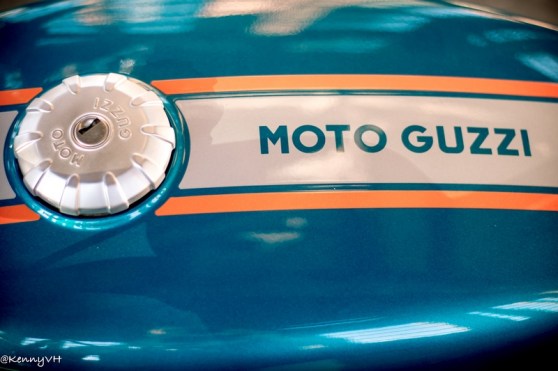
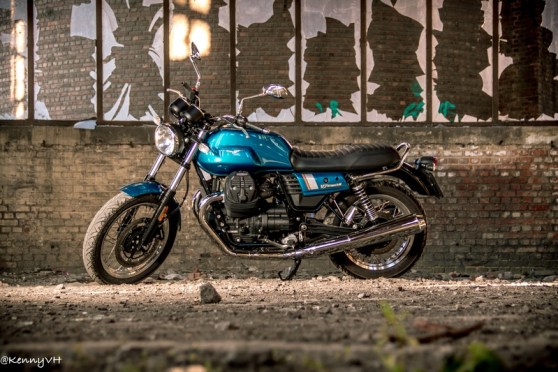
The Special has the most vintage-inspired style of the V7 range. The orange and gray lines on the fuel tank and flank panels nod to its ancestors, the Blu Zaffiro paint has a wonderful retro look, and the well-considered harmony between chrome and matte black powder coated parts proves that the North Italian designers don’t lack taste. The slightly upward bended double exhaust gives a sporty touch. And there’s also the nicely ribbed saddle, the passenger handgrip that twists beautifully around the back of the saddle and the (well, that’s been a while) unvarnished spoke wheels. Base price of the Special: $ 8,990 (USA) or 8.540 euro (Italy).

The V7 isn’t very generous on technology. ABS and (adjustable and disengageable) traction control are standard, and Continue reading
Review: Harley-Davidson Street Rod

Choppers and bulky bikes with a chrome overdose. If those are the first associations people make when they hear your brand name, it might be time to take action. Especially if you want to target a larger, younger audience.

That’s why Harley-Davidson introduced the Street 750 in 2015. Less heavy, less expensive and less of a Harley cliché. This new approach apparently gained traction, because in 2017 Harley presented the Street Rod. Based on the Street 750, but with a more lively, sportier attitude. I rode the Street Rod for a week.

Baby Harley?

The Harley-Davidson Street Rod has the smallest lung capacity of the entire Harley stable. After the Street 750, it’s also the cheapest Harley out there (starting at $8,699 in the US and € 8.225 in Germany).

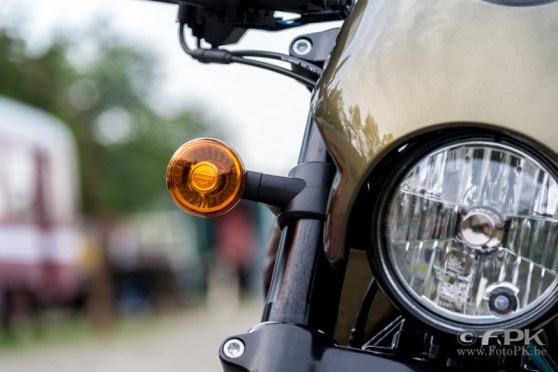
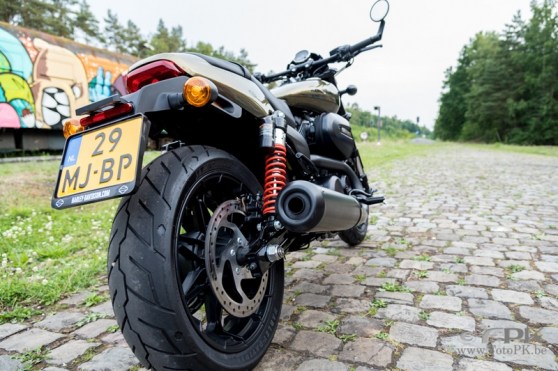
Nevertheless, you can’t say the Street Rod is a Baby Harley. Absolutely not. This is a genuine Harley which can pull up next to its bigger brothers without a blush. The built quality leaves little to be desired (the tie-wraps look a bit cheap, and the cabling could be done a bit more decent here and there), there are plenty of Harley logos (up to the Michelin Scorcher tires), and I can’t imagine non-Harley fans loathing things like the beautiful, wide tank and red rear shock absorbers.

So it’s an all-classic Harley? Well no, not entirely. The Street Rod wants to be sportier than the average Milwaukee creation. So the Street 750 got some seriously slogging. Starting with the V-Twin. The 749 cc engine got pumped up considerably, making it climb from 59 Nm and 57 hp to 65 Nm and 68 hp. Harley even dares to put a High Output label on it.

Compared to the 750, the Rod also gets more ground clearance (from 145 mm / 5.7 in. to 205 mm / 8.1 in.), a higher saddle (from 720 mm / 28.3 in. to 765 mm / 30.1 in.), a bigger lean angle (from 28.5 to 37.3 degrees before the left footpeg touches the asphalt) and a sharper rake (from 32 to 27 degrees). Sounds promising? Start your engines!

And then you find yourself not being thrown back to your childhood, when you loudly raced your bike through the streets, a bunch of playing cards in the spokes. Nope, in contrast to earlier Harleys that I tested, the Street Rod sounds rather tame. So be it. Open the throttle and … try to find a good spot to put your feet.

Ergonomics

As Harley tradition dictates, it’s almost impossible to Continue reading

Review: Ducati Multistrada 1260 S Touring

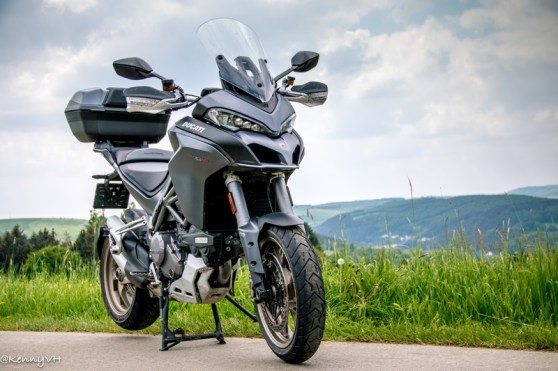
The first thing I notice when standing next to the Ducati Multistrada 1260 S Touring is what an impressive bike this is, with its tall shoulders, slim waist and broad hips. It’s almost intimidating. Some say it’s the prettiest Ducati ever built. I wanted to know if it’s also the best Ducati ever built. So I took it on a 3 day blast to the Eifel region in Germany.

Getting a taste of it

A first walkaround shows plenty of typical Multistrada elements: the pointy lights, the air inlets that look like nostrils in a beak, the beautiful LED rear light, the sophisticated single sided swing arm.

The grey color of my test bike almost looks, well, boring. I like the red version much more and the Pikes Peak version really makes me drool.

On top of the standard 1260, the S version comes with Skyhook Evo suspension, a quickshifter, a TFT display, LED lights and cornering lights. Albeit for an extra, obviously. US price: $ 20.995, Italian price: € 20.390. And if you want the Touring suffix (consisting of the Touring and Urban pack), you’re looking at an even larger extra.

That Dash

When I switch on the Multi a deep red Ducati logo appears on the 5” TFT screen. The crystal clear dash shows a lot of information. Current speed and chosen gear are indicated in big numbers while the rpm’s are shown on top of the dash. All clear so far. The rest of the information is shown only in the bottom third and it takes some getting used to to find what you are looking for immediately. You can find trip data, temperature, mileage, the menu entry, fuel level and all suspension settings. And more.

When hitting the start button, the first split second nothing seems to happen. Then the fat Testastretta DVT twin shakes itself awake. This shaking will always be present, be it more or less depending on the situation.

A modest deep sound rolls out of the double exhaust pipes when I start riding. Already after the few first meters Continue reading

Review: Triumph Street Cup

Triumph’s Modern Classics series grew to such proportions lately, that you’d almost stress out by the choice you have. Most definitely when you see the wide range of styling accessoiries. Broadly speaking, you can divide the classics into two groups: the 900 cc and the 1200 cc models. Triumph’s original classic, the Bonneville, can be found in both groups, while the Thruxton got a 1200 cc engine during its most recent update. You’re not particularly looking out for a more performance oriented bike (with a higher price tag) but you still prefer a sporty and at the same time classic looking Triumph? How about the Street Cup?

The Triumph Street Cup is the caféracer version of the Street Twin, which in turn is a Bonneville T100 in a more modern look. The Street Cup scores at the first glance, thanks to its beautiful finishing. Neat looking engine, well concealed cables, classy details such as logos, pinstriping and metal footpegs. Available from $10,500 in the US and the same amount in Euros in France, in two color combinations: adorable yellow-gray and somewhat dull gray-black. Although the dullness wasn’t that bad when I saw my test bike in the flesh. Especially the metallic gray sparkles beautifully.

The 900 cc parallel twin delivers 55 hp and 80 Nm. Numbers that won’t lead to astonished reactions when you pull up at your favorite pub. The torque, however, already peaks at 3,230 rpm, so the engine is spicier than you’d expect. With a good twist of the ride-by-wire throttle, you haste away. Experienced riders shouldn’t fear any lack of enthusiasm. At the same time, the power delivery is very smooth and friendly, easing newbies’ minds.

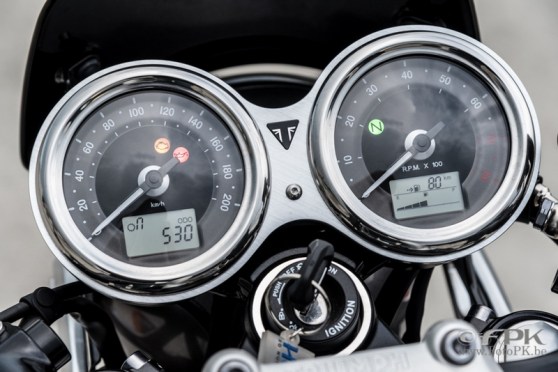
The display is classic: two analog meters for speed and revs. Each has a small digital display for, among other things, range, trip counter, selected gear and consumption.

With its dynamic appearance, the sloping handlebar and the forward bent sitting position you’d fancy to ride the Street Cup lively. To which it lends itself Continue reading

Review: KTM 1290 Super Adventure S

“Ready to race” the digital display of the KTM 1290 Super Adventure S announces when you press the start button. Not a lie, as the bike will soon prove. Did you expect something else, with 160 hp and 140 Nm? But before we talk about power, let’s first take a closer look at this bombshell.

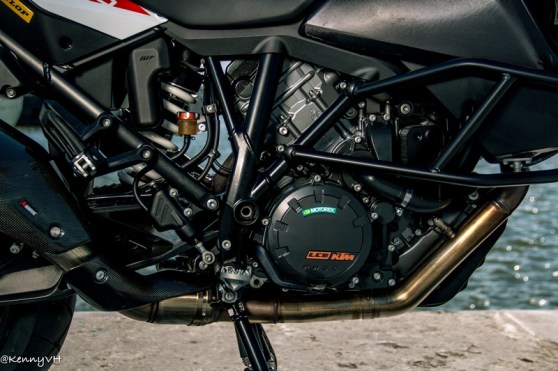
The 1301 cc LC8 engine that created quite some excitement for the KTM 1290 Super Duke, was also used by the Mattighofen team for a sports-touring motorbike and an adventure bike. I tested the 1290 Super Duke GT, the sports-tourer, before. Time to get to know that adventure bike.

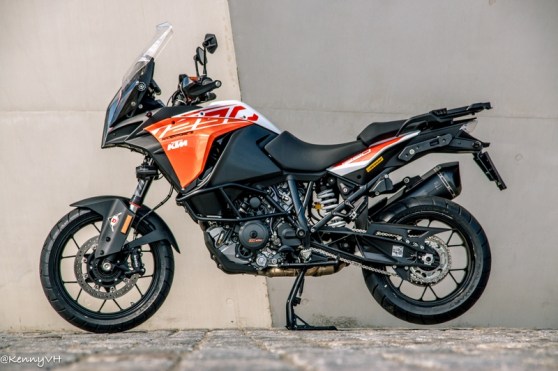
The KTM 1290 Super Adventure comes in an S and an R version. The R focuses more on offroad, with its spoked wheels, 21″ front wheel, higher seat and standard crash bars. The S aims at the asphalt, with cast wheels, 19″ front wheel and a lower, two-part, height-adjustable seat. I got to test the S for a week.

Brutal or subtle?

I remember from the 1290 Super Duke GT that it simply was a brute bike. In so many ways. Brute power, rough sounding exhaust, not always refined in handling. So I expected the same character from the 1290 Super Adventure S. And it immediately surprised me: Mr. Adventurer is more subtle than his sports-touring brother.

However, with its looks you’d assume the opposite. Especially the not particularly modest design of the headlight. Not everyone’s a fan of it. Me neither at first, but after a while, its distinctive and even photogenic nose grew on me. Finally a KTM adventure bike that comes close to that still good-looking 990 in terms of design.

A push on the start button generates quite some fuss. Caused by the optional Akrapovic exhaust. Its shortfall of subtlety has a Moses and the Red Sea effect in dense traffic. Or in this case: Orange Moses and the Car Sea.

And then it’s time to clamp the handlebars firmly – because maybe the bike throws you out of the saddle like a wild stallion – you open the throttle and … notice that this Super Adventure is extremely easy-going. There’s no sign of any brutality at all. Not yet.

The Super Adventure has four riding modes (Sport, Street, Rain and Offroad). Even in Sport, the Brussels city center at peak hour wasn’t a problem. Yes, the Sport mode has the harshest gas reaction, but you don’t necessarily need kid gloves to keep the KTM under control. Still, I found the Street mode more comfortable. I didn’t even try Rain (with 100 hp instead of 160) and Offroad.

Hard, harder, hardest

Fortunately, the 1290 Super Adventure doesn’t throw all the brutality overboard. Sporty driving is so easy and so tempting that a sixth sense for speed cameras would be a blessing. You go so fast so quickly, that it’s almost impossible to open the throttle completely. The (optional, perfectly working) quickshifter makes the explosive accelerations even more insane. And although the traction control was on, short wheelies couldn’t be avoided. The traction control, like the ABS, has cornering technology. A good thing.

Curves? Our Austrian friend Continue reading

Review: Husqvarna 701 Enduro

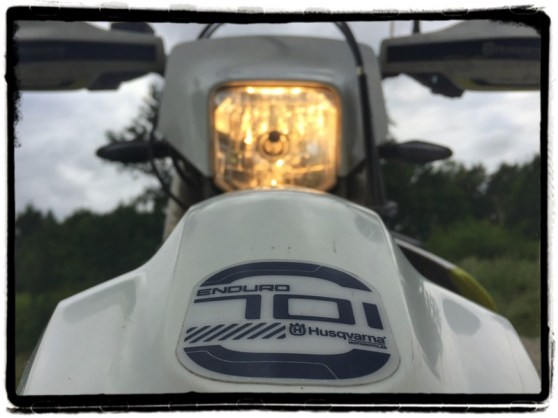
A while ago one of my friends did an adventure trip to the Ardennes with his brand new Husqvarna 701 Enduro. While we were cursing and sweating on our heavy adventure bikes, the Husky followed, fingers in the nose. So when I was planning a new adventure trip, to the Morvan region in France this time, I took the opportunity to test the 701 Enduro and see for myself if it’s really such an easy bike to ride off-road.

The Husqvarna name may not mean much to the average biker. But motocross pilots and fans know better. The Swedish brand has a rich enduro and motocross history. In the sixties and seventies, it won one world title after another. But in the late 80’s it got in trouble. After Cagiva, MV Agusta and BMW ownership, Stefan Pierer took the brand under his wings. Yes, that’s the Austrian guy who’s also heavily involved in KTM. So it’s almost pure logic that the current Husqvarna motorcycles have some KTM blood flowing through their veins.

The single cylinder engine of the 701 Enduro delivers 74 hp and 71 Nm at 6,750 rpm, so a KTM 1190 Adventure or a BMW R 1200 GS is completely out of the 701’s league. But if you push it hard enough that slightly crazy KTM character instantly awakens. Open the throttle recklessly in second gear and the front wheel will go airborn guaranteed. The engine runs quite rough in low rpm’s, something I also experienced with the KTM 1050 Adventure and the 1290 Super Duke GT, which also shows the close KTM tie.

Because of the cross-fertilization between the two brands you might think that the Husqvarna 701 Enduro is just a KTM 690 Enduro in disguise. Don’t be fooled. The engine comes from the brand new KTM 690 Duke, and on other levels too you should rather see the Husky as an upgraded KTM 690 Enduro. For example, the WP suspension is better and longer. 275 mm of travel means that bumpy tracks can be tackled easier. The suspension’s standard setting was completely to my liking but if you want you can adjust both the front and rear suspension.

On the highway the Husky easily reaches 120 km/h without losing stability. It can go faster but the wind will become an issue at that point. I heard some complaints about the seat being too firm. Yes, it’s firm. But I’ve already tested 100% road bikes with less comfortable seats. A 1,5 hour ride with the 701 wasn’t torturing. One thing was a torture: cleaning the seat after a few days of off-roading. An almost impossible task, especially the white and yellow parts.

If you want to go off-roading somewhere a long way from home, then you could do the complete trip with the 701. But keep in mind: little comfort and zero wind protection. You better have some character if you plan long stretches of highway.

Obviously more fun can be found once you leave the highway. The Husky needs some encouragement to enter corners, so you’ll tend to handle the bike more aggressively. It doesn’t mind that. Acting like a hooligan is its favourite pastime. Leaving corners swiftly, fully attacking the next corner, that’s the way (a-ha a-ha) I like it (a-ha a-ha). And the bike too.

On off-road tracks the contrast with a heavy adventure bike is quite spectacular. My 800 GS weighs more than 200 kg, the 701 Enduro 160 kg with a full tank. Forty kilos that make a big difference. If your 1200 GS buddies call you a cheater when you show up for an adventure trip on a 701 Enduro, well, Continue reading