Review: Yamaha MT-10

It’s always a matter of putting things into perspective. In my previous review I wrote the Triumph Tiger 800 XCa demanded more input to enter a corner than my own BMW F 800 GS. And then you get a Yamaha MT-10 for a week’s test after which you hop back on your GS and can’t help but notice how much effort cornering takes on your Beemer. And how terribly slow it is!

Okay, comparing a 800 GS with a MT-10 isn’t fair but there’s one BMW model that has a lot in common with the Yamaha: the BMW S 1000 R. Both are based on a 200 hp inline-four racer that lost its fairing and exchanged a fair bit of horsepower for more mid-range torque.

Still, the MT-10 isn’t just a naked R1. The frame, swingarm and suspension may be identical but on the other hand there’s a tweaked engine, a chassis that’s modified for more comfort and the aggressive headlight section, which I happen to like. Especially in Night Fluo finish the MT-10 is very expressive. The other colors (blue or black) are just plain boring.

Master of Torque

MT stands for Master of Torque and good heavens, there is no lack of torque indeed. The MT-10 is a wild beast with a very exciting power source. It accelerates like crazy: from 5000 rpm you better make sure you hold those handlebars tight. At 9000 rpm this torquey master reaches its maximum of 111 Nm.

Riding peacefully is no problem either. The 160 horses were very easy to handle during the rush hour in the centre of Brussels. Of course the Master prefers to be somewhere else, where it can dive into corners and exit them like a bat out of hell.

The frame likes that dynamic riding style. It remains stable and firm, with predictable and light steering behaviour. Correcting your riding line in a corner is easy to do. The suspension in standard setting is sporty without being stingy and is fully adjustable, front and rear.

The soundtrack is just Continue reading

Review: BMW R nineT

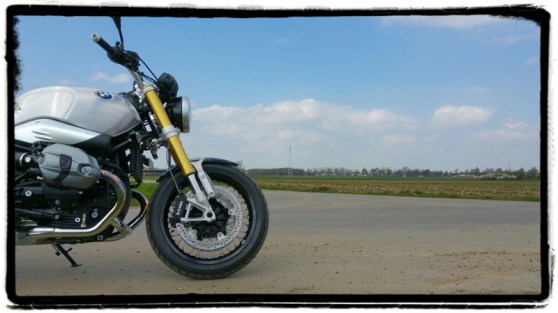
The sexiest bike of the entire BMW Motorrad range is the BMW R nineT. That’s my conclusion after testing one for a week. Praising words from (mostly non-motorcycling) colleagues, a big thumbs up from a car driver at a traffic light, a spontaneous chat at the gas station. I got more feedback with the R nineT than with any test bike I ever rode.

The R nineT was launched in 2014 on the occasion of 90th anniversary of BMW Motorrad. So it comes as no surprise the nineT has classic looks. Though not as classic as, say, a Triumph Bonneville T100 Black. The Beemer has a modern twist to it and tries to charm café racer and custom fans with its extensive personalization possibilities.

Back to the basics

The essence of riding is what the R9T is all about. Everything that’s not essential went overboard. No frills. While other BMW models are crammed with traction control, mappings, tire pressure control, electronically adjustable suspension and other techno shizzle, the nineT only got a non-switchable ABS. On the other hand it has a stylish design, finished with sweet details such as the BMW logo in the headlight or the embossed nineT logo on the air intake.

The 1,170 cc boxer comes from the previous R 1200 generation, and is the last of the Beemers with this type of engine. It’s not the newest of the newest but has proven its qualities with a long track record. Air-cooled, in contrast to the liquid-cooled flat twins that BMW currently assembles. The gears are a little shorter than on the previous RT and GS, for a more lively riding behavior.

A flat twin also means you’ll experience Continue reading

Review: BMW R 1200 RT

Of all current BMW motorcycles, the R 1200 RT probably has the most “midlife crisis” reputation. When I see it in the showroom, I soon imagine a settled fifty-year-old in the saddle, ready for a tour with the missus on a sunny Sunday afternoon.

But despite that reputation, the 1200 RT does extremely well in sales charts, and if you’re looking for a touring bike, this boxer so often seems the logical go-to answer. Is its stuffy image only a first impression? Could it change my mind in a week?

A trip to Austria, together with colleague Luc on his Triumph Tiger Sport, would be the ideal opportunity for an extensive RT test. 2200 km should be enough to form an opinion.

Personally I find the BMW R 1200 RT’s look quite a turn off. With its gigantic front you’d almost offer it a gym membership. The 17” front wheel even seems disproportionate. Fortunately the two round LED daytime running lights are pretty. A nice (but optional) wink to its four-wheeled family.

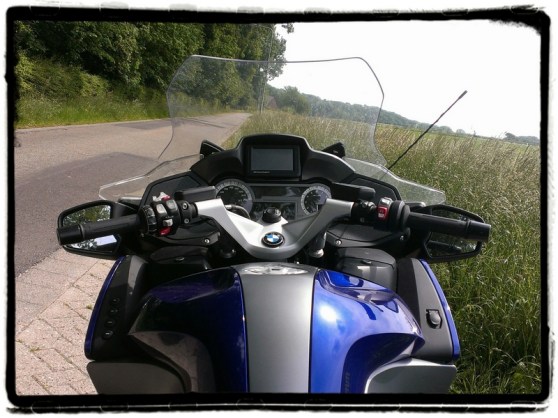
The finishing is also excellent. Meticulously and with an eye for detail. The dashboard is clear and informative. Two round analog meters (speed and rpm) with in between a beautiful TFT color display that informs you about autonomy, mileage, temperature and so on. Above the display there’s a bar with warning lights, and above that a mount for an (optional) GPS. Which is not very readable in direct sunlight. Some additional shielding from the sun wouldn’t be a bad idea for the next RT. Also: too bad the GPS can’t be locked so you have to take it with you every time you have to make a sanitary stop or enter a gas station shop.

You can easily control many settings from the handlebar. Most of them with your left thumb: scrolling through the extensive menu is peanuts with the multi-controller ring. Also handy: you can assign menu items as favorites. After selecting these you can go directly to, for example, the settings of heated grips or the GPS, instead of having to dive into the menu.

Broad beaked Beemer

I’ll admit it: I didn’t want to return the BMW R 1200 RT after my week’s test. What a splendid bike for endless days in the saddle. The windshield is Continue reading

Review: Suzuki GSX1250FA Touring

Suzuki’s GSX models all have four-cylinder engines, with the GSX1250FA having the largest lung capacity: 1255 cc. On some markets (Australia and Belgium for example), it’s available in a tourer trim, challenging other big tour bikes like the Triumph Trophy, BMW R 1200 RT and Yamaha FJR1300.

The Touring suffix doesn’t mean the GSX1250FA obtained lots of extra equipment: a vario windshield, a topcase and side panniers, that’s it. Fortunately, the model already had a nicely streamlined fairing so that suffix is justified.

Tough competition

The first question that raises is whether this Suzuki is up to the rather tough competition. If you compare the price tags, the GSX stands out: it’s a lot cheaper than its three competing colleagues. But while these offer technology like cruise control, heated grips, an electrically adjustable windshield, traction control and different riding modes, the Suz does without. Back to basics. And if you think the option list might have something to offer, well, you’ll only find a tank pad or wheel striping.

Still, the GSX1250FA Touring has ABS, a height-adjustable seat and a centerstand. The latter comes in handy because the GSX uses a chain to transfer the engine power to the rear wheel. You might expect a shaft drive on a touring oriented bike, but a chain of course lowers the price.

Some mistakes

The competitive price of the Suzuki GSX1250FA Touring doesn’t only imply a pretty basic standard equipment, the bike also makes some mistakes. For example, it has three keys. One to start the bike, one for the topcase, one for the panniers. Continue reading

Thoughts after 1 year with my BMW 650 GS

One year ago I bought my first motorcycle. Without much experience you aren’t sure you’re making the right choice of course. So here we are, with 20,000 km more on the odometer. Time to evaluate my BMW F 650 GS.

The short story: I’m very pleased with my bike. It’s an excellent learning machine, both for first-time bikers as for first-time off-road riders. It can handle about anything and has proven very reliable.

You prefer the longer story? Here you go:

Looks

It wasn’t love at first sight and I still think the BMW F 650 GS isn’t a dazzling beauty. Luckily looks aren’t critical to me.

Learning bike

During my search for a first motorcycle, the 650 GS was praised regularly as the ideal bike for beginners. Which isn’t a lie. It’s perfect to learn maneuvering. It’s not too heavy, not too aggressive and gives confidence quickly.

The 650 GS is also a good learning bike for those who want to pick up off-road riding with an allroad bike. It has enough power and its weight (176 kg dry weight) is easier to handle than for example a 1150 GSA that weighs 60 kg more. It’s also robust enough although the plastic parts get damaged pretty easily.

Sitting position

I knew I was going to do lots of highway commuting and lanesplitting with my bike. So a good sitting position was pretty essential. On the 650 GS you sit upright and the seat offers plenty of space to move around so your back won’t hurt quickly.

The knees are fairly bent but it doesn’t get annoying or painful. Just a question of getting used to.

Weather protection

On daily commutes some protection against wind and rain comes in handy. The 650 GS hasn’t much to offer to be honest. The wind screen is tiny and there’s hardly any fairing. For instance an RT would be a better choice but it can still get worse. Like the Iron 883 for example, which really is a good weather only bike.

Accessories

After a few months with my 650 GS I began to feel the need for some accessories. Such as panniers. Would be more comfortable than riding with a backpack every day. Happy I found a set of secondhand BMW Vario panniers.

The windscreen offers very limited protection. I’ve been thinking about getting a bigger one but in the end I decided it’ll have to do.

I also thought about extra lights. Especially for being more visible in winter. But (falling a lot when) off-road riding would probable ruin the lights during the first ride. So no fog lights.

The mirrors have a quite large blind spot. But again, it’s something you get used to. So I didn’t get other mirrors. And you can always get worse (yes, the Harley again).

Maintenance

The BMW F 650 GS has a chain drive so you need to grease it regularly. Takes about 2 minutes. That’s all you need to do. The rest can be done during the inspections at the dealership, like an oil change or replacing wearing parts such as brake pads and the chain set.

Power

The 650 GS certainly isn’t a racer but with its single cylinder, 652 cc and 50 hp, it’s remarkably snappy. Its powerband is spread out nicely and it doesn’t feel short of breath in high revs.

At 120 km/h it does 5,000 rpm which is pretty high. Lower would feel more comfortable but in the end it’s something you get used too.

Forecast

My colleague Nicolas, who owns a Triumph Street Triple, was sure that I would change my 650 GS for a more powerful bike within a year. I’ve proven him wrong.

The 650 GS perfectly meets my needs, mainly because I’m still a learner, especially off-road. A heavier bike would only make things more difficult, so I don’t see why I would get rid of my little GS any time soon.

It also copes well with my daily commutes. In fifth gear on the highway you feel you’re nearing its peak, but if you stick to the traffic rules you’ll never reach those limits.

So for now my BMW F 650 GS is here to stay. To be continued!

Review: Harley-Davidson Iron 883

Clothespins and playing cards. That’s all you needed when you were a kid and you wanted your bicycle to sound like a motorbike. In fact you were brainwashing yourself with that loud rattle because if there’s one motorcycle brand that approaches that sound, it’s Harley-Davidson, right?

Fast-forward to 2014. If I’d like to test a Harley for a week, they asked. My motorcycle experience is limited, I never even rode a Harley, so … why not?

If you think of Harley-Davidson, you probably imagine choppers, big tour bikes and of course that typical Harley sound that you hear coming from a few streets away.

My test bike wasn’t a massive Milwaukee beast like the CVO Limited but their lightweight: the Iron 883 from the Sportster series. Although a new featherweight will join it in august when the Street 750 will expand the bottom end of the Harley range.

The Iron 883 will however stay one of the entry-level Harleys, with a boarding ticket starting from $8,999. That’s an attractive price. And with its narrow built and low seat it’s not intimidating so Harley newbies who don’t want to tame a Fat Boy right away are easier to convince to join the HOG.

Sitting position: it’s a rebel

From the first meters you feel the Iron 883 waking up the rebel inside you, even if it’s one of the lightest Harleys. Pressing your knees against the tank? Riding with your toes on the footpegs? Forget about it. Not with this chum.

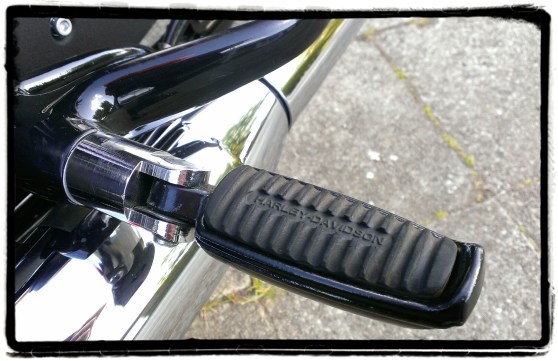
The footpegs are positioned far out and your toes don’t feel at home on them. But if you put the center of your feet on the pegs, you immediately notice that this is the way to go. Now you can just pivot your foot on the left peg to switch gears. Same story on the right for the rear brake.

And because x-legged riding is a very strange feeling, you ride with your legs spread. Period. Of course the downside of this sitting position is less feedback, less control and more wind.

The seat doesn’t offer any space to move. You sit down and you’ll keep the same spot all ride long. Which isn’t a disaster on short rides but longer trips aren’t very pleasant for your back and behind.

Bad boy with tempting looks

The Iron 883 is a real headturner. At home I – or rather the bike – got a very warm welcome from my wife. It stole her heart in an instant. “Why don’t you change your BMW for this one,” she asked several times during my week’s test.

The 883 has an attractive type of toughness. The black coated engine looks more modern than Continue reading

Tow a caravan behind your motorcycle

If you travel by motorbike, you’ll spend the night in a hotel, a B&B, your tent or – why not – your caravan. Because towing a trailer behind your bike is an option too.

Moby1 builds caravans for motorcycles. You might lose a bit of riding pleasure because of the weight (between 280 and 320 lbs, depending on the model you get). And obviously you can’t expect a luxurious five star stay.

The Moby1 C2 caravan has a length of 80” and is available in two widths: 40” and 48”. In other words: if you don’t travel alone it’ll be very cozy.

A mattress covers the complete floor of the C2 caravan and there are some hanging cabinets. There’s also a rear door that conceals some more storage space and a worktop. Toilet, shower, dishwasher, microwave and jacuzzi are of course absent. Although every caravan is built to order, starting from $ 6.500 and according to the wishes of the customer, so you never know what you can ask for.

If you know other manufacturers of motorcycle caravans, please let us know in the comments below.