Review: Honda CRF1000L Africa Twin Adventure Sports

In 2016 I tested the Africa Twin and I wasn’t exactly wild about it. Three years later I have to revise my opinion. But first, let’s look at the bigger picture.
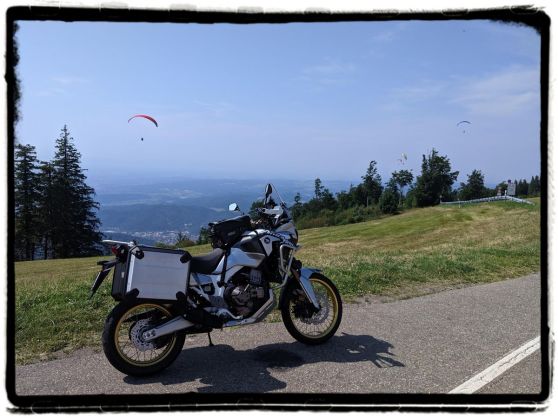
In the late 1980s the Honda XRV650 started the Africa Twin story. The discontinuation of the XRV750 production in 2003 interrupted that story, but Honda breathed new life into the Africa Twin: in 2016 the CRF1000L saw the light of day, after a few years of rumors and speculation.

First update

In 2018, the CRF1000L Africa Twin got its first update and an adventure-oriented variant was revealed: the CRF1000L Africa Twin Adventure Sports.

That update made the Africa Twin 2 kg lighter. It got a ride-by-wire throttle and a new, more extensive LCD display. The engine gained mid-range torque thanks to a lighter balance shaft and a revised inlet and exhaust system. The DCT (automatic gearbox in normal human language) also got an update.
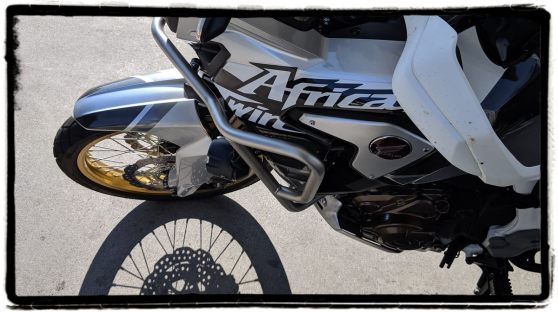
Even more than the Africa Twin, the Adventure Sports is built for long, adventurous journeys. It has a larger tank (24.2 liters compared to 18.8 on the Africa Twin), a higher windshield, a taller fairing, tough-looking crash bars, slightly higher positioned handlebars and 2 cm more ground clearance than the Africa Twin. The adjustable seat can be set at 900 or 920 mm (on the Africa Twin: 850 or 870 mm). There’s also a lower seat available (60 mm lower).

Oh no, DCT!

I spent a few days with the Africa Twin Adventure Sports in Germany’s Black Forest to find out if Honda’s big adventure bike really improved. I hoped to get one with a manual gearbox, because in 2016 my first experience with Honda’s DCT absolutely hadn’t convinced me. So I was slightly disappointed when I discovered that the Adventure Sports I got to test was one with automatic transmission.
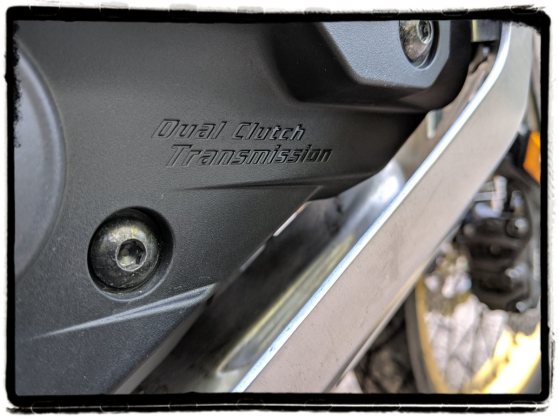
I knew that I had to skip the D-mode of the gearbox (due to its sleep-inducing slow shift pattern) and immediately chose the S3 mode, the most extreme of the three sportive shift modes. Very quickly my initial disappointment Continue reading

Review: Honda X-ADV

It was on a drizzly winter’s day that I was reflecting on the coming motorcycle season. I wanted to try something different, something special. So I got in touch with Jean.
“I want to test a maxi scooter,” I said.
Silence. Then, with a hint of disbelief: “You want to test a scooter?”
“Yes,” I answered.
“A scooter?”
“Yes.”
Silence again.
“Which one?”

I know nothing about maxi or mini scooters, except that they’re highly popular in big cities. Just join the daily traffic jams on the Brussels Ring and you’ll see many of them lane-splitting. So I became curious about those maxi scooters. But which one should I test?

Soon I bumped into the Honda X-ADV. Not just “a scooter”, but one that claims to be in a class of its own: a motorcycle with the sitting position and the comfort of a scooter.

The X-ADV is part of Honda’s adventure range, which is justified by giving the X-ADV some adventure characteristics: a larger front wheel than on traditional scooters, adjustable front and rear suspension, switchable traction control, hand guards and a beautiful digital dashboard similar to the one of the CRF450 Rallye. Combined with tough “armored” colors and rugged Bridgestone tires, the X-ADV just looks cool.

Motorcycle or scooter?

Right from the very first meters I notice how agile the X-ADV is. Ideal for city traffic, where it really plays out its scooter nature. The sitting posture takes some getting used to. It’s upright, with wide handlebars, and feels a bit like an adventure bike. But my feet in front of me and nothing between my legs, that’s new to me. Yet, it doesn’t take long before I throw the scooter from one corner into another. When I stop at a pub, I can easily store my helmet in the 21-liter compartment under the seat.

When I leave the city and can pick up the pace, the X-ADV’s stability Continue reading

Review: Triumph Scrambler 1200 XE

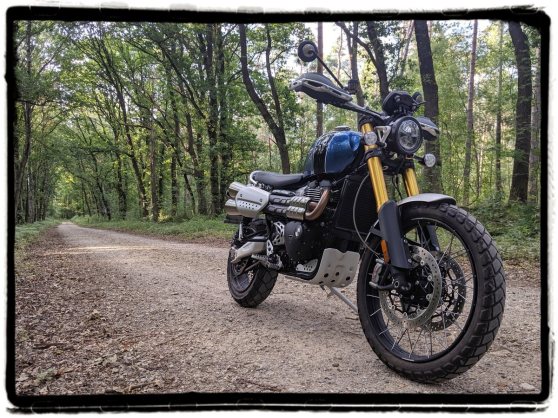
When Triumph announced the new Bonneville T120 and the new Thruxton at the end of 2015, that was just the beginning of the story of their all-new 1200 cc twin engine. In 2017 they introduced the Bobber, in 2018 the Speedmaster, and in 2019 they even released two new models with the parallel two-cylinder: the Scrambler 1200 and the Speed Twin. You can’t ignore that Triumph aims at a lot of different types of riders.

I was most curious about the Scrambler 1200. I had already met its smaller brother, the Street Scrambler, during an off-road training. A good-looking bike, but it had a hard time to convince me on unpaved tracks, which the “Street” in its name predicted. The Scrambler 1200 doesn’t have any “Street” in its name. Sounds promising.

So let’s hop on that seat of the Scrambler 1200 XE. With a height of 870 mm it’s even heigher than the Tiger 800 XCa. Not exactly the most exciting news for the short-legged.

Swag & high tech

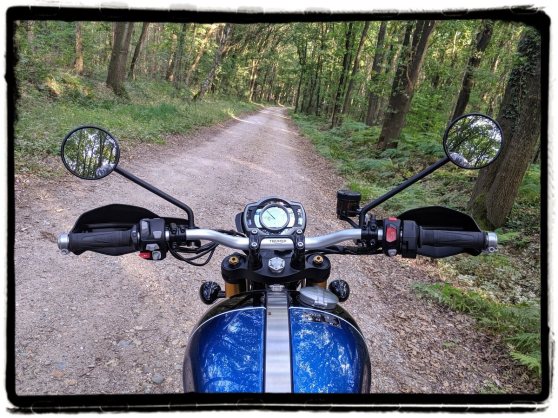
Once you sit on the seat, the dashboard and the controls on the handlebars will make you realize very quickly that this isn’t a back-to-basics scrambler. The 1200 has a modern TFT display and lots of buttons.

Not only is this scrambler packed with technology, it doesn’t lack swag either. The classic look and the finish of the entire bike, including the engine, are topnotch: very detailed and stylish. At the same time, the Scrambler 1200 XE has a Continue reading

Review: Moto Guzzi V85 TT

The midweight adventure bike segment is getting pretty crowded lately. We already double-tested the new BMW F 850 GS and the Triumph Tiger 800 last year, and this year the KTM 790 Adventure and the Yamaha Ténéré 700 are causing quite some buzz. You’d almost overlook an Italian bike that mingled in quietly: the Moto Guzzi V85 TT. A brand-new model with a brand-new engine.

I wouldn’t say the Guzzi is a direct competitor of the aforementioned four. For that, it lacks the off-road capabilities. Just look at its 19″ front wheel and the 170 mm suspension travel. The other four have a 21″ in the front and at least 30 mm more travel.

Nor does the V85 TT compete with the less off-road oriented Kawasaki Versys 650, Honda NC750X or Suzuki V-Strom 650. No, the Guzzi has something that these bikes don’t have, and that’s a good portion of emotion and a distinct look which also characterize the BMW R nineT Urban G/S and the Ducati Scrambler Desert Sled. These aren’t typical adventure bikes, but motorcycles that combine the sturdy looks of an adventure bike with a classic design and a distinctive engine.

Off to the Pyrenees!

I took the Moto Guzzi V85 TT for a trip to the Pyrenees (still working on the report). On that 4,464 km trip it regularly Continue reading

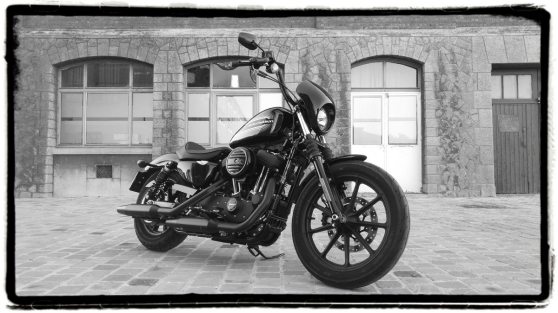
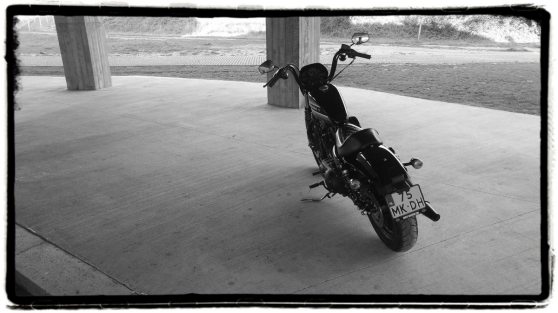
Review: Harley-Davidson Iron 1200

It’s hard to ignore the fact that in recent years Harley-Davidson has been broadening its range to seduce a wider audience. The most talked about models that Harley will soon launch are the electric LiveWire (already in September of this year!) and an adventure bike that will see daylight only next year but that’s already causing quite some stir. It’s safe to say both bikes belong in the “pretty particular” category.

Luckily, Harley doesn’t forget the beginner bikers. Proof of this is the 750 engine that was introduced in 2015, first in the Street 750 and later in the Street Rod.

Still, the lightest Harley isn’t always a novice’s first choice, which is why the Sportster range was expanded this year with the Iron 1200. Indeed, a big 1202 cc engine, but in the slender body of the Iron 883. Yet its price is just slightly higher than the 883’s: the Iron 1200 starts at £ 9,395 while you ride a new Iron 883 from £ 9,045.

So isn’t that bigger twin cylinder engine too much for a beginner? Well, I found the Iron 883 to have a nice engine but it lacked some excitement. The Iron 1200 wants to remedy that. The newcomer delivers 96 Nm and 67 hp while the 883 does 70 Nm and 52 hp. But other than a clear difference between the engines Continue reading

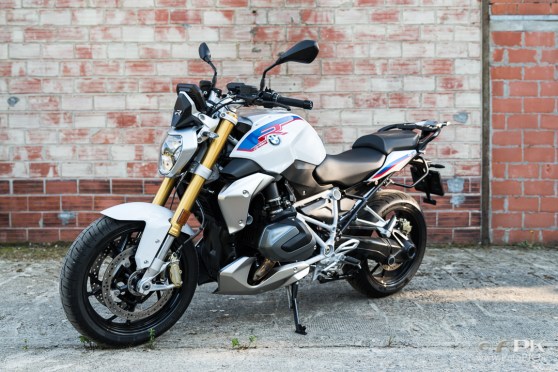
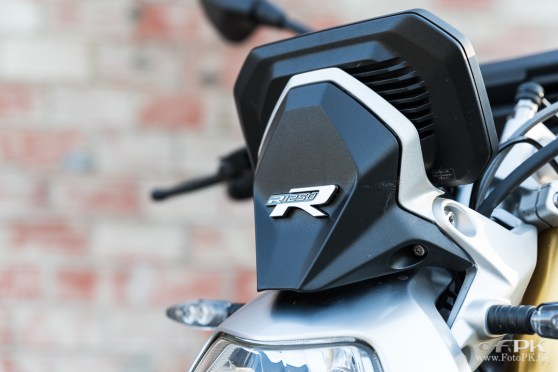
Review: BMW R 1250 R

Can you imagine a BMW line-up without boxer engines? The emblematic image of the two bulging cylinders is inextricably linked to the brand. So probably BMW won’t bury their flat-twin any time soon. In any case, they continue developing it. Because the competition doesn’t stand still either of course.

One hundred years after the birth of the very first BMW boxer engine, the M2B15, BMW adds another chapter to its boxer book with the introduction of the brand-new 1250 two-cylinder. The new engine is available in four flavors: GS, RT, RS and R. With the latter you experience the flat-twin in its purest form.

All aboard the VVT train

The last 1200 boxer engine dated from 2013. With the development of the new 1250, BMW focused first and foremost on more muscle in low rpms. The engine displacement increased from 1,170 to 1,254 cc, the horse stable was expanded from 125 to 136 stallions, and the peak torque climbed from 125 Nm (at 6,500 rpm) to 143 Nm (at 6,250 rpm).

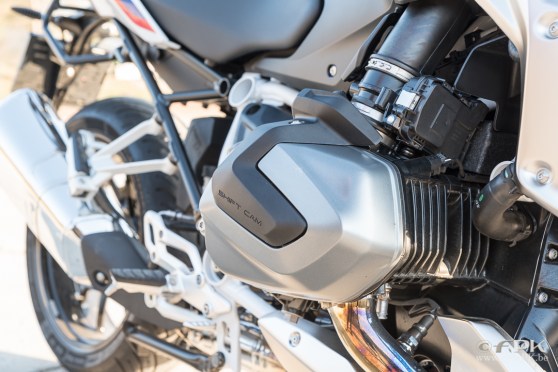
Next to those boosted figures, BMW makes its debut with the ShiftCam technology, also referred to as variable valve timing. While some brands have already been using this technique for years, the Bayern Boys are only now boarding the VVT train. The Euro5 standard seems to Continue reading

Review: Yamaha Tracer 700 GT

The “sport tourer” moniker probably brings big muscular bikes to mind, like the KTM 1290 Super Duke GT or the BMW S 1000 XR, or rather bulky long-distance runners such as the FJR1300 or the GSX1250FA.

Going fast is easy with those bikes but if you look for light-footedness in a sport tourer, you need to look somewhere else. Enter the Yamaha Tracer 700 GT.

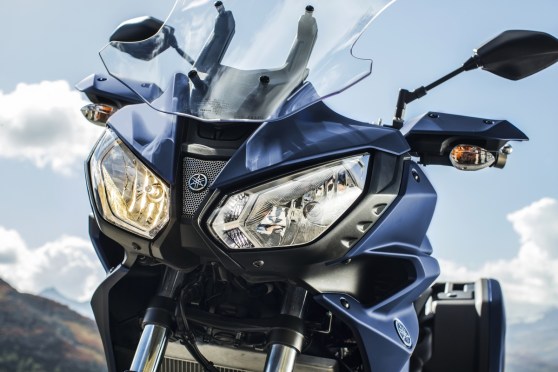
For a few years now, the Yamaha MT-07 has been a popular model from which Yamaha smartly derives other models. The XSR700 already stole my heart in 2016 and now the (already reasonably touring-oriented) Tracer 700 gets an (even more) touring-oriented relative: the Tracer 700 GT.

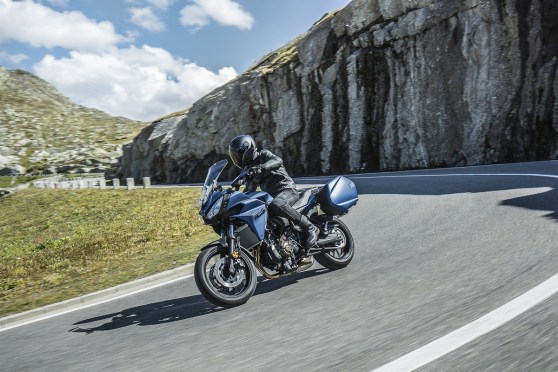
The Japanese kept it simple and drafted an easy upgrade: take a stock Tracer 700, exchange the windshield for a bigger one, replace the seat with a comfort seat and mount color-matched 20-liter side cases. There you go: the Yamaha Tracer 700 GT. Price for that suffix: £600, bringing the total to £7,999. That’s an attractive price tag. But isn’t the GT label too promising?

Hop on the comfort seat and you’ll immediately notice that the Tracer 700 GT doesn’t make an overwhelming first impression like the big sport tourers mentioned in the intro do. The Tracer feels compact and very manageable. At 835 mm the seat isn’t Continue reading