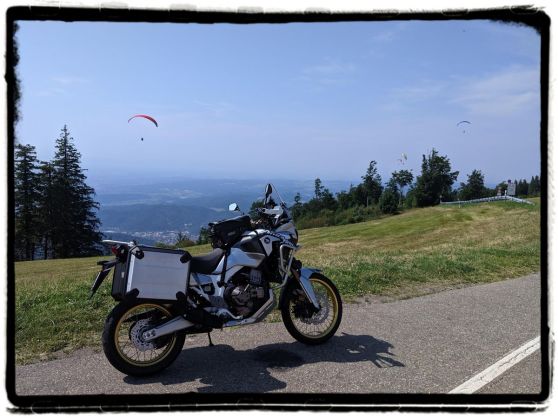
Review: Honda CRF1000L Africa Twin Adventure Sports

In 2016 I tested the Africa Twin and I wasn’t exactly wild about it. Three years later I have to revise my opinion. But first, let’s look at the bigger picture.

In the late 1980s the Honda XRV650 started the Africa Twin story. The discontinuation of the XRV750 production in 2003 interrupted that story, but Honda breathed new life into the Africa Twin: in 2016 the CRF1000L saw the light of day, after a few years of rumors and speculation.

First update

In 2018, the CRF1000L Africa Twin got its first update and an adventure-oriented variant was revealed: the CRF1000L Africa Twin Adventure Sports.

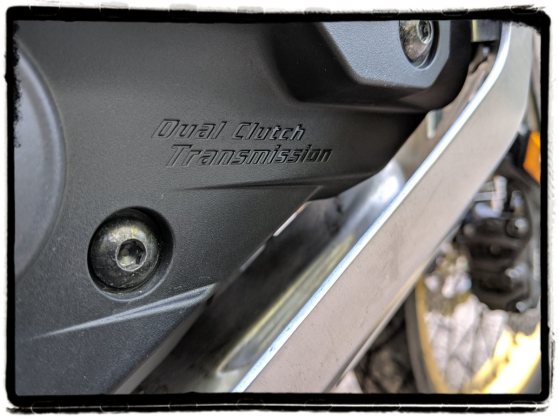
That update made the Africa Twin 2 kg lighter. It got a ride-by-wire throttle and a new, more extensive LCD display. The engine gained mid-range torque thanks to a lighter balance shaft and a revised inlet and exhaust system. The DCT (automatic gearbox in normal human language) also got an update.

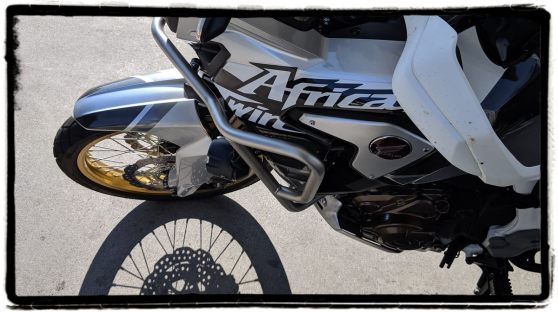
Even more than the Africa Twin, the Adventure Sports is built for long, adventurous journeys. It has a larger tank (24.2 liters compared to 18.8 on the Africa Twin), a higher windshield, a taller fairing, tough-looking crash bars, slightly higher positioned handlebars and 2 cm more ground clearance than the Africa Twin. The adjustable seat can be set at 900 or 920 mm (on the Africa Twin: 850 or 870 mm). There’s also a lower seat available (60 mm lower).

Oh no, DCT!

I spent a few days with the Africa Twin Adventure Sports in Germany’s Black Forest to find out if Honda’s big adventure bike really improved. I hoped to get one with a manual gearbox, because in 2016 my first experience with Honda’s DCT absolutely hadn’t convinced me. So I was slightly disappointed when I discovered that the Adventure Sports I got to test was one with automatic transmission.

I knew that I had to skip the D-mode of the gearbox (due to its sleep-inducing slow shift pattern) and immediately chose the S3 mode, the most extreme of the three sportive shift modes. Very quickly my initial disappointment Continue reading

Photo special: Distinguished Gentleman’s Ride Genk

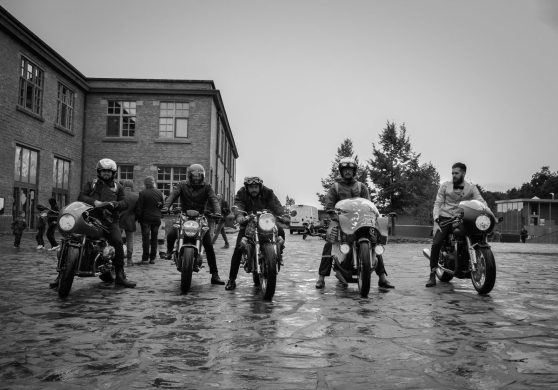
Last Sunday, all over the world, thousands of motorcyclists started their engines because it was that time of year again: the Distinguished Gentleman’s Ride. The goal of this event is to raise funds and awareness for prostate cancer research and men’s mental health, while in the meantime enjoying a nice ride. Preferably in a distinguished styled outfit.

Photographer Michele Micoli went to the Genk Ride (Belgium) and took these pics:

Continue reading

Review: Triumph Scrambler 1200 XE

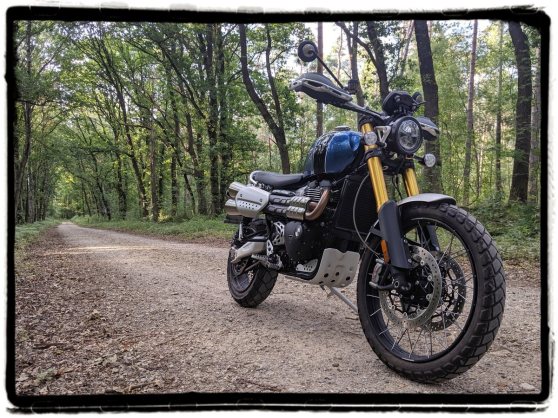
When Triumph announced the new Bonneville T120 and the new Thruxton at the end of 2015, that was just the beginning of the story of their all-new 1200 cc twin engine. In 2017 they introduced the Bobber, in 2018 the Speedmaster, and in 2019 they even released two new models with the parallel two-cylinder: the Scrambler 1200 and the Speed Twin. You can’t ignore that Triumph aims at a lot of different types of riders.

I was most curious about the Scrambler 1200. I had already met its smaller brother, the Street Scrambler, during an off-road training. A good-looking bike, but it had a hard time to convince me on unpaved tracks, which the “Street” in its name predicted. The Scrambler 1200 doesn’t have any “Street” in its name. Sounds promising.

So let’s hop on that seat of the Scrambler 1200 XE. With a height of 870 mm it’s even heigher than the Tiger 800 XCa. Not exactly the most exciting news for the short-legged.

Swag & high tech

Once you sit on the seat, the dashboard and the controls on the handlebars will make you realize very quickly that this isn’t a back-to-basics scrambler. The 1200 has a modern TFT display and lots of buttons.

Not only is this scrambler packed with technology, it doesn’t lack swag either. The classic look and the finish of the entire bike, including the engine, are topnotch: very detailed and stylish. At the same time, the Scrambler 1200 XE has a Continue reading

Report: Magic 12 Belgium Rally 2019

I guess the Iron Butt Association (or IBA) doesn’t need a big introduction? Their most talked-about long-distance rally is the Iron Butt Rally in the States (11 days long!) but also elsewhere rallies are being organized regularly since you can find IBA’s in South Africa, India, Brazil and Australia and Germany. And it’s the latter who organized the Magic 12 Belgium Rally on a Saturday this September.

The format of a Magic 12 Rally: collect as many points as possible in a maximum of 12 hours by visiting predefined locations. The Germans wanted to do something exotic and decided to do a rally in Belgium. Even as an IBA rookie I thought: home match! On top of that BMW lent me a 1250 RT (my opinion about it at the bottom of this article), so 12 hours of riding shouldn’t be a big issue.

The preparation

Five days before the start, each participant received a file with all locations (77 in total) and the rallybook. In addition to some explanation about the rally, the rallybook contained more information about the locations.

It was impossible to visit all 77 locations in 12 hours, so you had to plan a route. A route that got you a high score preferably.

Every location had a certain amount of points (from 190 to 3,450 points) and a photo assignment. Because of course you had to prove that you had actually been on the claimed locations.

Usually the photo assignment was something like: take a picture of this building or that view, but there were also some special assignments. For example, to claim the 3,450 points location, you had to walk to a statue and take a photo. A 3.4 km walk to be precise!

Also an obligatory element in every picture: the rally flag (which you could print at home) with your starting number (which you only got the evening before the start).

In addition to the points per location, you could score extra points by collecting combos. A number of locations where grouped thematically, for example Statues, Beer and Borders. The more locations of a combo you visited, the higher your extra score.

Feeling a bit stressed when you hear you should plot a route with all that info? Grab a stress ball, ‘cause there’s more! Three days before departure we received the “minimum requirements” in our mailbox: six groups of 24 locations in total. Per group you had to visit at least one location of your choice. Again there was a theme: Flanders, Wallonia, Brussels, Dutch-speaking, French-speaking and German-speaking. Skipping one group would result in 5,000 penalty points. If you missed two, you were disqualified, or DNF (did not finish) in IBA jargon.
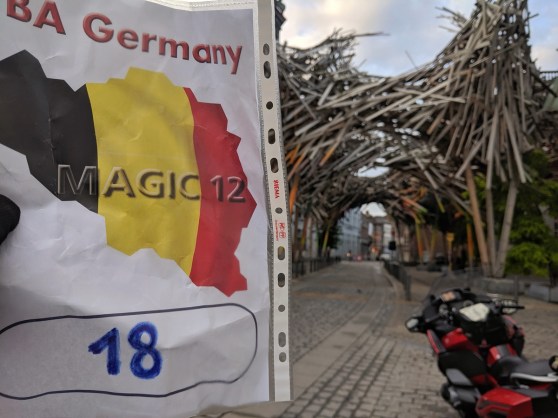
With all that info, I could start setting up a route. The Street Art combo drew my attention: this combo had the most locations but also the highest score. If I did all ten locations, I’d receive a bonus of 12,000 points.

So I loaded the locations into MyRouteApp: visiting all ten street art locations in 12 hours wouldn’t be Continue reading

Review: Moto Guzzi V85 TT

The midweight adventure bike segment is getting pretty crowded lately. We already double-tested the new BMW F 850 GS and the Triumph Tiger 800 last year, and this year the KTM 790 Adventure and the Yamaha Ténéré 700 are causing quite some buzz. You’d almost overlook an Italian bike that mingled in quietly: the Moto Guzzi V85 TT. A brand-new model with a brand-new engine.

I wouldn’t say the Guzzi is a direct competitor of the aforementioned four. For that, it lacks the off-road capabilities. Just look at its 19″ front wheel and the 170 mm suspension travel. The other four have a 21″ in the front and at least 30 mm more travel.

Nor does the V85 TT compete with the less off-road oriented Kawasaki Versys 650, Honda NC750X or Suzuki V-Strom 650. No, the Guzzi has something that these bikes don’t have, and that’s a good portion of emotion and a distinct look which also characterize the BMW R nineT Urban G/S and the Ducati Scrambler Desert Sled. These aren’t typical adventure bikes, but motorcycles that combine the sturdy looks of an adventure bike with a classic design and a distinctive engine.

Off to the Pyrenees!

I took the Moto Guzzi V85 TT for a trip to the Pyrenees (still working on the report). On that 4,464 km trip it regularly Continue reading

Photo special: Bikes at the C-mine

Bikes at the C-mine is a new motorcycle event which takes place three times this summer at the photogenic C-mine in Genk (Belgium). The concept is simple: a laid-back get-together of motorcycle riders and enthusiasts. You’ll mainly see classic bikes and customs, and if you’re thirsty or hungry, you’ll be taken care of.

Photographer Michele Micoli took his camera to last Wednesday’s event (which was the 2nd edition). This is what he saw:

Continue reading

Review: Harley-Davidson Iron 1200

It’s hard to ignore the fact that in recent years Harley-Davidson has been broadening its range to seduce a wider audience. The most talked about models that Harley will soon launch are the electric LiveWire (already in September of this year!) and an adventure bike that will see daylight only next year but that’s already causing quite some stir. It’s safe to say both bikes belong in the “pretty particular” category.

Luckily, Harley doesn’t forget the beginner bikers. Proof of this is the 750 engine that was introduced in 2015, first in the Street 750 and later in the Street Rod.

Still, the lightest Harley isn’t always a novice’s first choice, which is why the Sportster range was expanded this year with the Iron 1200. Indeed, a big 1202 cc engine, but in the slender body of the Iron 883. Yet its price is just slightly higher than the 883’s: the Iron 1200 starts at £ 9,395 while you ride a new Iron 883 from £ 9,045.

So isn’t that bigger twin cylinder engine too much for a beginner? Well, I found the Iron 883 to have a nice engine but it lacked some excitement. The Iron 1200 wants to remedy that. The newcomer delivers 96 Nm and 67 hp while the 883 does 70 Nm and 52 hp. But other than a clear difference between the engines Continue reading