I’m not gonna lie: KTM’s biggest adventure bike has always been very welcome here at Team Throttle. We already tested the 1290 Super Adventure S back in 2018 and 2021, and on both occasions it went home with an outstanding review.
Fast-forward to 2026, and KTM has been through some pretty turbulent times. Financial problems at parent company Pierer Mobility led to a change of ownership in 2024, with the Austrian brand now being part of Bajaj. That name may not immediately ring many bells in the West, even though the Indian company is one of the world’s largest motorcycle manufacturers. Besides, Bajaj has held a stake in KTM since 2007, so the change of ownership didn’t exactly come out of the blue.
Exactly what the future holds for KTM remains anyone’s guess, but at some point comments from bossman Rajiv Bajaj suggested that production on European soil could disappear. That plan wouldn’t be entirely surprising: KTM would certainly not be the first European motorcycle brand to move production to the East. However, KTM CEO Gottfried Neumeister later told the press such a move to India is out of the question.
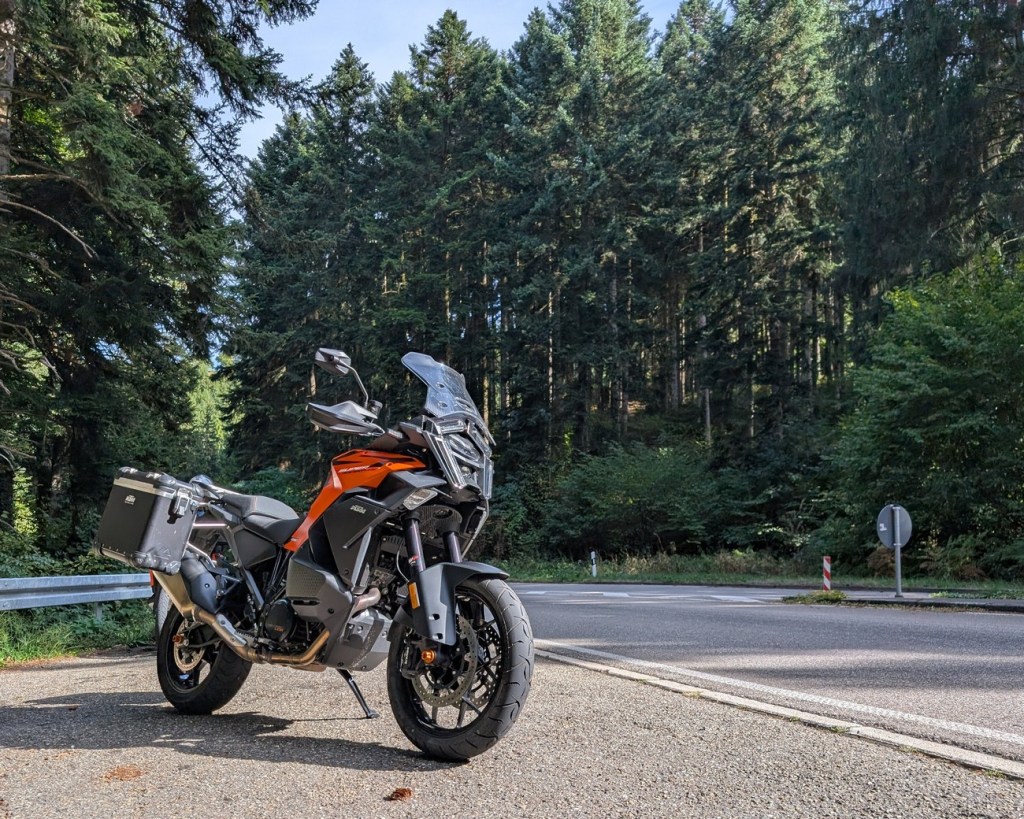
Okay, that’s enough economic news for a review. Let’s get to the fun stuff. And there are three flavours to choose from: the R, the S and the S Evo. The R version of the KTM 1390 Super Adventure is the off-road-focused model, featuring 21-inch and 18-inch spoked wheels and WP XPLOR suspension. The S is the road version, with 19-inch and 17-inch cast wheels, less ground clearance and a larger windscreen. The S Evo, meanwhile, adds an automatic gearbox to the S’s mix.
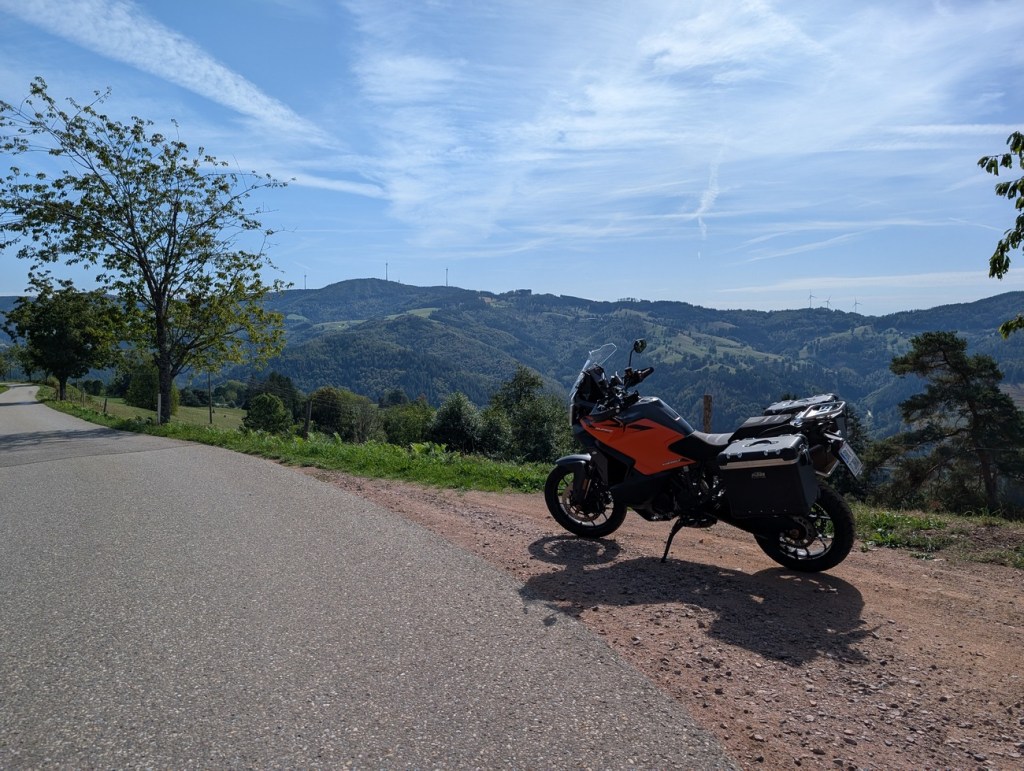
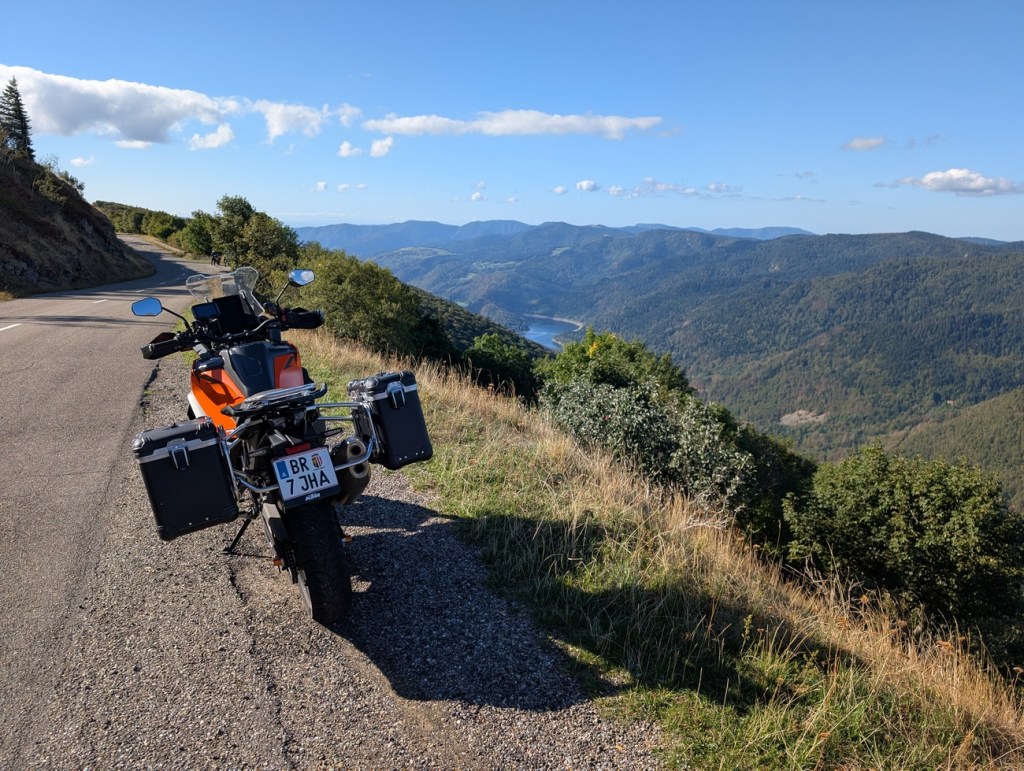
Since I had no off-road plans, I headed out on the S for a week-long trip to the German Black Forest and the Vosges in France, racking up around 2,500 km of testing along the way.
The name change from KTM 1290 Super Adventure to KTM 1390 Super Adventure suggests a bigger set of lungs, although both numbers are slightly misleading: displacement goes from 1,301 cc to 1,350 cc. The horsepower and torque figures also received a bump, now topping out at 173 hp and 145 Nm. That’s 15 hp and 7 Nm more than its predecessor.
The engine hasn’t just grown bigger, it also got Camshift technology (or variable valve timing, if you prefer). This allows the V-twin to perform more efficiently at both lower and higher revs. Hardly groundbreaking technology (previously seen at for example Suzuki, Ducati, Harley-Davidson and BMW) but it’s a first for the Super Adventure.
When it comes to design, KTM continues to embrace the path of making slightly unconventional choices. The LED headlight looks anything but standard, but somehow it works. The now well-proven low-hanging fuel tank design is also present. The least convincing part, at least to my eyes, is the side fairing, which I think could have been a little less substantial.
Of course the Super Adventure also received technological upgrades. The most visible new feature, besides the automatic gearbox on the S Evo, is the large 8-inch display. The touchscreen works at all speeds, is easy to read in all conditions and has a clear layout.
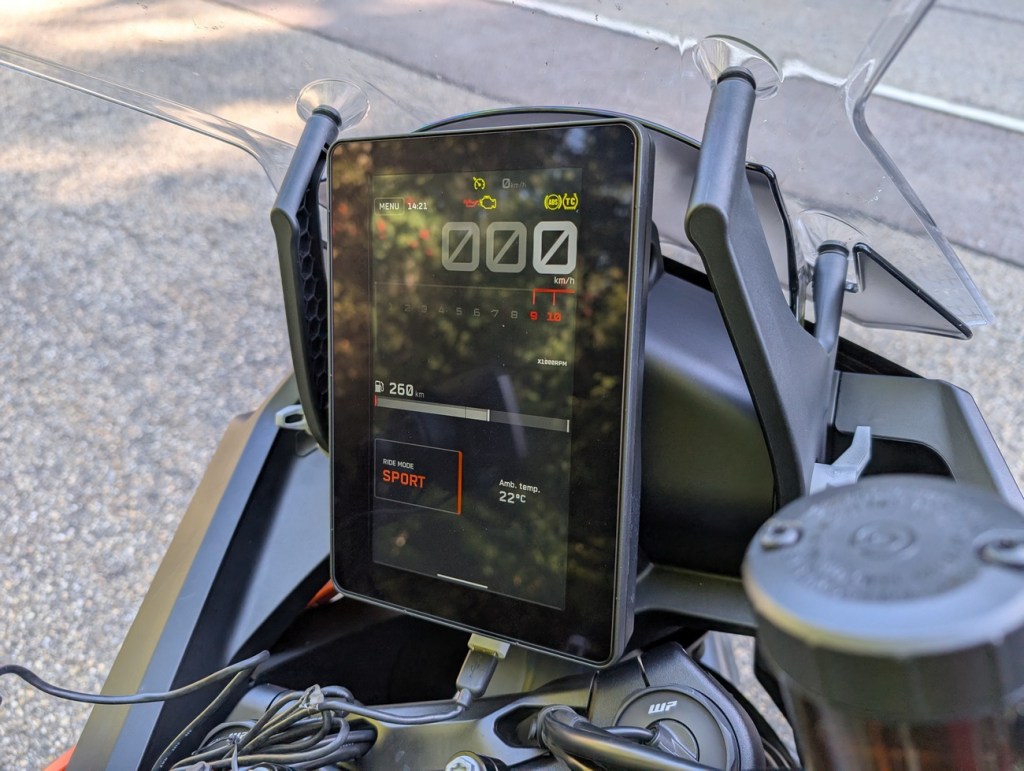
Standard equipment also includes tyre pressure monitoring, keyless ignition and cruise control. Heated grips and seat, front radar (for adaptive cruise control, among other things) and a quickshifter are available as options. Only the latter was activated on the bike I tested.
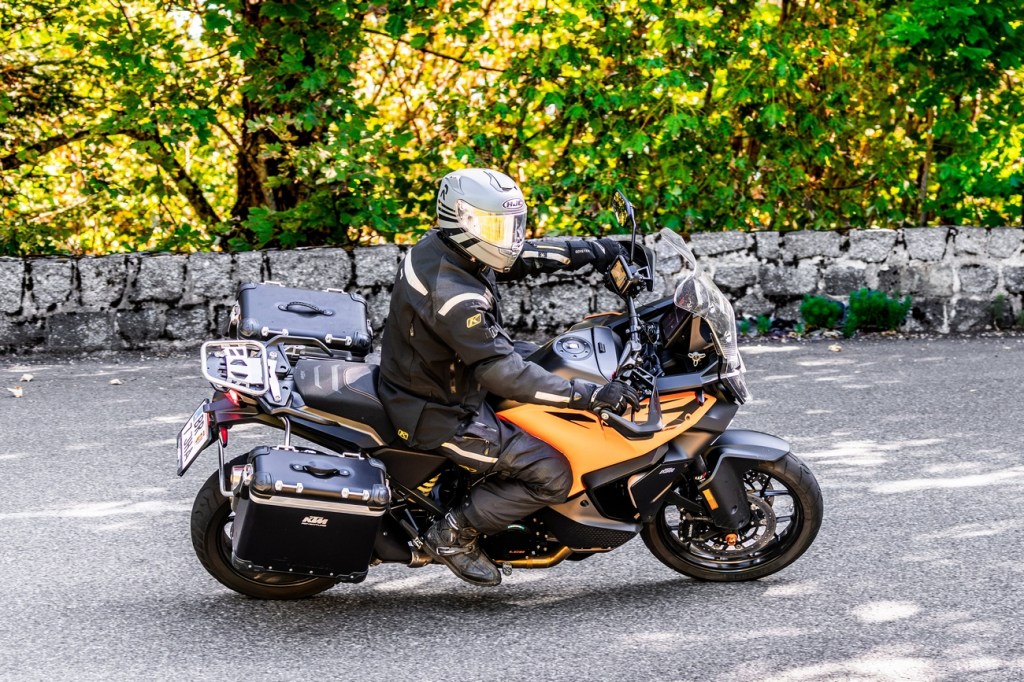
As I rolled the fully loaded KTM out of my garage, I was struck by how light it feels. Even with two fully loaded panniers and a large roll bag strapped to the back, the Super Adventure remained easy to manoeuvre by hand. The low centre of gravity, courtesy of those tank lobes, obviously helps, but the difference compared to some other bikes (the ones I can barely move once they’re fully loaded) remains remarkable.
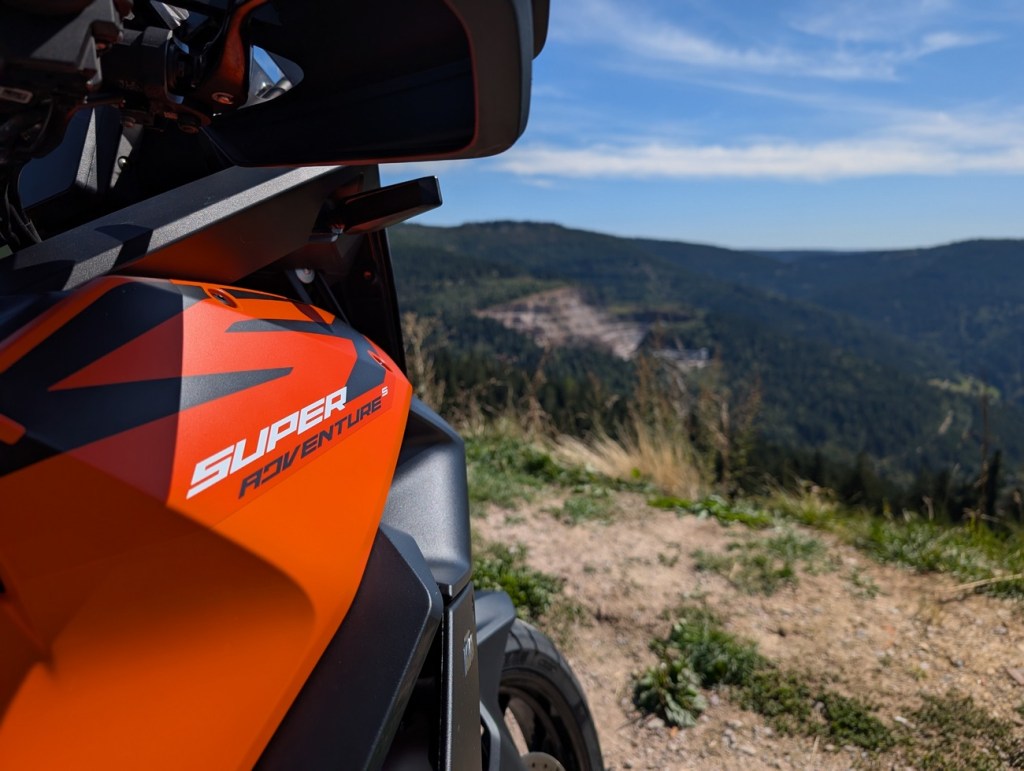
I planted my backside on the seat and it immediately felt like home. The first few hundred kilometres of motorway confirmed that feeling. A comfortable riding position, thanks to the wide handlebars and height-adjustable seat, while the broad tank and the windscreen did a good job of directing the airflow around me. At 1.80 metres tall, I noticed a little turbulence over the top of my helmet, although it’s minimal.
The windscreen can be adjusted through 7 cm, by the way. Not electrically, but with knobs that are easy enough to give a turn while riding. Why overcomplicate things with technology when you can just do it by hand, right?
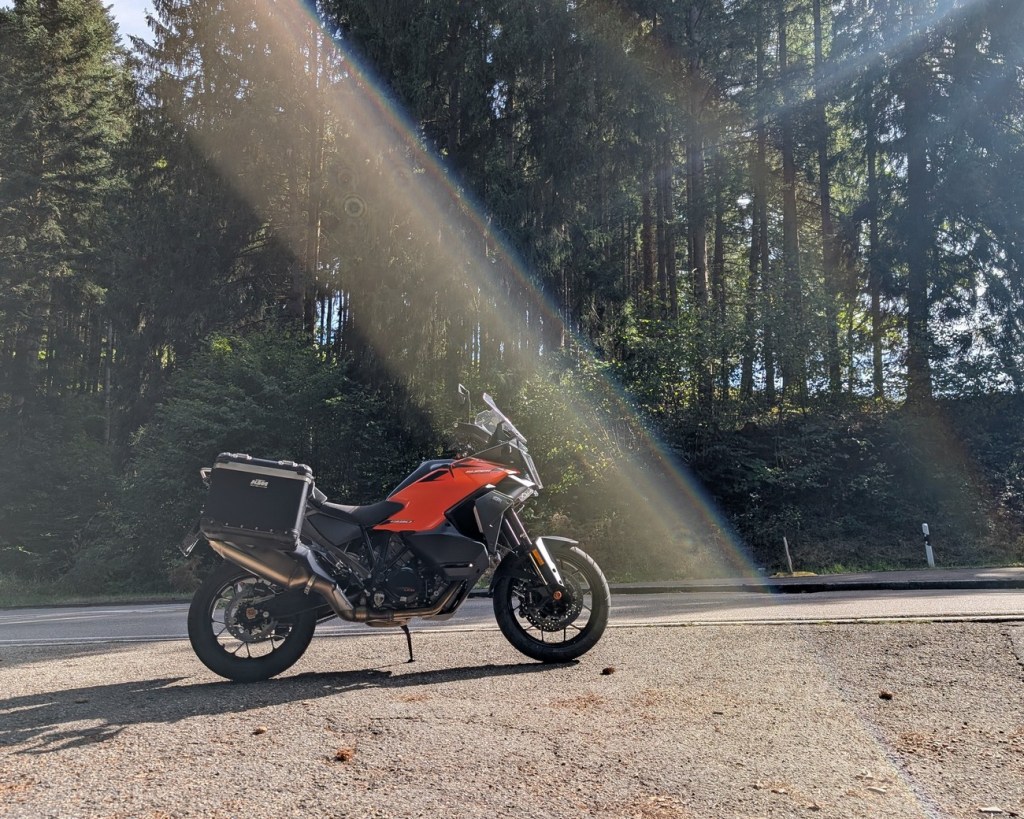
The cruise control works flawlessly, as do the gearbox and quickshifter (apart from a few false neutrals). Boring motorway stretches are also the perfect opportunity to dive into the menu. To begin with, there are the riding modes: Street, Sport, Rain, Offroad and the optional Rally mode. Various parameters can be fine-tuned for each riding mode, including suspension, engine braking, preload and nose dive. And as if that wasn’t enough, there are three custom riding modes that you can configure entirely to your liking. That’s what you call choice overload.
At a fuel stop, I explored the menu some more and I almost lost my way in what feels like an endless sea of settings. You can even adjust things like the coming-home light or the brightness of the backlit controls.
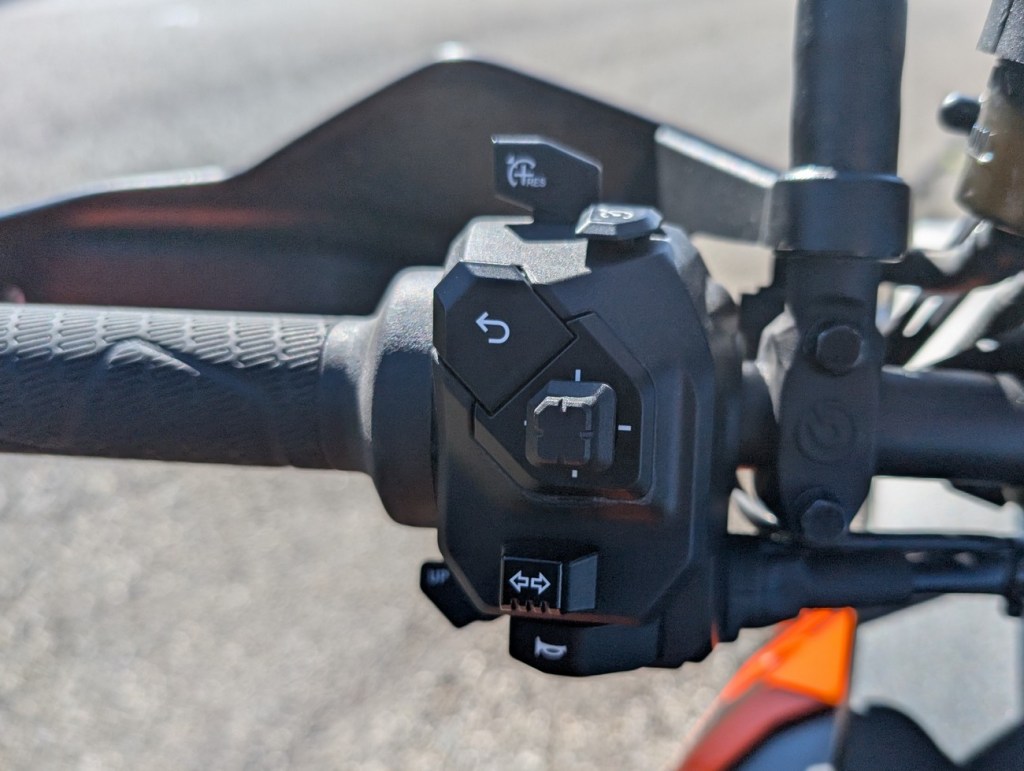
The interface is easy enough to operate thanks to the five-way switch, and the menu structure is reasonably well laid out, although the sheer number of settings can still turn it into a bit of a treasure hunt. But fair enough: once you’ve got everything set up the way you like it, there’s very little button-pushing left to do.
When the motorway tarmac gave way to winding back roads, I quickly switched from the Street to the Sport mode. The throttle response becomes just a little sharper without ever getting twitchy. And, just like with my previous Super Adventure experiences, the LC8 V-twin remains a huge source of joy. It likes to flex its muscles, and the amount of power on tap is downright impressive. It accelerates like a starving Austrian whose mother is frying up fresh schnitzels, yet it’s equally happy to tiptoe through a 30 km/h zone.
Combine that magnificent powerplant with the excellent semi-active WP Apex suspension and a set of Brembo brakes that initially bite fairly gently before throwing out the anchors with absolute conviction (which is exactly what you want if you ask me) and there you have it: a motorcycle that is downright impressive.
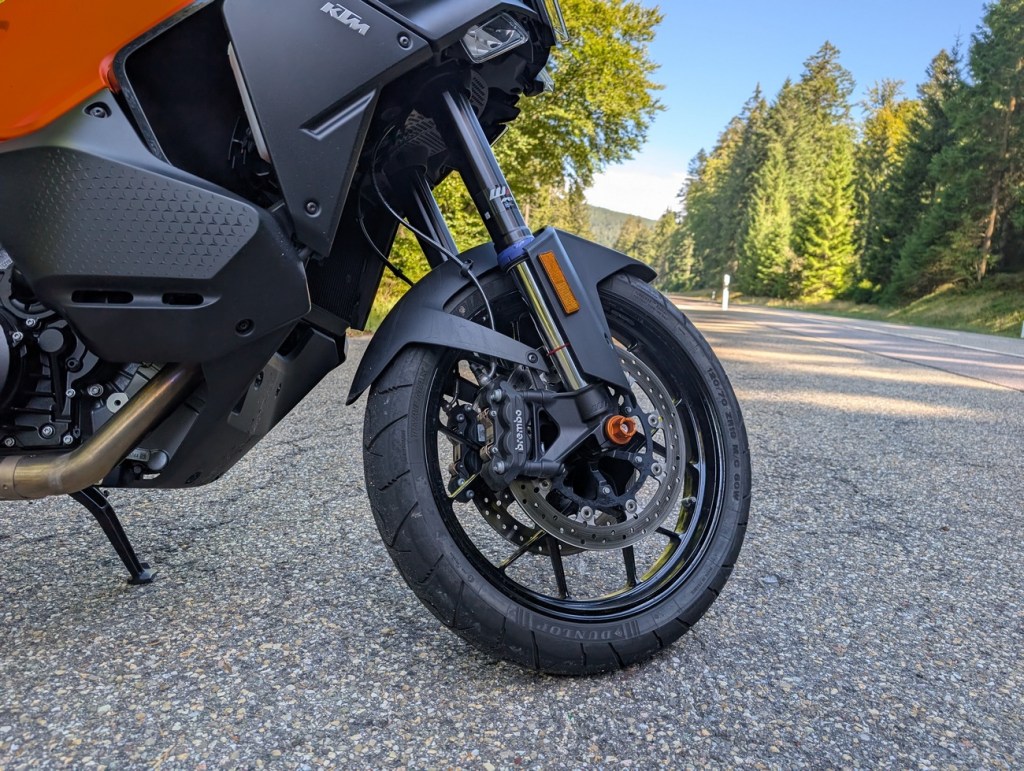
After some experimenting, I found my favourite setup: Sport riding mode, suspension in Sport, anti-dive switched on and engine braking at maximum. Whether it were hairpins in the Black Forest or faster corners in the Vosges, the 1390 Super Adventure S simply couldn’t get enough. And neither could its rider.
I already mentioned how much confidence its predecessor inspired, and that hasn’t changed on the 1390. The Brembos allow you to brake deep into a corner with plenty of feel, while the stability of the chassis practically begs you to wind open the throttle the moment the corner exit comes into view.
The Super Adventure S turns sharply and precisely, while still feeling agile and light on its feet, and it’s not easily thrown off its game. Except, perhaps, by a few particularly battered stretches of Vosges tarmac, which made the Sport suspension setting a little nervous. A quick switch to Street restored the calm. Nothing to worry about.
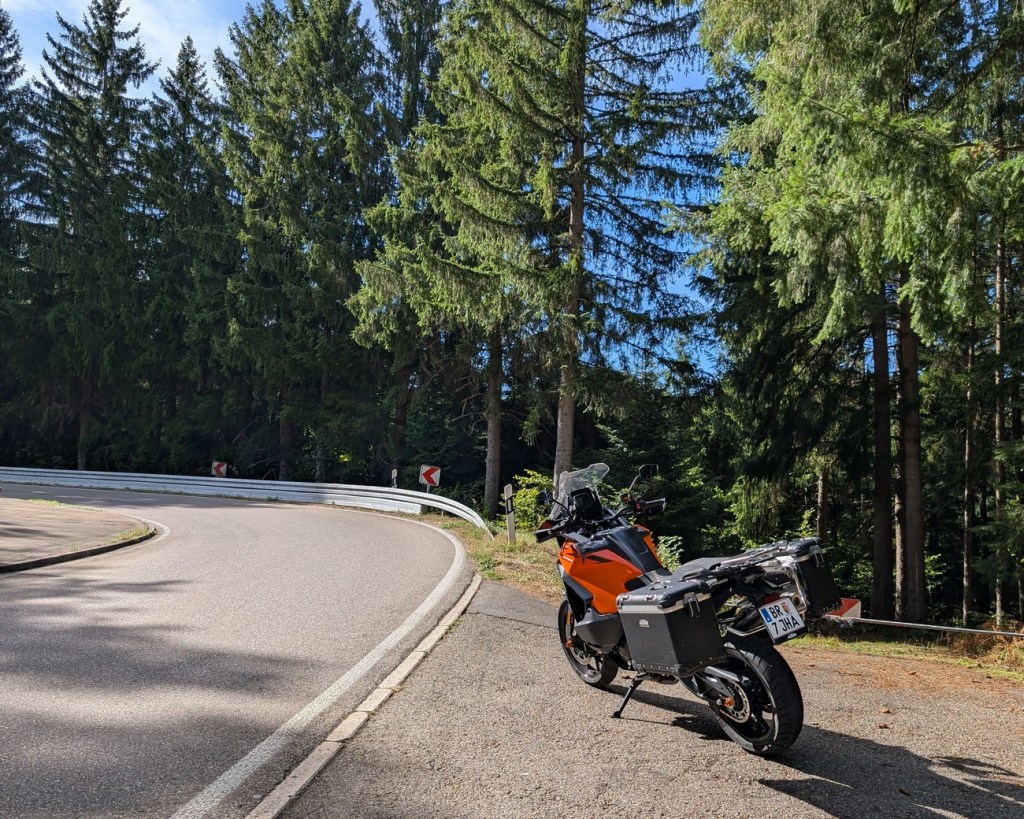
So, is it all good news then? No, because things aren’t quite as smooth on the software side. Several times a day, I was treated to warning lights: an overly sensitive rear tyre pressure sensor (despite there never being anything wrong with the tyre), “key out of range” messages even though the key was safely in my trouser pocket, and a yellow warning triangle appearing on the display every now and then. But when I checked the warning menu to see what was going on: nothing. A minor blemish on what was otherwise a flawless week.
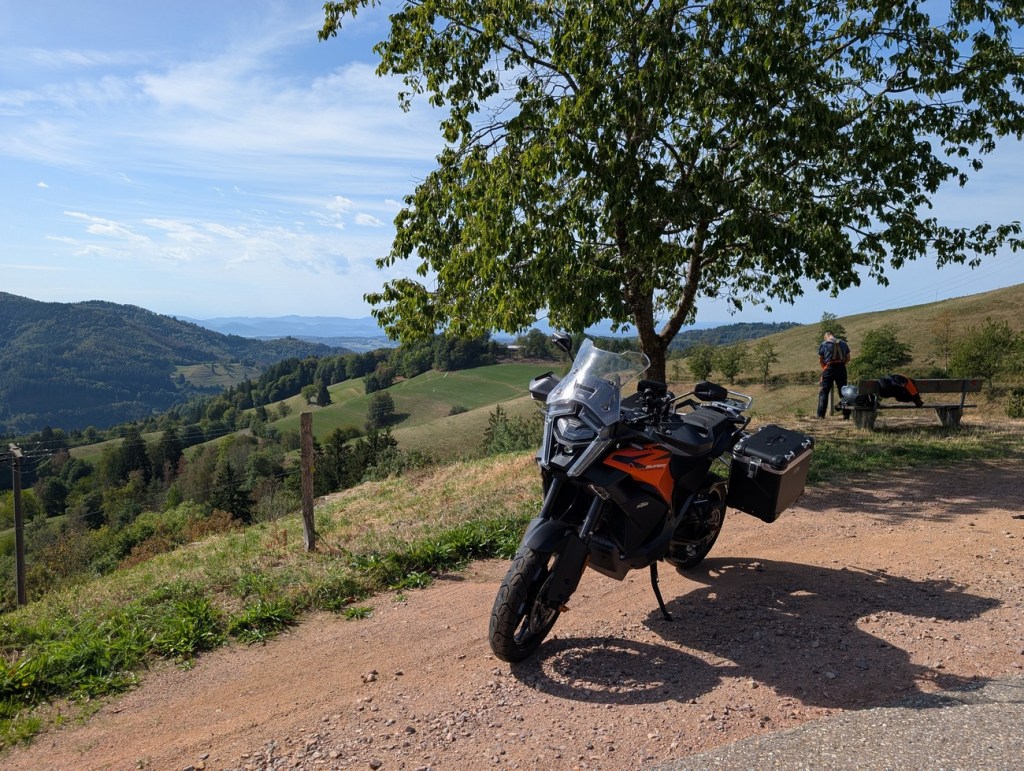
Conclusion
With the KTM 1390 Super Adventure S, the Austrian brand isn’t exactly launching a revolution, but rather delivering a logical evolution. The combination of engine, suspension and brakes has been further refined, and remains a prime example of just how exciting an adventure bike can be.
From an engine perspective, the more powerful powerplant and Camshift upgrade are relatively subtle improvements. The most eye-catching changes are the LED headlight and, above all, the excellent display. The interface is reasonably intuitive, although the seemingly endless list of settings feels like a bit much, if you ask me. More choice isn’t always better choice.
Fortunately, these are settings you don’t need to fiddle with on every ride, and the Super Adventure really shines where it matters most: riding. Its behavior and handling inspire heaps of confidence, making the fun almost impossible to stop. Whether you’re an adrenaline junkie or a keen long-distance rider, there’s plenty here to put a smile on your face.
Pros
+ Confidence-inspiring in all conditions
+ Excellent display with a clear layout
+ Gotta love the LC8
Cons
– There is such a thing as too many settings
– Some software hiccups
Tech specs
Engine
Design: 2-cylinder, 4-stroke, V 75°
Displacement: 1350 cm³
Power: 173 PS
Torque: 145 Nm
Transmission: 6-speed
CO2 emissions: 139.5 g/km
Cooling: Liquid cooled with water/oil heat exchanger
Engine cylinder: Twin cylinder
EMS: Keihin EMS with RBW, twin ignition
Engine oil: Motorex, SAE 10W-50
Drive type: Combustion
Silencer material: Stainless steel
Silencer type: Silencer
Chassis
Front brake: 2 x Brembo 4-piston, radially mounted caliper, brake disc Ø 320 mm
Rear brake: Brembo 2-piston, fixed caliper, brake disc Ø 267 mm
Chain: 525 X-Ring
Frame design: Chromium-Molybdenum steel trellis frame, powder coated
Steering head angle: 65.3 °
Rear subframe design: Aluminium, powder-coated
Trail: 110 mm
Wheelbase: 1558 mm
Suspension
Front suspension: WP SAT (semi-active technology) Upside-Down Ø 48 mm
Rear suspension: WP SAT (semi-active technology) shock absorber
Suspension travel (front): 220 mm
Suspension travel (rear): 220 mm
Suspension travel (front): 8.66 inch
Suspension travel (rear): 8.66 inch
Front suspension adjustment: Semi-active control
Rear suspension adjustment: Semi-active, electronic preload
Dimensions
Seat height: 847/867 mm
Wheelbase: 1558 ± 15 mm
Tank capacity (approx.): 23 l / 6.08 US gal
Ground clearance: 223 mm
Weight (without fuel): 227 kg
Weight fully fueled: 244 kg
Wheelbase tolerance: 0.59 inch
Wheels: 3.50 x 19″; 5 x 17″
Wheels: Cast aluminium wheels

