Every self-respecting brand has at least one big-bore adventure bike in its lineup. Still, it’s the middleweights that fly out of showrooms the fastest. Honda sells more Transalps than Africa Twins, Triumph can’t build enough Tiger 900s while the 1200 gathers dust, and KTM’s 890 dominates their sales charts. Even Suzuki moves more V-Strom 800s than 1050s.
At BMW, it’s a different story. The smaller GS has spent generations living in the pitch-black shadow of its big brother. And while mid-size adventure bikes have become increasingly off-road capable in recent years, the F 850 GS – and its predecessors – just didn’t deliver as soon as the asphalt stopped.
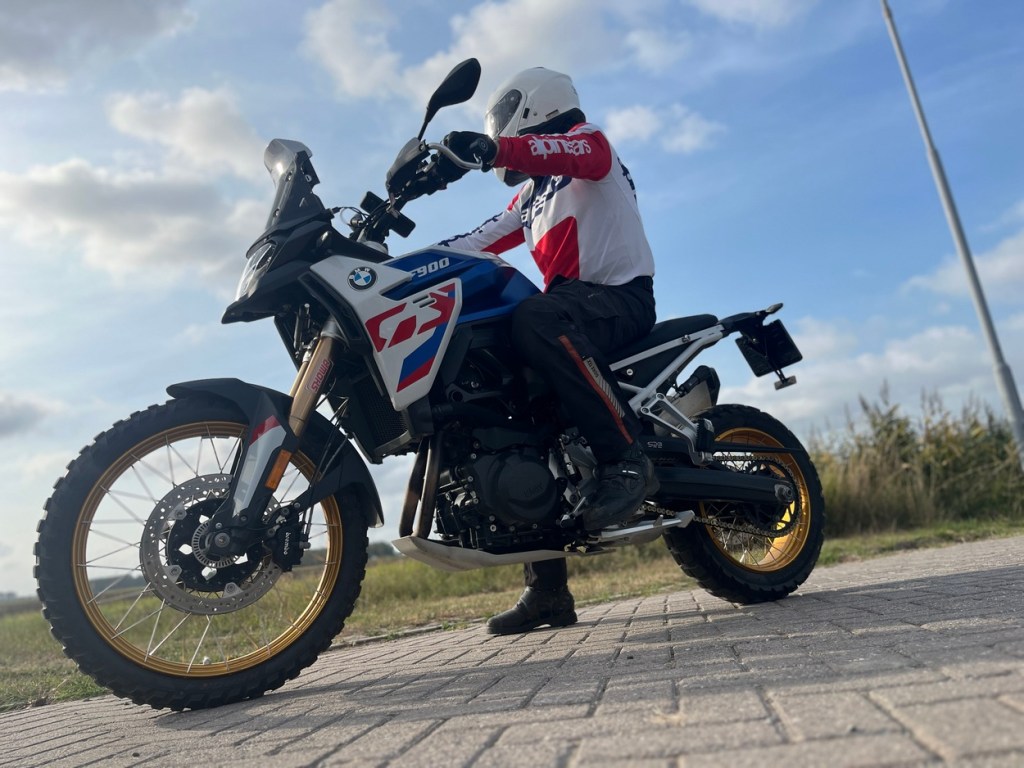
Enter the BMW F 900 GS. In Bavaria, they’ve flipped the script completely and gone all-in on a more hardcore approach. I notice it right away when hopping off my own (big) GS and onto the 900: the handlebar sits higher and further forward, while the footpegs are much lower. The ergonomic triangle of the 900 GS is clearly optimized for off-road riding.

Swing a leg over the 870 mm seat and it immediately feels like home. The 6.5-inch TFT display, the buttons, the mirrors: it’s all familiar BMW stuff that’s been around for years. The menu structure and controls are still best in class, though after more than a decade, a little refresh wouldn’t hurt.
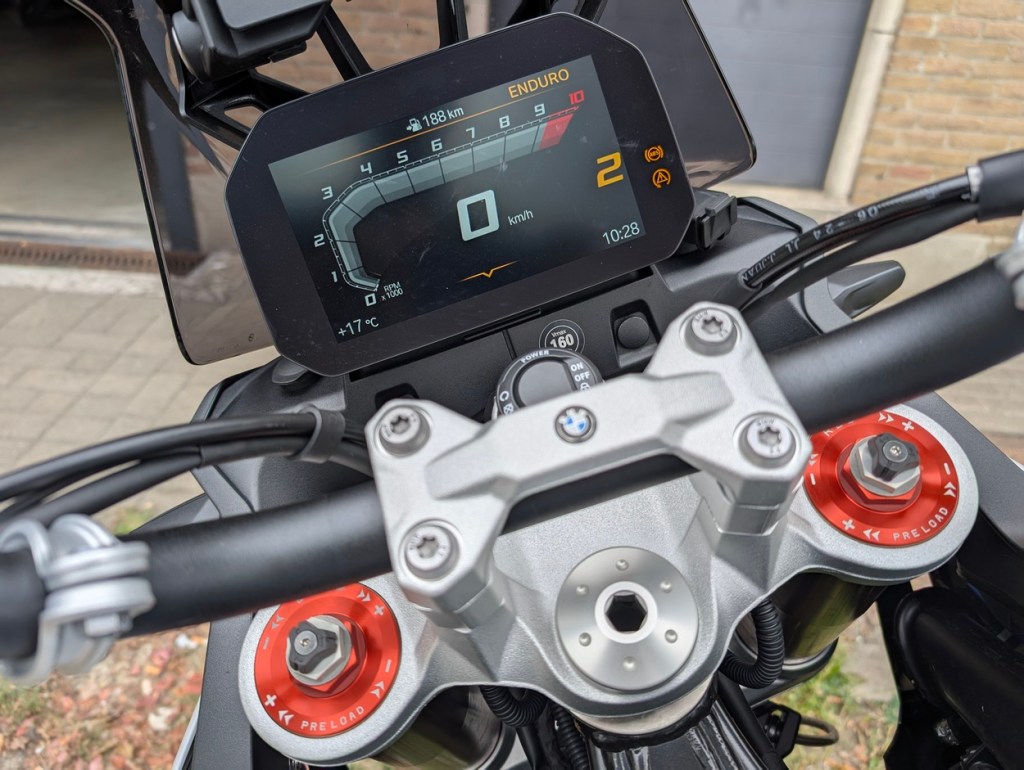
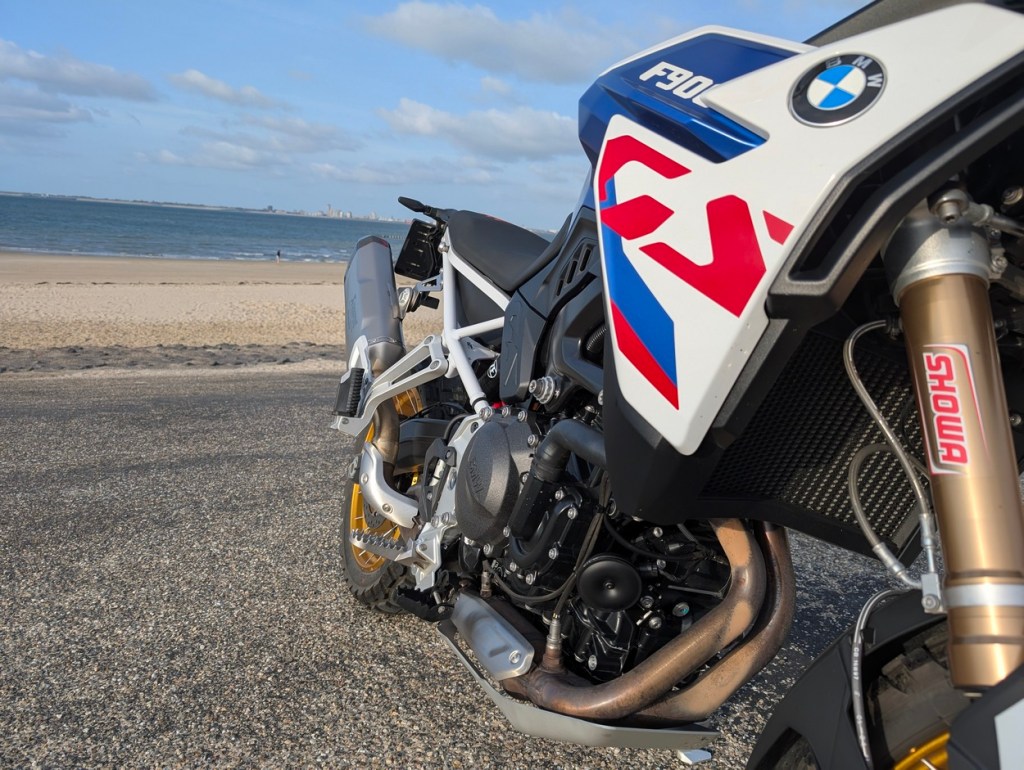
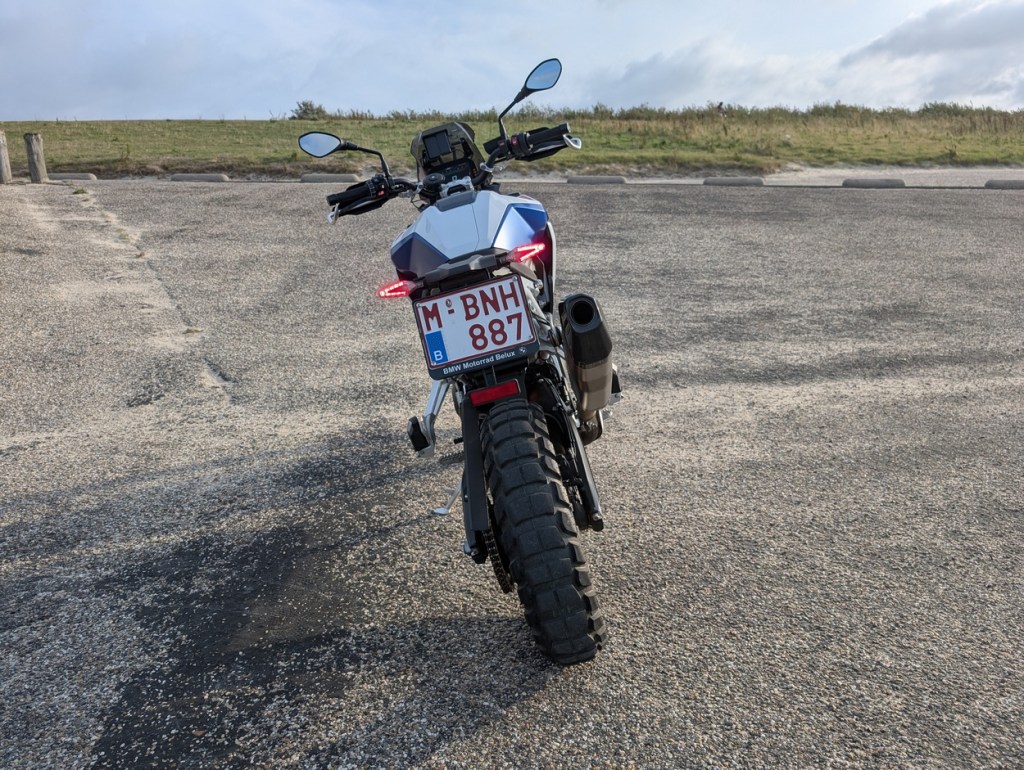
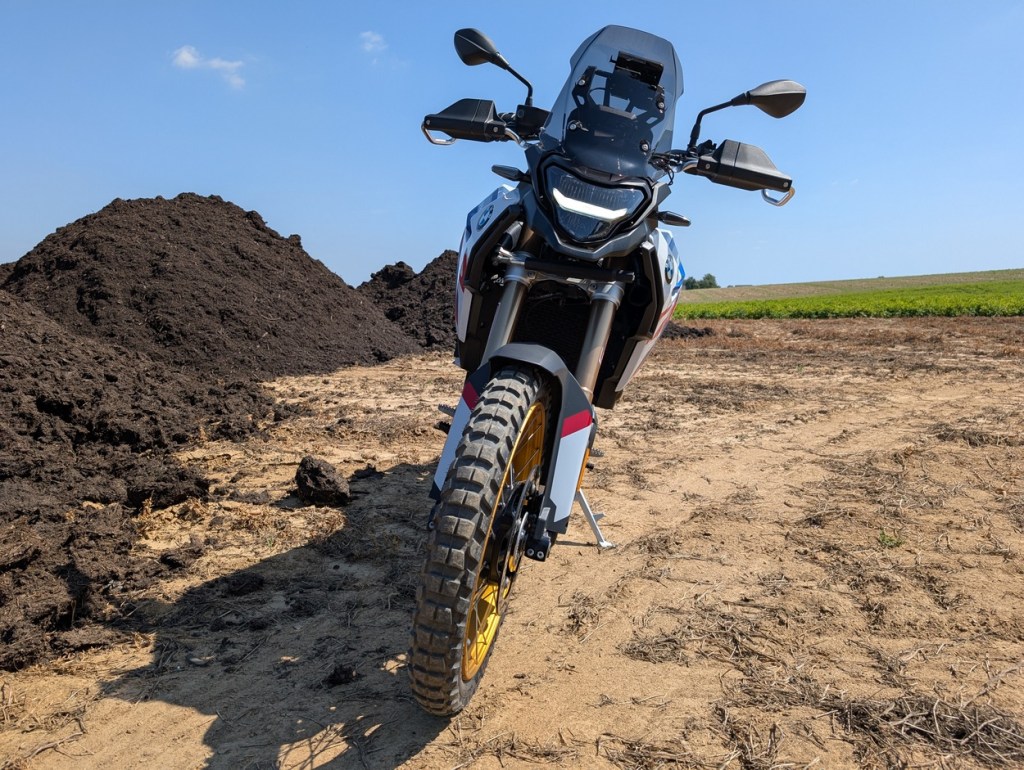
What jumps out right away are the red-anodized caps on the Showa forks: they pop sharply against the triple clamp. That contrast pretty much sums up the whole F 900 GS design. My test bike came in the GS Trophy color scheme with the Enduro Pro Pack, which adds a gold fork, gold rims and a white subframe, all working together to create some serious visual punch. Add the sleek, trimmed-down tail, and you’re looking at one stunning adventure bike.
That Enduro Pro Pack deserves all the praise. The extra-tall risers lift the black handlebar by 24 mm, making the transition from sitting to standing effortless. The 45 mm Showa forks and Sachs rear shock are fully adjustable, and – except for front preload and high-speed damping – you can do it all without tools. You read that right: the rear shock offers both low- and high-speed damping. Built for off-road? You bet.
BMW wouldn’t be BMW if the riding modes didn’t come bundled in a pack. The Dynamic Pack adds Dynamic and Enduro modes on top of the standard Rain and Road settings. The first two are the only ones I actually used. Of course, you’ll also want the optional quickshifter that comes with this pack. Both packs are absolute must-haves if you want to unlock the full potential of the F 900 GS.
Talking about potential, this middleweighter has plenty of it. The old 850 GS was a gentle chap: soft suspension, underwhelming power, about as exciting as lukewarm soup. The 900 GS? It’s the complete opposite.

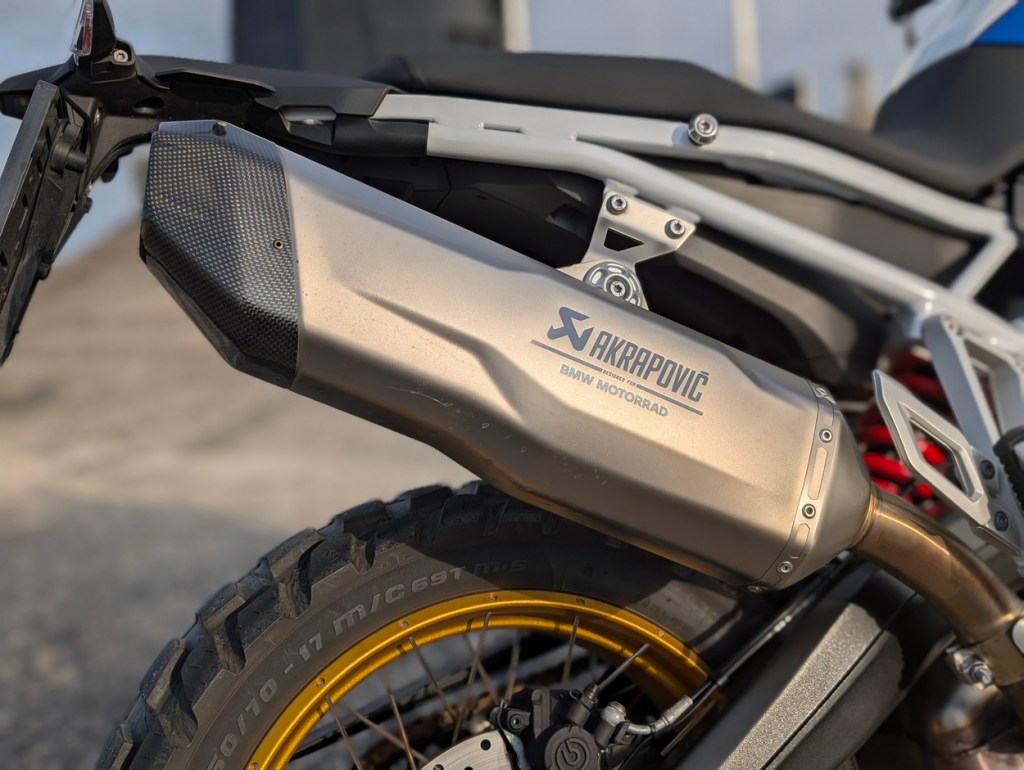
The suspension is set up pretty firm out of the box, but it delivers tons of feedback. The 900cc parallel-twin really shines in this GS. Smooth throttle control, plenty of torque and a punchy midrange that lets you flick from corner to corner with confidence, while the burbles and pops from the optional Akrapovič exhaust tempt you to keep shifting up and down, just for the fun of it.
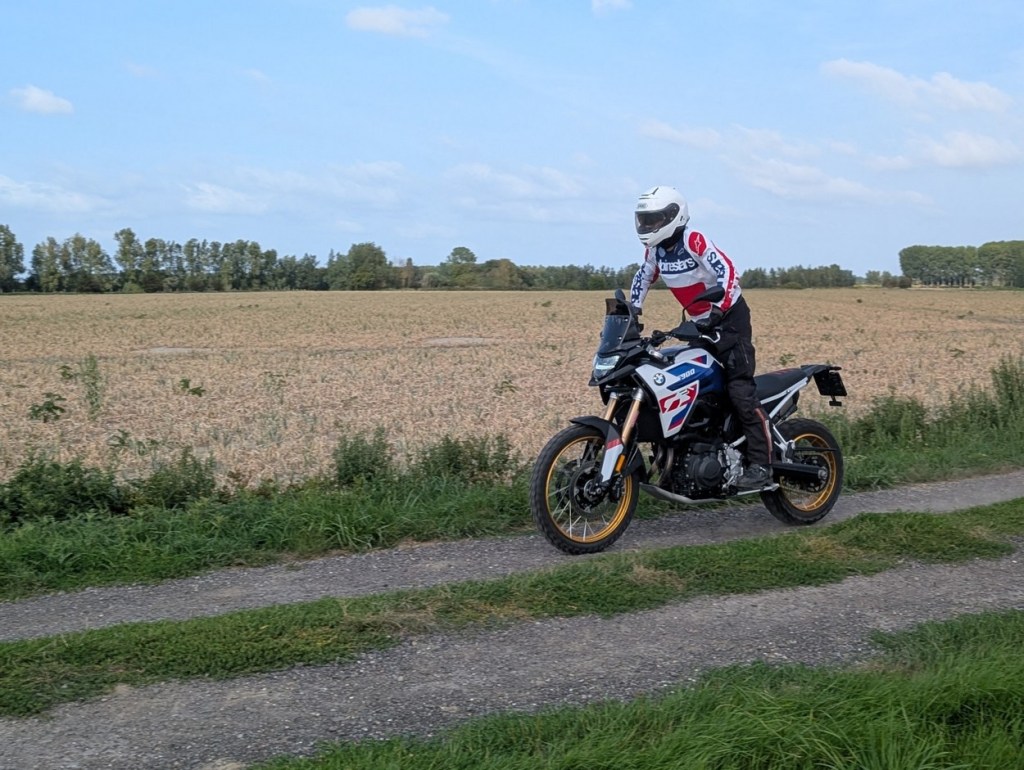
Off-road, the Enduro mode quietly lends a hand, allowing just enough wheelspin to glide through the dirt with full control. But even on pavement, the 900 GS delivers a far livelier ride than you’d expect from a bike with such a long travel, 21” front wheel and knobby tires.
Conclusion
The little brother of the big GS is no more. Long live the BMW F 900 GS! “Hardcore” is the word that best sums it up. During my test week, I couldn’t resist comparing it to another hardcore midweight adventure bike: the Yamaha Ténéré 700 World Raid, which stole my heart in the Vosges. What the T7 lacked, the 900 GS delivers: cruise control and a proper, comfy seat. I remember the Ténéré’s suspension in standard mode being a bit more forgiving than the Beemer, though with a little tweaking, you can probably match it.
If you want something more street-oriented, check out the BMW F 900 GS Adventure. Undoubtedly more comfortable, but that wasn’t the point BMW was making here: the F 900 GS is a through-and-through Reise-Enduro. Emphasis on enduro. What a beast of a bike, this F 900 GS, especially if you tick the Enduro Pro and Dynamic packs on the order form.
Pros
+ Hardcore through and through
+ Killer design
+ More comfortable than a Ténéré thanks to cruise control, a better seat and slightly better wind protection
Cons
– Hardcore through and through, so not for everyone
Tech specs
Engine
Rated output: 105 hp at 8,500 rpm
Emission control: Closed-loop 3-way catalytic converter
Type: Water-cooled, 2-cylinder, four-stroke engine with four cam-operated valves per cylinder, two overhead camshafts and dry-sump lubrication
Bore x stroke: 86 mm x 77 mm
Capacity: 895 cc
Compression ratio: 13.1 : 1
Mixture control: Electronic intake pipe injection / digital engine management system: BMS-X with throttle-by-wire
Max. torque: 68.6 lb-ft (93 Nm) at 6,750 rpm
Electrical system
Alternator: Permanent magnet alternator with 416 W (nominal power)
Battery: 12 V / 9 Ah
Power transmission
Clutch: Multiplate clutch in oil bath, slipper clutch
Drive: Endless O-ring chain with shock damping in rear wheel hub
Chassis / brakes
Frame: Bridge-type frame, steel shell construction
Steering head angle: 62°
Wheels: Cross spoke wheels
Rim, front: 2.15 x 21″
Rim, rear: 4.25 x 17″
Tire, front: 90/90 R21
Tire, rear: 150/70 R17
Brake, front: Twin disc brake, floating brake discs, diameter 305 mm, 2-piston floating caliper
Brake, rear: Single disc brake, diameter 265 mm, 1-piston floating caliper
ABS: BMW Motorrad ABS
Castor: 4.71″
Wheelbase: 62.6″
Suspension travel, front / rear: 9.05” / 8.46”
Front wheel location / suspension: Upside-down fork, diameter 43 mm, spring pre-load manually adjustable, rebound and compression adjustable
Rear wheel location / suspension: Cast aluminum dual swing arm, central WAD spring strut, spring pre-load hydraulically adjustable, rebound damping adjustable; SA Enduro Paket Pro: central WAD spring strut, spring pre-load hydraulically adjustable, rebound damping adjustable (High/Low Speed)
Dimensions and weights
Seat height at unladen weight: 34.2″ (OE lowering: 32.0″; OE rally seat high: 35.0″; OE rally seat low: 32.8″; OA single seat: 34.2″)
Reserve: approx. 1 gal
Unladen weight: road ready, fully fueled: 482 lbs
Permitted total weight: 981 lbs
Payload (with standard equipment): 498 lbs
Width: 37.1″ (without accessories)
Height: 54.8” (above windshield)
Length: 89.4″ (over mud guard)
Usable tank volume: 3.8 gal
Inner leg curve at unladen weight: 76.1″ (OE lowering: 70.8″; OE rally seat high: 77.3″; OE rally seat low: 74.8″; OA single seat: 76.1″)
 Team Throttle