For years there’s been a Triumph Street Triple 765 RS sitting in my garage. I barely ride it, and after every riding season I say with full conviction: “next year I’m selling it”! Yet every spring, it manages to seduce me into taking it for a spin, and bam! That addictive engine, sublime handling and phenomenal brakes never fail to plaster a giant grin across my face.
Unfortunately, that grin doesn’t last long. After half an hour, it turns into a doubtful grimace because the riding position is too cramped for my aging body. And when I tuck the bike back under its cover, I often find myself sighing: “Why doesn’t Triumph make a taller Street Triple?”.
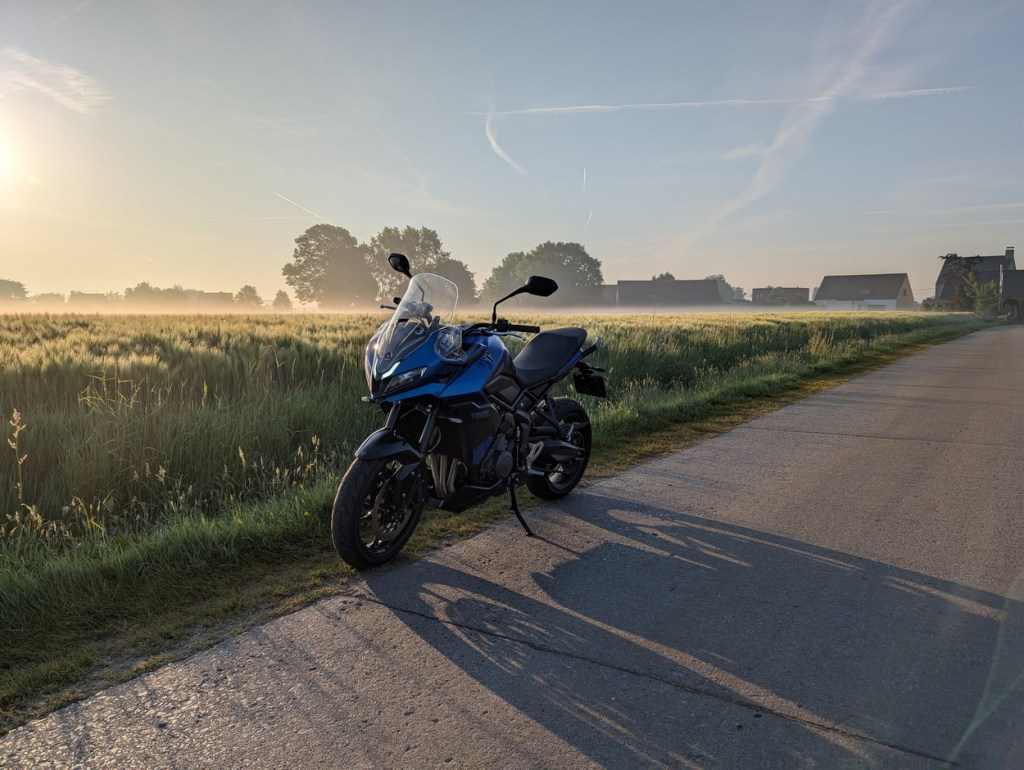
When Triumph introduced the Tiger Sport 800 last year, it felt like my wish had come true. But my first encounter wasn’t entirely positive. During my visit to EICMA, I named Triumph’s latest crossover the disappointment of the show: beautifully designed, but the seated test session was a letdown.
Curious to see if a week-long test ride could change my mind, I took the Sport to the Taunus mountain range in Germany, together with a group of riding buddies.
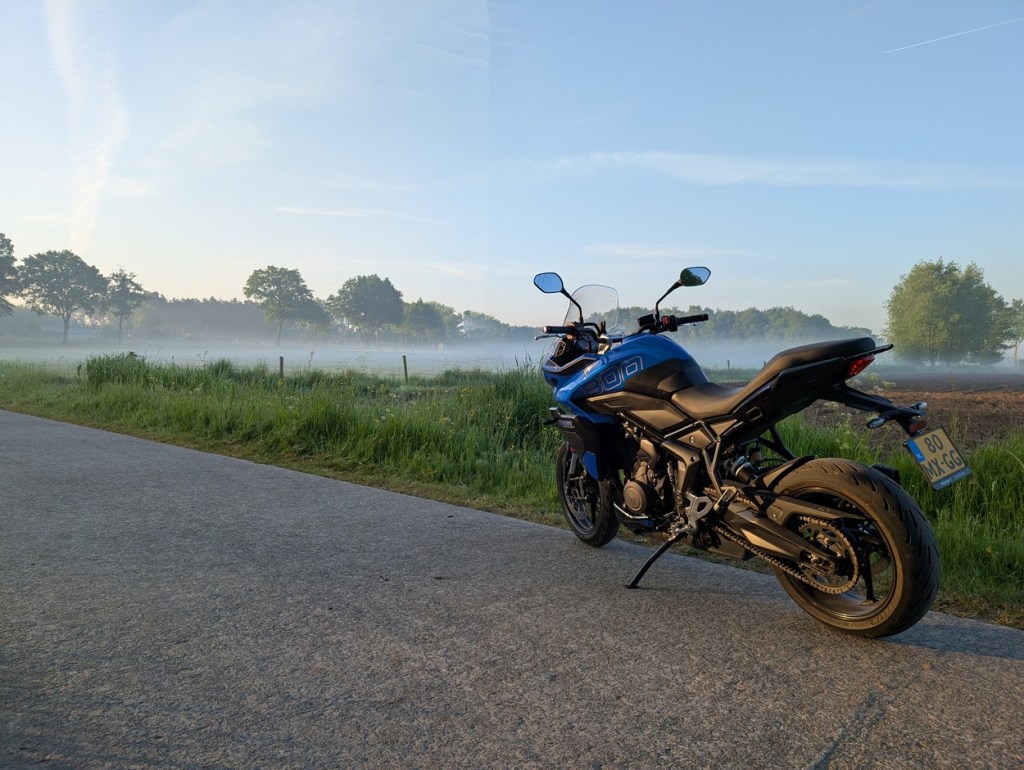
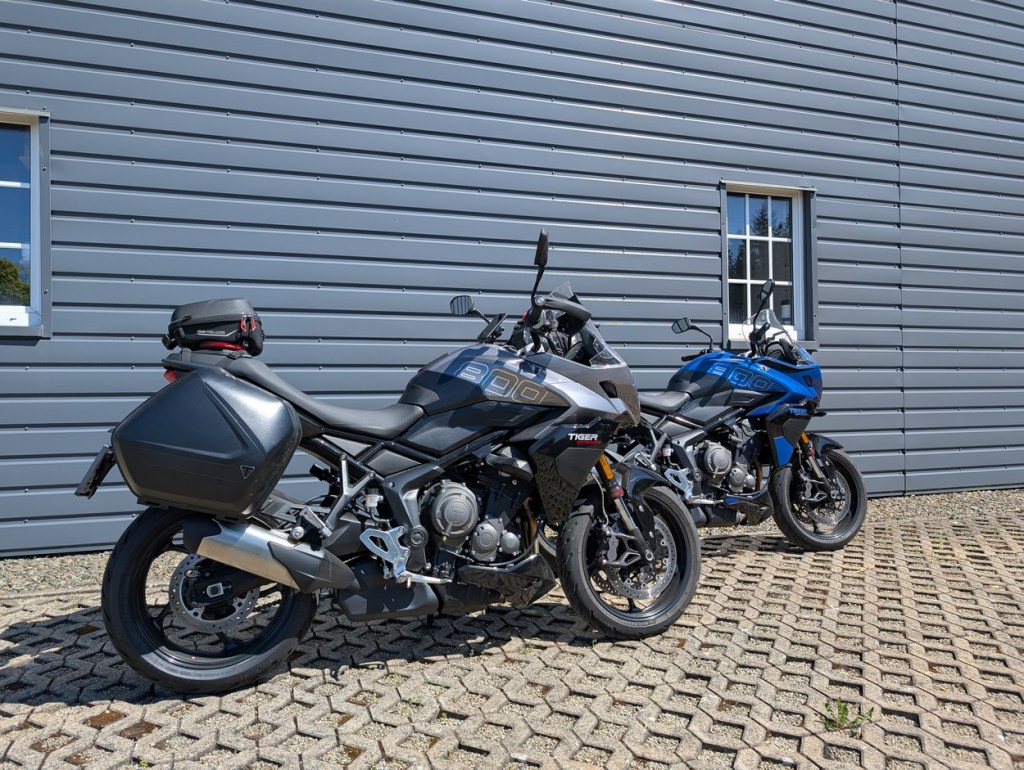
The 800 clearly inherits its styling from the Tiger Sport 660. Extra DRLs, wind deflectors and a bit more fairing at the bottom give it more presence, although it remains a very slim-looking bike. That impression is reinforced by the narrow tail section. The finish is – just as we’ve come to expect from Triumph – impeccable. Also striking: the visible exhaust. On the 660, the muffler is tucked under the bike.
The Sport 800 comes in four colors: Cosmic Yellow looks stunning but not very timeless, the grey version has the most class and the black one is the coolest in my opinion. For the test, I got the Caspian Blue version, which I personally find the least attractive. But tastes differ: someone immediately said “what a beautiful color”.
Although Triumph calls it an all-new engine, the inspiration clearly came from the Street Triple 765. The stroke of the triple was extended by a few millimeters while the bore remained the same, increasing the displacement to 798 cc. This results in 115 hp and 84 Nm of torque, most of which is available from just 3,000 rpm. Perfect for a bike that you’ll ride more in the midrange than at high revs.
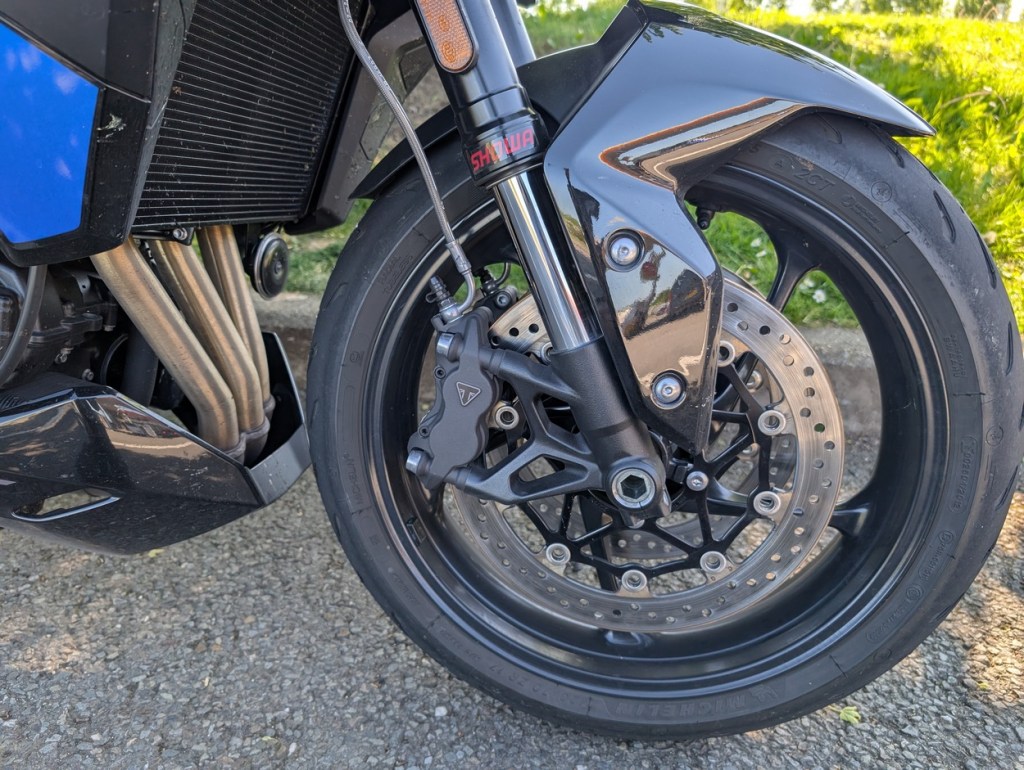
Rider aids like ABS and traction control are managed by a 6-axis IMU, and Triumph equipped the Tiger Sport 800 with cruise control for comfort. The adjustable suspension comes from Showa, and the brakes bear the Triumph logo.
In addition to the styling and the swingarm, the dashboard – unfortunately – has also been lifted from the 660 family. The small screen sits low in the cockpit and is split into a bright LCD on top and a small TFT at the bottom.
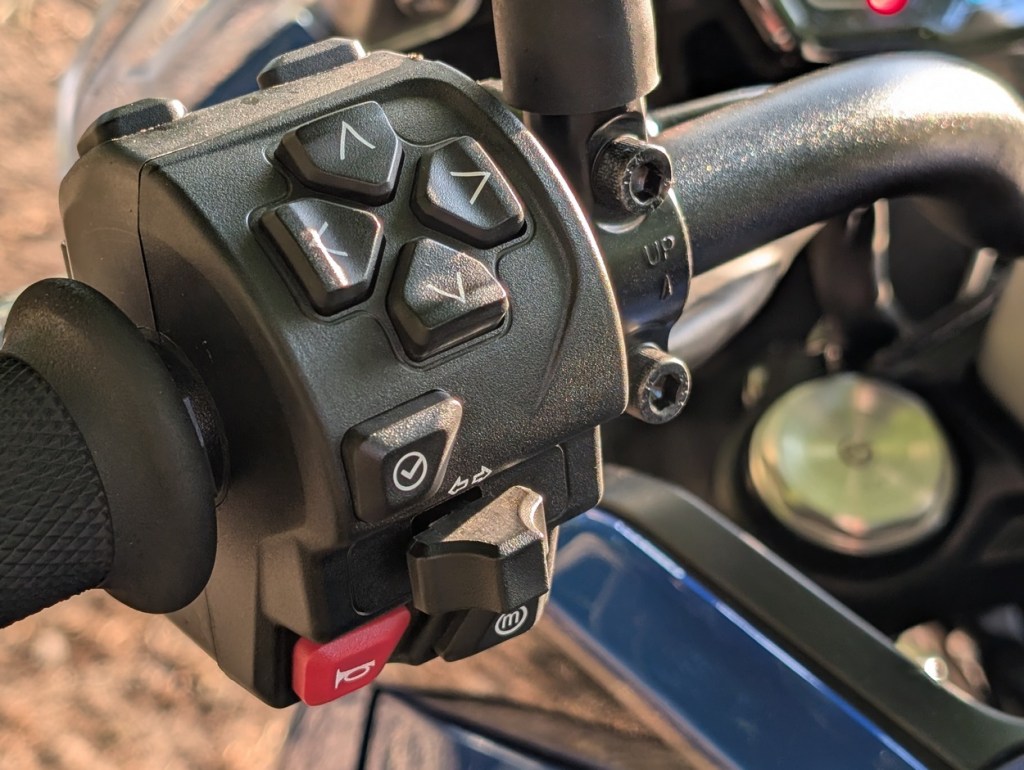
Navigating the menus is easy thanks to the five buttons on the left handlebar, and the layout is quite intuitive. However, due to the small TFT, there are a lot of subscreens, about half of them for connectivity and music. Thankfully, you can choose what appears while scrolling, so I turned off the extras immediately, which made the interface feel much tidier.
The Tiger Sport 800 has three ride modes (Rain, Road and Sport), each with clearly different power delivery. Unfortunately, switching between them requires at least four actions, and the selected mode isn’t shown anywhere on the dash. A missed opportunity.

The ride to the Taunus started with a highway stint, so out of habit I set the windscreen to its highest position. This can be done single-handedly and in several steps. However, it jumps straight to the highest or lowest setting, and once riding, the wind pressure makes adjustment nearly impossible.
That highest setting caused so much turbulence that I immediately dropped it back to the lowest. It stayed there for the rest of the week. In that position, the airflow was acceptable and fairly clean on my helmet. Despite the notable deflectors on the sides of the screen, my shoulders still caught a lot of wind, but overall wind protection was good.
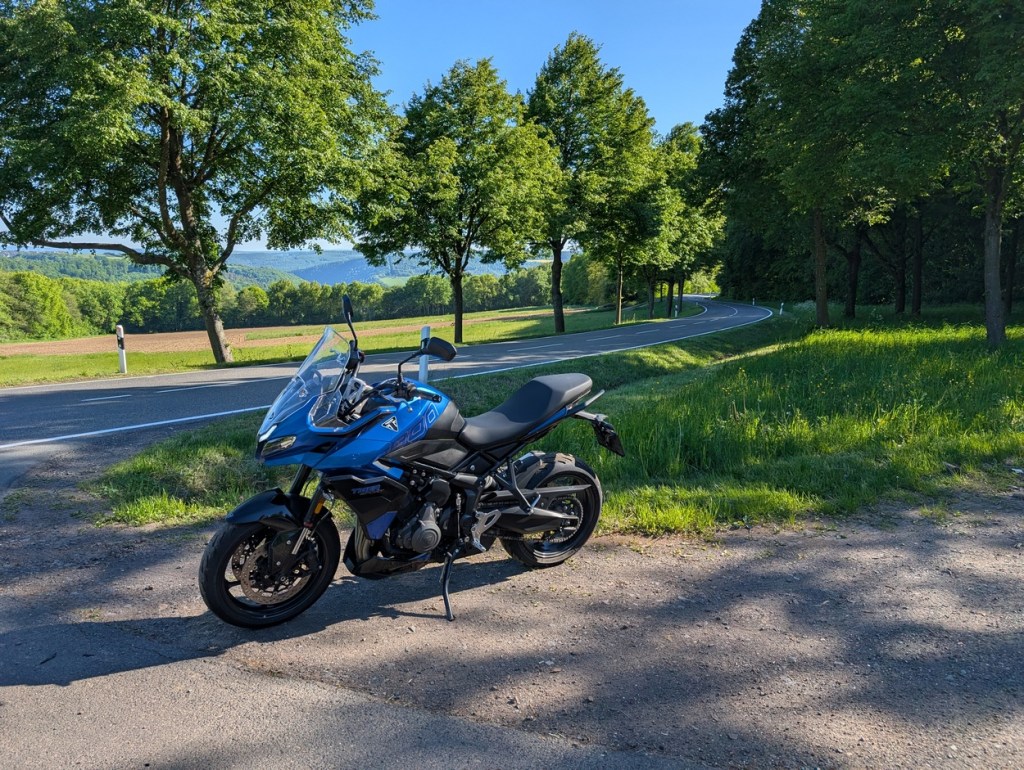
A ride on the highway is also perfect for testing the cruise control. On the Sport 800, it can be switched on or off, and that’s it. Adjusting your speed slightly or resuming a previously set speed? Not possible. The seat is surprisingly comfortable, and the triangle it forms with the handlebars and footpegs allows for active riding without sacrificing comfort.
Highway miles are fine, but it’s the twisties we came for. The mid-mountain region of the Taunus offers perfect terrain for a crossover like the Sport 800. Twisty roads connect the villages, and the asphalt is typically German: mostly perfect, sometimes terribly pockmarked.
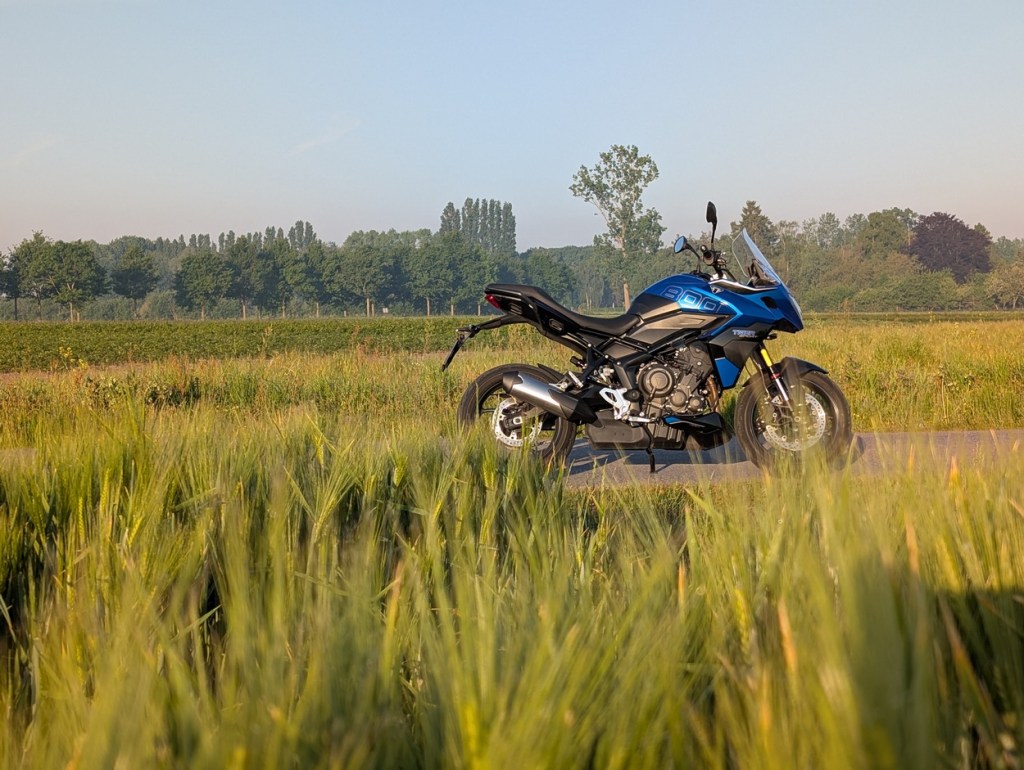
The Tiger turns in sharply in corners, but at a higher pace it has a tendency to drift toward the outside of the curve. Luckily, the Showa suspension is adjustable. You’ll need tools and have to count turns since there are no clickers. I slightly increased both compression and rebound damping at the front and dialed up rear preload using the external knob. That instantly improved cornering precision, with the front now tracking like it’s on rails, even on rough patches mid-turn.
When I wanted to tweak the rear damping, I had to go hunting for the adjuster. It wasn’t easy to find, and I had to check the manual to be sure it existed. It did: hidden high in the rear suspension, a tiny little screw glinted. The toolkit under the seat consists of exactly one useless screwdriver. Even a standard one from a buddy’s toolbox couldn’t reach the adjuster.
Fortunately, that doesn’t take away from the dynamic handling of this Sport, which lives up to its name. Thanks to the excellent frame and suspension, and most of all, the fantastic engine. Docile when needed, a beast when unleashed: it offers total control with flawless throttle response. There’s not even a millisecond of lag, and when you open the throttle in Sport mode, the Tiger pulls through the revs with ferocious eagerness.

Helping you along is a perfect quickshifter that never misses a beat, up or down. Passing maneuvers become effortless, and it’s so fun that I often found myself downshifting on purpose just to hammer the throttle and blast ahead. Addictive!
When corners came up faster than expected, the J.Juan brakes (with Triumph logo) provided ample power and great feel, without the aggressive initial bite of more well-known brands. The stock Michelin Road 5 tires (with angled valves) offer tons of grip in all weather conditions. An ideal match for this versatile bike.
During the four-day trip, I also had a chance to ride a Yamaha Tracer 9 GT, arguably the Tiger’s closest rival. Both follow the same recipe: high-legged bikes with 17″ wheels and triple-cylinder engines with similar power output.
Even though the Tracer was the previous generation (with the infamous Wall-E dash), it was immediately clear that it offers more comfort. The GT’s semi-active suspension is more forgiving on bad roads, the seat is wider and more supportive, the riding position is more relaxed and wind protection is clearly better. While the Tiger transmits high-rev vibrations mostly through the footpegs, the Tracer does so through the seat. Despite the deeper growl of Yamaha’s CP3 engine, the Tiger’s powerplant feels more eager, the brakes are stronger, and the riding position is more engaged. In impromptu drag races over the weekend, the Tiger consistently edged out the Tracer. Overall, it feels like the Tracer is the more mature version of a playful Tiger.

Conclusion
At EICMA, I was disappointed by what seemed like cheap equipment and an awkward seating position on the Triumph Tiger Sport 800. It’s now crystal clear that I’ve never been more wrong in an initial judgment of a new motorcycle.
The Tiger Sport 800 proves you don’t need Öhlins gold to shine, or Brembo brakes to stop hard. And while a big TFT is nice, I didn’t miss it here. This bike was clearly built with a set budget in mind, but Triumph picked the right parts so well that the sum is greater than its parts. The result is an incredibly well-balanced motorcycle that delivers (almost) the thrills of a Street Triple with much more comfort.
Addictive acceleration, rock-solid handling, and confidence-inspiring brakes make the Triumph Tiger Sport 800 a brilliant machine that had me grinning ear to ear, day after day. I’ll take one of these Street Triples on stilts, in black please.
Pros
+ What a spirited engine!
+ Balanced package with superb handling
+ Fun and comfort at an affordable price
Cons
– Not a “premium” Triumph, if that’s important to you
– A full TFT dash and proper cruise control wouldn’t hurt
– Wind protection in highest screen setting is lacking
Tech specs
Engine & transmission
Type: Liquid-cooling, 3 cylinders, 12 valves, inline DOHC
Capacity: 798 cc
Bore: 78.0
Stroke: 55.7
Compression: 13.2:1
Max Power: 113 HP/ 115 PS (84.6 kW) @ 10,750 rpm
Max Torque: 70 lbft @ 8,250 rpm
System: Bosch Multipoint sequential electronic fuel injection with electronic throttle control. 3 rider modes (Rain, Road, Sport)
Exhaust: Stainless steel 3 into 1 header system with sided mounted stainless steel silencer
Final Drive: X-ring chain
Clutch: Wet, multi-plate, slip
Gearbox: 6 speed
Chassis
Frame: Tubular steel perimeter frame
Swingarm: Twin-sided, fabricated steel
Front Wheel: Cast aluminum alloy, 5 spoke, 17 x 3.5 in
Rear Wheel: Cast aluminum alloy, 5 spoke, 17 x 5.5 in
Front Tire: 120/70 R 17
Rear Tire: 180/55 R 17
Front Suspension: Showa 41mm (1.61in), upside-down separate function cartridge forks, adjustable compression and rebound damping, 5.90in (150mm) wheel travel
Rear Suspension: Showa monoshock RSU with adjustable rebound damping and remote hydraulic preload adjustment, 5.90in (150mm) wheel travel
Front Brakes: Twin 310mm (12.20in) floating discs, 4-piston radial calipers, OCABS
Rear Brakes: Single Ø255mm fixed disc, single piston sliding caliper, OCABS
Instrument Display and Functions: LCD Multifunction Instruments with integrated color TFT screen
Dimensions & weights
Width Handlebars: 32.6 in (828 mm)
Height Without Mirror: 54.56in / 51.29in (high / low screen position)
Seat Height: 32.7 in (830 mm)
Wheelbase: 56.0 in (1422 mm)
Rake: 23.8 º
Trail: 3.9 in (99 mm)
Tank Capacity: 4.9 US gal (18.6 litres)
Wet Weight: 471 lb
 Team Throttle
Hey Jan, I am so glad I found your review on this bike. Torn apart between the 800 sport and a 765 RS… i understand their differences and I think it might be my last window of opportunity to have a little beast like the RS… did you end up selling yours? Would you say a 1:30 hour trip on the RS would be really tiring? Thanks!
LikeLike
Hello Alex, thanks for reacting. I did end up selling the RS, and it still breaks my heart thinking about it. The RS is the best bike I ever owned and probably one of the best I’ve ever ridden. It just didn’t fit my kind of riding which is 8+ hours a day in the saddle, or long weekend and holiday trips. My GS is much better for that. Although the 800 Sports is a well balanced bike, the RS is more premium than the 800 Sports. Engine, brakes and suspension of the RS are in a league of their own. Can’t really go wrong with either of them, however if you can afford it and don’t really need the long touring capacities of the Sports, there is not a doubt in my mind you should go for the RS. Trust me, you won’t regret it 🙂
LikeLike
Hiya guys Simon here, a big Jap bike fan!! I currently own 4 Yamahas and I have always had Hondas or Yams. My 2018 XT660X always makes me grin, I have Arrow exhausts and cat removed so perhaps 50 horses (48 standard I think). She uses very little fuel and I had the very basic suspension fitted with the wonderful Hyperpro front cartridges and rear mono and wow, she now runs dead straight at speed and corners like an R1!!!
LikeLike
And ps cheap as chips too!!!
LikeLike