Review: Yamaha FJR1300AS

FJR. What do these three letters stand for? Fast Joy Ride? Furiously Jumping Rhino? For Jackass Racers? Nope. The correct (and official) answer is Fast Journey & Ride.

Since many years the Yamaha FJR1300 has a permanent spot in the sports tourer segment. Yamaha introduced this model in 2001. Today it exists in three versions: the FJR1300A (the basic version), the FJR1300AE (with electronically adjustable suspension) and the FJR1300AS (everything from the AE plus a semi-automatic transmission). I had a date with the latter.

The AS, the most complete FJR model, costs £17,099. In return for that pile of pounds you receive a bulky package: generous fairing, electrically adjustable windscreen, two mappings, ABS, switchable traction control, height-adjustable seat, sidecases, electronically adjustable suspension, semi-automatic transmission, cruise control, heated grips, LED lights with front cornering lights, 12v socket, shaft drive. In other words, everything you need and more.

The FJR is perfect for long journeys. The sitting position on the wide seat is comfortable yet slightly bowed towards the handlebars. Yamaha sells the FJR1300 as a sports tourer and not as a pure touring machine, so that forward bend seems legit.

With the windscreen down, only your head’s in the wind. If you raise the screen, there’s minor turbulence around the helmet, depending notably on the traffic in front of you: behind a truck, your head will shudder more than when you’re flying down an empty highway. Also a minor (but subtle) Continue reading

Quick test: Yamaha Niken

A few weeks ago, Maxxmoto sent me a message. “Jean, Niken test. What do you say?” The Yamaha Niken? That three-wheeled creature that got labelled “the Multipla of motorcycles” online? What do I say? Yes, of course! Because I really doubted Yamaha would release such a controversial machine if they didn’t believe in it for 200%. On top of that, the reactions, photos and videos after the first press introduction were very promising. So off I went, together with a dozen of other curious helmet heads, for a speed date with the Niken.

Whichever way you look at it, the Niken has an odd appearance. It’s not easy to get used to those three wheels. So it makes (sort of) sense that people dislike it, based on looks alone. And if you have a motorcycle license, why would you want two front wheels!? Plenty of prejudices, so it’s time to ride!

The first few meters leaving the parking lot feel weird. There’s no doubt that you’re manipulating two front wheels that are guided by a bulky construction including two forks per wheel (which makes four in total!). It’s not just getting used to, you really have to steer that thing in the direction you want.

But as soon as the speed slightly increases, everything changes. And a new Continue reading

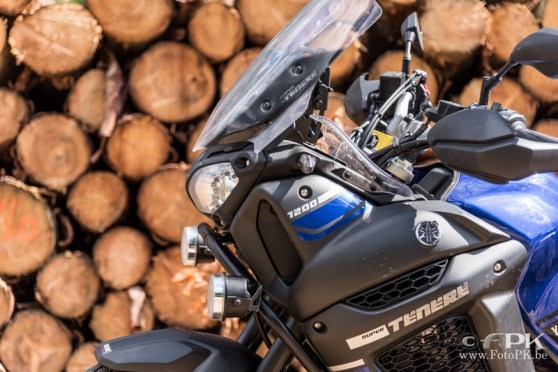
Review: Yamaha XT1200ZE Super Ténéré

Travel back in time to 1983 and there it is: the very first Ténéré. After impressive Paris-Dakar participations in the late 1970s, Yamaha decided to commercialize their rally bike as an all-round kind of touring model: the XT600Z Ténéré. 43 hp, 595 cc and one single cylinder.

Thirty-five years later and there’s no longer a monocylinder bike in Yamaha’s adventure range. In 2016 we said goodbye to the last one, the XT660Z Ténéré, and with the brand new Ténéré 700 coming soon (we hope), a new twin will be added to the range. The other twin in the Yamaha’s allroad line: the Super Ténéré.

The Super Ténéré was introduced in 2010 as a direct competitor of that other 1200 cc shaft-driven adventure bike: the 1200 GS. I took the XT1200ZE Super Ténéré to the Vosges (travel report here). 2000 km should be enough to tell something meaningful about it.

The ZE has better specs than the basic Super Ténéré: adjustable electronic suspension, centerstand, cruise control and heated grips. There’s also a substantial price difference: 13.495 euro for the XT1200Z Super Ténéré, 15.895 euro for the XT1200ZE Super Ténéré (German pricing).

Still, the basic Ténéré’s configuration isn’t very basic: adjustable seat height (845 – 870 mm), two mappings, adjustable traction control, integral brake system, shaft drive, spoked wheels and adjustable windscreen. My demo bike also got crashbars, skid plate, LED fog lights and side cases.

More punch please

The 1199 cc parallel twin delivers 112 hp at 7,250 rpm and 117 Nm at 6,000 rpm, which certainly aren’t the highest peaks in the segment. If you keep close to those peaks, the power delivery is quite alright, yet it’s hard to deny that the XT1200ZE misses some punch. This becomes even more striking with the T (of Touring) mapping. In S (of Sport) the bike reacts more snappy without being too on-off.

The exhaust too could use some more punch. Stationary and full throttle sound good, but otherwise: meh. Sometimes the Super Ténéré is so quiet that you hold your breath, just to hear if the engine is still running.

Superb suspension

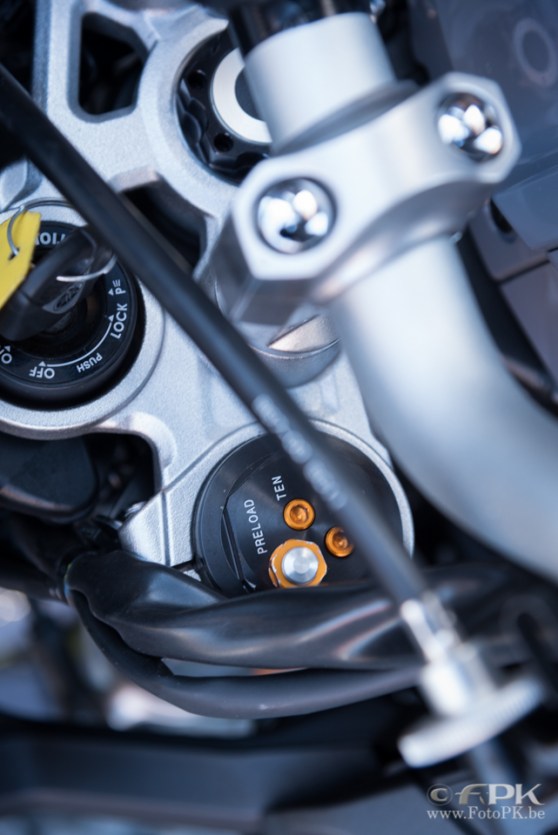
The S10 (the Super Ténéré abbreviation often used by S10 fans) counters its lack of balls with Continue reading

Review: Yamaha Tracer 900

In 2013 Yamaha released the MT-09 (then called FZ-09 in North America). A brutal naked with a widely praised three-cylinder engine, although comfort and versatility aren’t its strenghts. Which sparked an idea: in 2015 the Japanese manufacturer revealed the MT-09 Tracer (then called FJ-09 in North America): a sporty motorcycle with clear touring features and the same MT-09 engine. Since this year it’s called Tracer 900 but otherwise the bike remains unchanged.

So how do you transform a naked into a sports tourer? Yamaha did the trick with a few additions and changes. A more upright sitting position, some fairing, a bigger tank, an adjustable windscreen, wider handlebars, a higher, adjustable seat, a centerstand, a 12V socket and handguards. Only cruise control and heated grips are missing, even though the latter’s on the option list.

But before we go into detail, first let’s have an overall look. The Tracer 900 appears a lot less aggressive than the MT-09 but it does have personality. Okay, maybe a bit of a “Transformers” personality but other than that there’s hardly anything to complain about. The finishing is good, with a nice looking, powerful LED headlight.

Touring additions

Let’s go a little deeper into the touring additions. The seat is quite spacious and offers two heights (check the video to learn how to change the seat height). It’s pretty firm so your butt might start complaining after an hour’s ride. The optional comfort seat could counter those complaints.

In contrast to your butt, your legs can easily cope with longer rides: they’re not forced into a too sharp angle. The seating position is straight and relaxed, with the windshield leading most of the wind away from your torso. You can adjust that windshield in height but not while riding. Continue reading

Review: Yamaha MT-10

It’s always a matter of putting things into perspective. In my previous review I wrote the Triumph Tiger 800 XCa demanded more input to enter a corner than my own BMW F 800 GS. And then you get a Yamaha MT-10 for a week’s test after which you hop back on your GS and can’t help but notice how much effort cornering takes on your Beemer. And how terribly slow it is!

Okay, comparing a 800 GS with a MT-10 isn’t fair but there’s one BMW model that has a lot in common with the Yamaha: the BMW S 1000 R. Both are based on a 200 hp inline-four racer that lost its fairing and exchanged a fair bit of horsepower for more mid-range torque.

Still, the MT-10 isn’t just a naked R1. The frame, swingarm and suspension may be identical but on the other hand there’s a tweaked engine, a chassis that’s modified for more comfort and the aggressive headlight section, which I happen to like. Especially in Night Fluo finish the MT-10 is very expressive. The other colors (blue or black) are just plain boring.

Master of Torque

MT stands for Master of Torque and good heavens, there is no lack of torque indeed. The MT-10 is a wild beast with a very exciting power source. It accelerates like crazy: from 5000 rpm you better make sure you hold those handlebars tight. At 9000 rpm this torquey master reaches its maximum of 111 Nm.

Riding peacefully is no problem either. The 160 horses were very easy to handle during the rush hour in the centre of Brussels. Of course the Master prefers to be somewhere else, where it can dive into corners and exit them like a bat out of hell.

The frame likes that dynamic riding style. It remains stable and firm, with predictable and light steering behaviour. Correcting your riding line in a corner is easy to do. The suspension in standard setting is sporty without being stingy and is fully adjustable, front and rear.

The soundtrack is just Continue reading