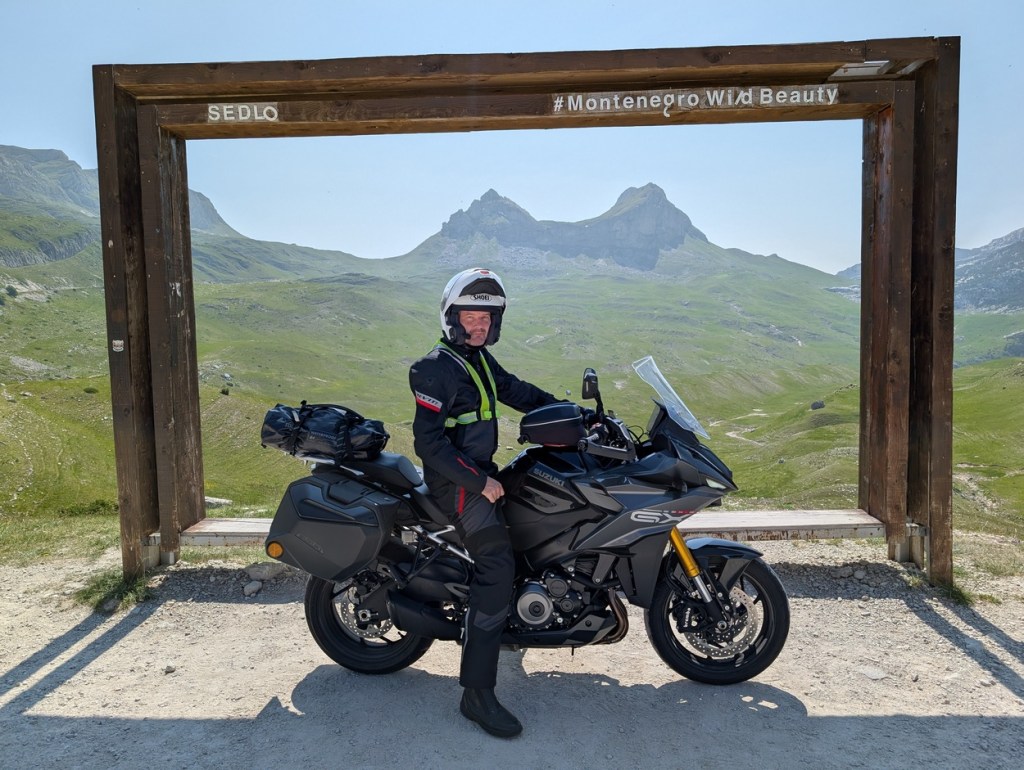
Durmitor National Park in Montenegro has fired up my imagination for years. With its jaw-dropping karst landscapes, turquoise mountain lakes and deep canyons, it’s easily one of Europe’s most breath-taking nature parks. But it’s not exactly around the corner. “Ideal for a sporty touring bike adventure,” I suggested at the editorial table. Suzuki liked the idea too and that’s how I ended up blasting my way to the Balkans on a GSX-S1000GX.
Suzuki’s GSX-S1000GX is their answer to the ever-growing crossover segment: a mix of the comfort and long-travel suspension of an adventure bike with the sharp handling of a road-focused 17-inch-wheeled naked.
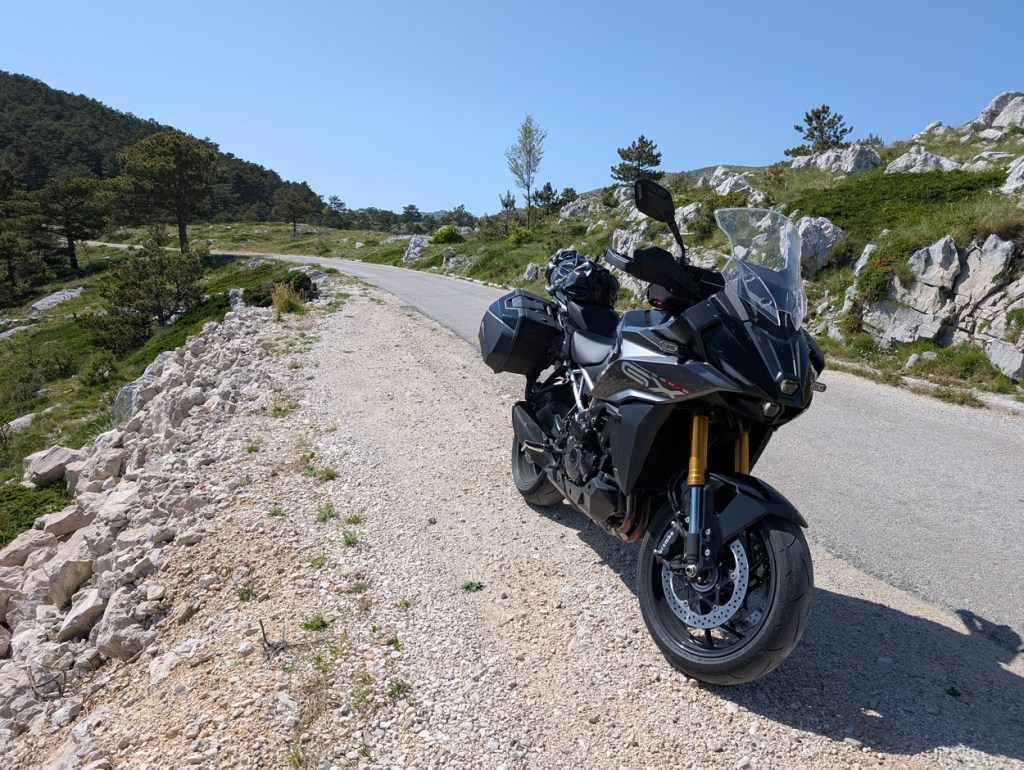
Suzuki gave the GX a sharp, angular design. It’s clearly part of the same family as the GT. With its twin stacked headlights and narrowed “side eyes”, I think it’s a seriously good-looking bike. The finish is top-notch and the cockpit feels clean and calm thanks to the absence of exposed cables or awkward gaps.
The GSX-S1000GX is Suzuki’s first motorcycle equipped with adaptive suspension. Judging by the way they showcase it in the brochure, they’re clearly proud of it. But it doesn’t stop there: the GX is packed with electronic rider aids. Suzuki bundles them under the name S.I.R.S. or Suzuki Intelligent Ride Systems. Listing them all would take too long. Best to hop on, ride, and discover them as you go.
My plans take me to the Croatian coast in two days, though I hadn’t accounted for the fact that half of Germany and Austria would be heading in the same direction at the exact same time. The result: massive traffic jams. But also: perfect conditions to discover that the GX could actually be the ideal commuter bike. I weave confidently between the rows of cars and thanks to its slim profile, the GX fits through every gap. The same can’t be said for a bulky GSA with equally bulky panniers, which was forced to wait behind in frustration when a tunnel got blocked.

At these low speeds, the GX is surprisingly pleasant to ride. The big 1000cc engine is incredibly smooth and torquey at the bottom end, and the Low RPM Assist quietly helps you roll along in any gear without stuttering or needing to touch the throttle. Handy!
Even though the four-cylinder K5 GSX engine has been around for over twenty years, it remains a benchmark for power and smoothness. In the lower revs, it responds eagerly without any aggressive punch: ideal for a touring bike like the GX. From 8,000 rpm onwards, the nuclear powerplant really wakes up: by that point, you’re already doing 160 km/h in second gear.

Reaching the 10,000+ rpm range on public roads is less straightforward. Not just because of the sheer speed and acceleration involved, but also because the GX’s chassis becomes quite nervous up there. My test bike was fitted with the optional panniers and Suzuki politely recommends not exceeding 130 km/h with them. I forgot that for a moment when I spotted an unrestricted stretch of Autobahn and let the GX off the leash: at 210 km/h, it began to wobble alarmingly. Fortunately, the ECP (Electronic Control Protection) stepped in, cut the power and quickly brought the bike back under control. Still, it gave me a bit of a scare.

Along the Croatian coast, the Adriatic Highway offers hundreds of kilometers of twisty fun on top-quality asphalt. In the first corners, I have to get used to the GX’s handling. It tips into turns effortlessly, but staying on the chosen line requires a fair bit of rider input.
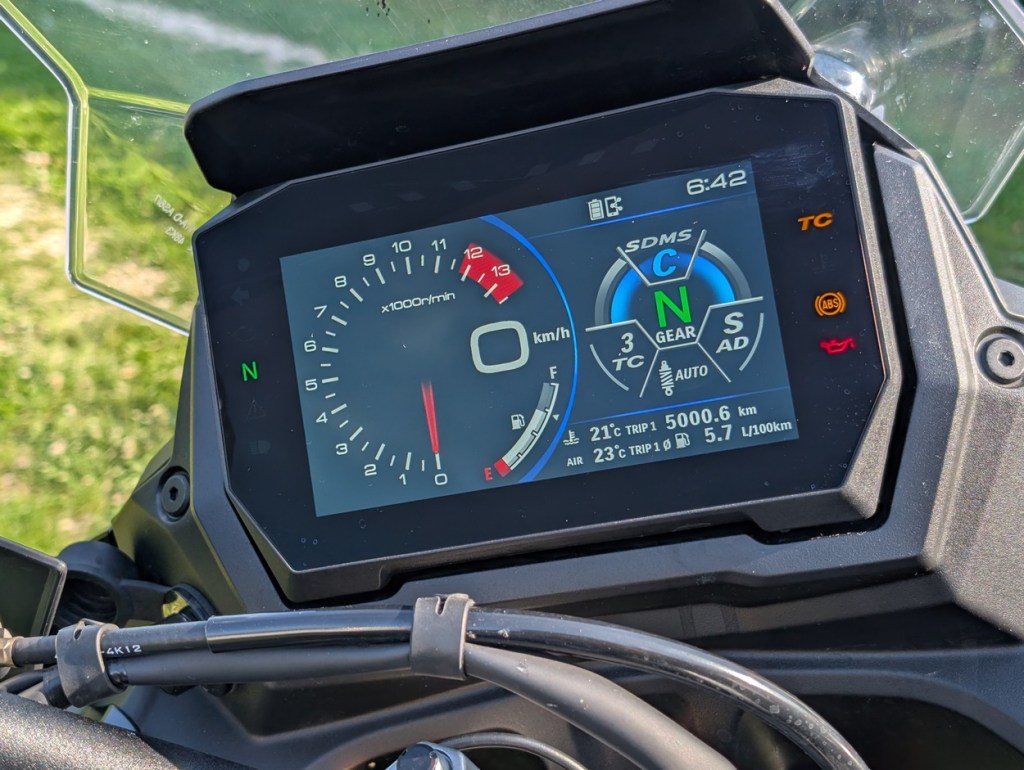
Finding the best suspension setting takes a bit of experimentation too. There are four damping modes: soft, medium, hard and user mode, each one tweakable in the menu. Preload comes with four options as well: solo, with luggage, with passenger or automatic. In that last mode, the GX adjusts its height based on the load. I eventually settle on automatic preload and – surprisingly – the soft damping setting. It turns out to be perfect for a spirited yet comfortable ride along Europe’s most beautiful coastline. The D8 is also known as the Jadranska Magistrala, and “majestic” is no exaggeration.
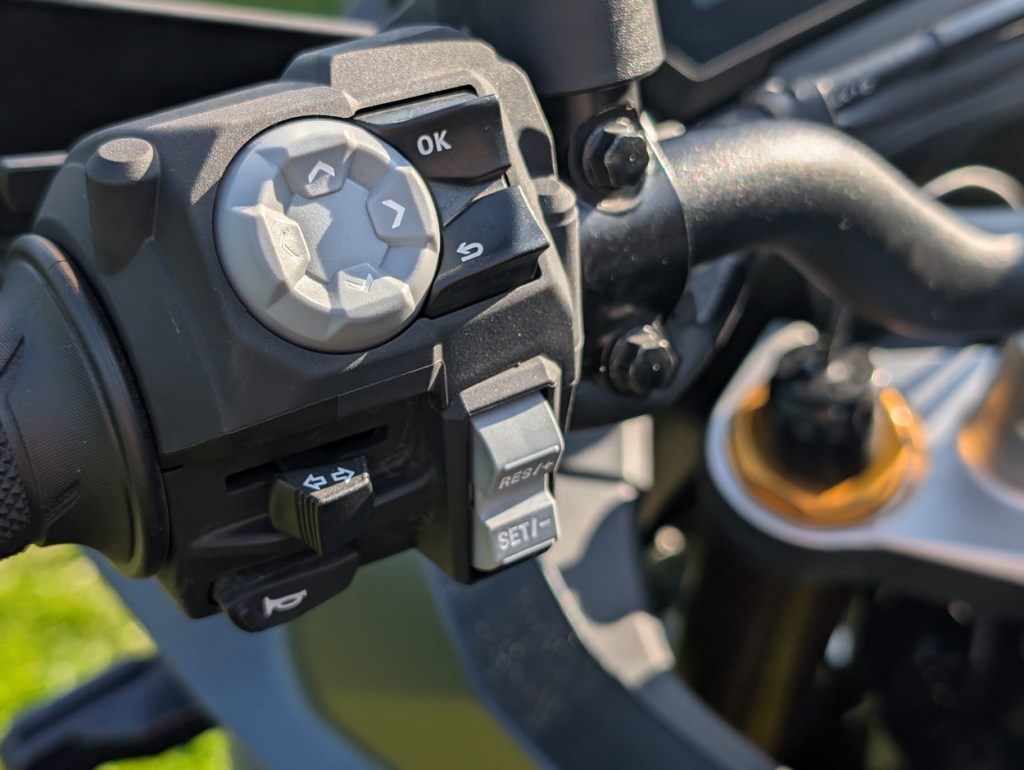
When the pace picks up, I switch the damping to hard. It’s easy enough to do, but not exactly intuitive. Even after a week of riding, I still have to glance at the display to confirm what I’m adjusting. The neutral suspension settings feel a bit neither here nor there, and I end up never using them. The same goes for the riding modes: Suzuki labels the otherwise cryptic A, B, and C as Active, Basic and Comfort. ‘Active’ offers the sharpest throttle response and control, while mode C noticeably delays throttle input and limits power.
Halfway along the D8, I turn off toward Sveti Jure, Croatia’s second-highest mountain, located in the Biokovo Nature Park. In less than 25 km, you climb from sea level to over 1,700 meters, twisting your way through stunning scenery. Needless to say, this stretch includes steep gradients and plenty of hairpins.
It’s on this spectacular, bump-riddled road that the GX wins me over once and for all. The Skyhook suspension is working overtime but never loses composure, while the torquey four-cylinder engine pulls effortlessly through the tightest of corners. Add the brilliant quickshifter which works flawlessly both up and down the gears, even with the throttle open, and I’m sold.

That seduction does come with a few caveats, and they’re not minor ones. From the very first meters on the GX, the amount of turbulence and noise around my helmet is striking. Not just on the highway, but also at lower speeds. I had the windscreen set to its highest position for the entire trip, but adjusting it requires tools and guess what, they’re not included in the underseat toolkit. Whether the noise would be reduced in a lower position, I couldn’t tell. But on a bike in this category and price range, you’d expect at least an (electronically) adjustable screen.
As for the seat: it seems super comfortable for the first hour, but over longer distances it turns out to be too soft. Pressure points start to build, resulting in a sore butt. Two comfort shortcomings that could undoubtedly be resolved with aftermarket solutions, but in standard trim, they’re a serious downer on the riding experience.
A third caveat concerns the brakes: while they’re powerful enough and never let me down, they felt spongy and a bit numb, and they required a fair amount of pressure. Rather unexpected from Brembo calipers of this caliber.
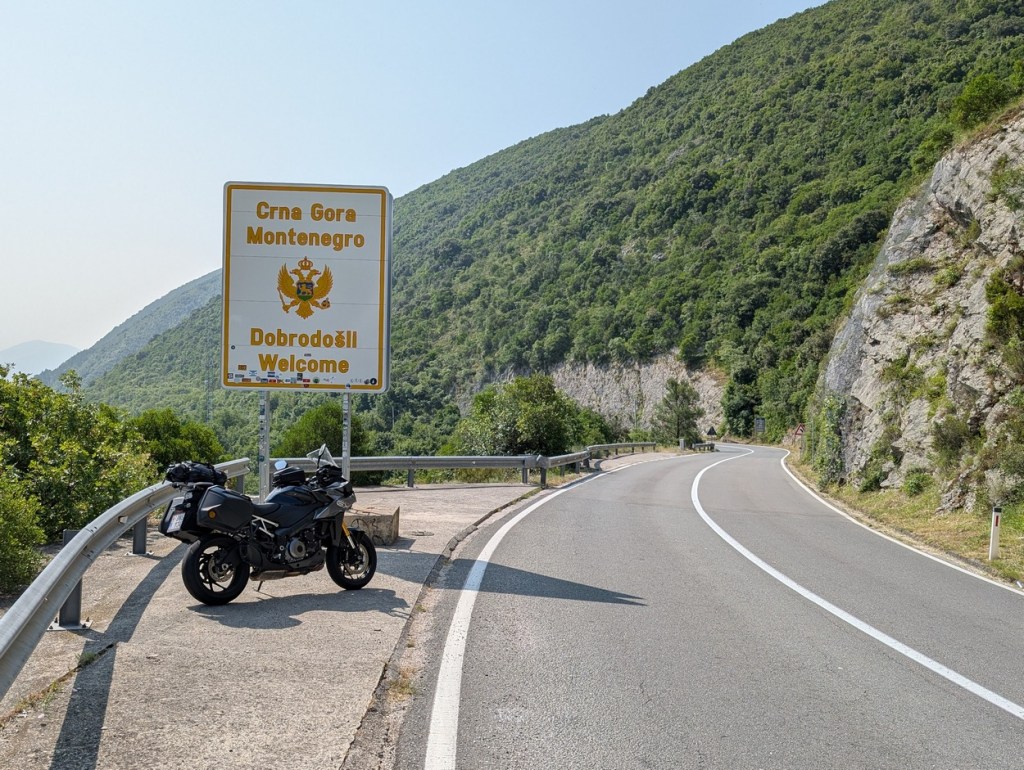
After the stunning yet scorching Croatian coastal stretch and a quick visit to Dubrovnik, it’s time to head inland. Crossing the border into Montenegro went relatively smoothly, after which the absolutely bonkers R1 from Kotor to Cetinje follows: a narrow road with 16 hairpin bends packed with massive tourist buses. Then it’s on to the slick-as-glass roundabouts near Podgorica. Thirty-eight degrees Celsius and polished asphalt are a terrible combo and after I feel the rear wheel sliding twice, I switch the mapping to mode C for the first and only time on this trip.
Before long, I leave the chaos of Montenegro’s capital behind, on to a half day of flowing, fast, twisty roads along deep gorges and through dark tunnels. It’s in tunnel number 9 – they’re all numbered – that I discover the GX’s high beam isn’t so “high” after all. Surprised by a bend in the pitch-black tunnel, I barely manage to avoid the tunnel wall, and that with the high beam on.
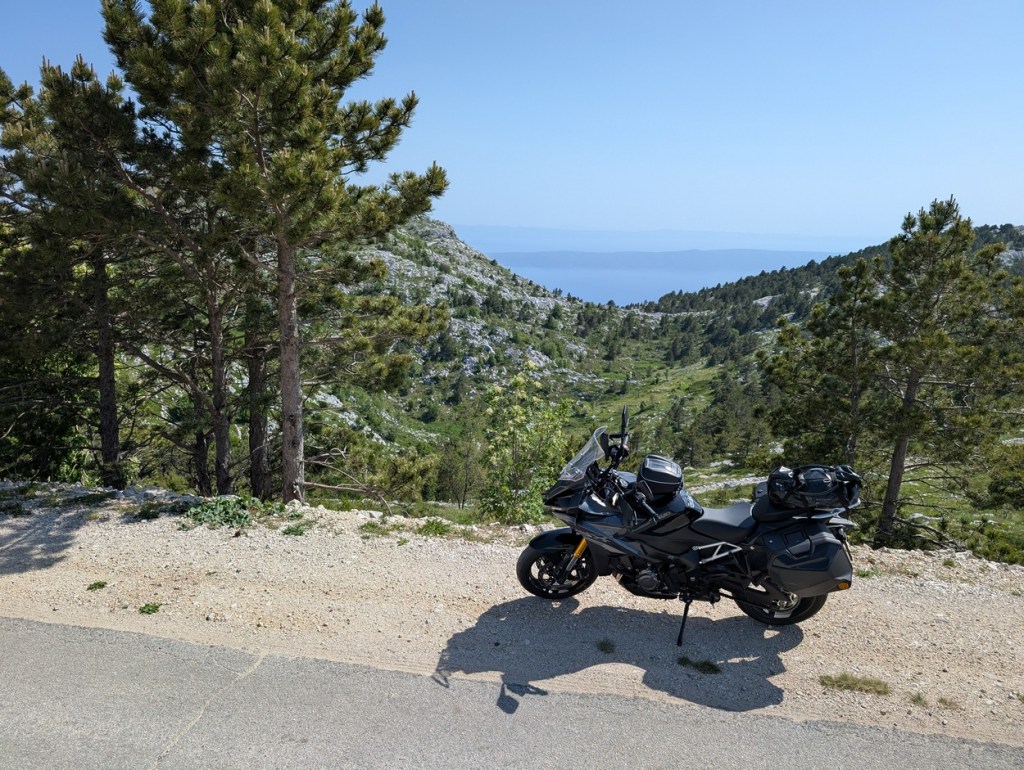
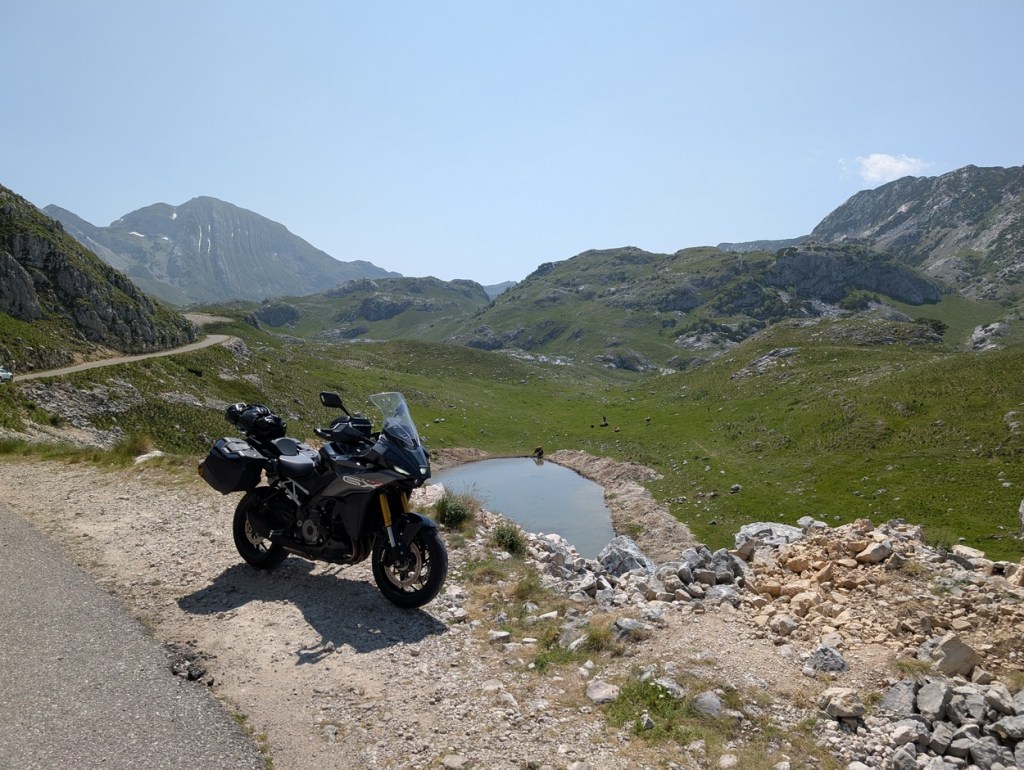
Then day 6 finally arrives: the ultimate destination of this Balkan trip reveals itself and it absolutely does not disappoint. Durmitor National Park is a true gem. Although not very large, this part of the Dinaric Alps is unique and the roads winding through it are a motorcyclist’s paradise. It’s pure bliss from the saddle of the GX.
After crossing the border into Bosnia and Herzegovina, visiting the world-famous bridge in Mostar and making a mandatory stop at the abandoned Željava airbase, the journey ends at the beautiful Plitvice waterfalls in Croatia.
Just like on the way out, I planned to ride home over two days. That plan falls apart when I roll into my planned stop at 4 PM. After 800 km, I’m still feeling pretty fresh, there’s hardly any traffic and the Suzuki shows its best side in the German left lanes. So I decide to keep going. At speeds that are highly illegal back home in Belgium, the kilometers melt away beneath me. Just before midnight, I’m home, having covered 1,496 km in less than 14 hours. A personal best and the ultimate proof of the GX’s touring chops.
Conclusion
In its bid to carve out a slice of the crossover market, Suzuki has delivered a hell of a bike with the GSX-S1000GX. The engine, electronic suspension and quickshifter steal the show, but there are also small, less obvious details that make life aboard the GX a whole lot more enjoyable. The anti-spill fuel filler is the best I’ve ever seen while the cords on the pannier lids cleverly retract so they don’t get pinched between the lid and the frame. Even the one-push start button quickly grows on you. When I picked up my own bike, I initially pressed it too briefly, so it wouldn’t wake up.
Still, there’s work to be done before the GX truly sits at the top of its segment. The menu controls, operated through a somewhat odd cluster of buttons, aren’t the most intuitive, and the brakes could definitely be better. But the real sacrilege on a bike like this is the poor wind protection from the screen. You’ll notice it from the very first meters, even on a short dealer test ride. Replace that screen with an adjustable one that eliminates turbulence and you might just have the most genuine crossover of them all. Nimble handling combined with the comfort of a tall bike? You can safely leave that to the Suzuki GSX-S1000GX.
Pros
+ The smoothness of this powerful GSX engine is unmatched
+ The electronic Showa suspension really works
+ Best quickshifter ever? Could very well be the case
+ Great design and high-quality finish
Cons
– The wind protection from the screen is downright poor
– The seat is too soft for longer rides
– The high beam’s light output isn’t very impressive

Tech specs
Engine
Engine: 999cc, 4-stroke, liquid-cooled, 4-cylinder, DOHC
Bore x Stroke: 73.4 mm x 59.0 mm (2.890 in. x 2.323 in.)
Compression Ratio: 12.2:1
Fuel System: Fuel injection with Ride-by-Wire electronic throttle bodies
Starter: Electric
Lubrication: Wet sump
Drive train
Clutch: Wet, multi-plate SCAS type
Transmission: 6-speed constant mesh
Final Drive: Chain, RK525GSH, 525 x 116 links
Chassis
Suspension Front: Inverted telescopic, coil spring, oil damped with remote, electronically controlled tuning
Suspension Rear: Link type, single shock, coil spring, oil damped with remote, electronically controlled tuning
Brakes Front: Brembo, radially mounted 4-piston calipers, dual 310mm disc, ABS-equipped
Brakes Rear: Nissin, 1-piston, single disc, ABS-equipped
Tires Front: 120/70ZR17M/C (58W), tubeless
Tires Rear1: 90/50ZR17M/C (73W), tubeless
Fuel Tank Capacity: 19.0 L (5.0 US gal.)
Electrical
Ignition: Electronic ignition (transistorized)
Spark Plug: NGK CR9EIA-9 or DENSO IU27D Iridium-style
Headlight: Dual Mono-focus LED
Turn Signals: LED
Tail Light: LED
Dimensions
Overall Length: 2,150 mm (84.6 in.)
Overall Width: 925 mm (36.4 in.) Dimension excludes mounted side cases
Overall Height: 1,350 mm (53.1 in.)
Wheelbase: 1470 mm (57.9 in.)
Ground Clearance: 155 mm (6.1 in)
Seat Height: 845 mm (33.3 in.)
Curb Weight: 232 kg (511 lb.) Dimension excludes mounted side cases
 Team Throttle