It’s already been five years since I attended the Belgian launch of the Yamaha Ténéré 700. In a short time, the T7 established itself as the reference within the mid-range adventure segment. The most common criticisms of the standard model were its somewhat limited range and the suspension, which was considered too soft for more serious off-road work. Yamaha addressed this by introducing four additional Ténéré models, offering something for everyone.
The Ténéré 700 Extreme has longer suspension travel and lightweight components, while the Ténéré 700 Explore offers shorter suspension travel and more comfort than the standard model. The World Raid is a T7 with a 23-liter tank and better suspension, and the latest addition to the line-up is the World Rally: a World Raid with a nice retro color scheme and goodies like an Akrapovic exhaust.

Electronics
When it comes to the equipment of the T7 models, we can be brief. The World Raid was the first one to feature a TFT color display and Bluetooth connectivity, in addition to the dual tank and a suspension upgrade.

The still vertical display feels much more modern than the LCD screen of the first T7 generation. It’s well-designed and easy to read. You navigate the menu using a small, overly sensitive scroll wheel on the right side, which also serves as a push button. The difference between scrolling, short presses, and long presses is frustratingly vague.

In addition to some basic settings, the menu allows you to choose between three different themes (Explorer, Street and Raid) and configure the ABS (fully engaged / front on, rear off / fully off). The handy, separate ABS ON button now only lets you turn the ABS back on. Why this button doesn’t control all ABS functions is beyond me. There isn’t much more technology to be found on this T7, except for the USB port.
Engine
The World Raid is powered by the much-praised CP2 engine, which Jean lauded multiple times. After testing the standard T7, Jean bought a Ténéré 700 Rally Edition, a version no longer available in the Benelux.
I didn’t share his enthusiasm for the 689 cc crossplane parallel-twin engine. In the R7, I found the spartan seating position too distracting, and Yamaha hasn’t equipped the Tracer 7 with the suspension and braking components it deserves. I was curious to see if the World Raid could change my opinion during a four-day trip in the Vosges.

On the way there, I kept wondering (out loud!) why I didn’t just put the bike on a trailer instead of riding for five hours on the highway. That was no fun at all. The turbulence pounded my head, and because of the stiff throttle and lack of cruise control, my right hand went numb after half an hour. I just gritted my teeth and looked forward to seeing the hotel.
The following days featured 350 km rides filled with twisties, from the famous Ballons to smaller, lesser-known mountain passes across the Vosges. Although the thermometer showed 34 degrees at midday, the forested surroundings remained humid, with damp patches on the road. When, like on the T7, there is no electronic safety net, so throttle and clutch control become very important in those circumstances. In other words, the fundamentals of motorcycling.
And oh boy, this is so much fun on the World Raid! In every corner, I consciously twisted the throttle, and with every millimeter, I felt the surprisingly well-performing Pirelli Scorpion Rally STR tires gripping more and more, letting me accelerate out of the bend with full confidence. It’s addictive, and it remains a cliché: the old-fashioned throttle cables and the slightly heavier throttle connect the wrist directly to the rear wheel. At least, that’s how it feels.

Now, I too fell head over heels for the charms of the CP2 engine: rich, creamy, always with plenty of torque, and enough power to sprint from corner to corner far too quickly. The fact that the gearbox isn’t the lightest only adds to its character. Upshifting is smooth and clear, while downshifting is a bit vague (though it never misses a shift), and in second gear, the response can be a bit on-off, but you quickly get used to it.
Suspension
As I turned onto le Mont de Vannes, the asphalt became a bumpy, narrow ribbon. This was where the real fun began. Fireworks were lit, and confetti cannons filled the air, as the true star of this World Raid revealed itself: the suspension. Yamaha has equipped the Ténéré 700 World Raid with 43 mm KYB forks, offering 230 mm of travel (20 mm more than the standard T7), with the dark bronze Kashima coating ensuring smooth operation. The rear shock, with a separate gas reservoir, also has 20 mm more travel.

The whole setup works phenomenally. The road surface never fazed the T7, and it danced confidently over bumps. The overall stability of the bike is downright impressive. I have no doubt: the World Raid has the best stock suspension I’ve ever tested on an adventure bike.
Fuel tank
I’m usually not interested in a bike’s fuel consumption, but with a reported fuel consumption of 4.3 L/100 km and a 23-liter tank, the World Raid should have a range of over 500 km. Impressive numbers that I was eager to test for myself.

When the fuel gauge reached its last bar, I decided to refuel. Better to fill up in time, as the Vosges aren’t packed with gas stations. To my surprise, I could only fit 16 liters in the tank.
The next day, I rode until a flashing bar indicated I was running on reserve. With 402 km on the trip meter, I should still be able to ride about 100 km more. Said and done, but after 60 km, I got nervous and searched for a gas station. And sure enough: I could fit 19 liters in. So, that 500 km range is definitely achievable, though you’d need the guts to ride over 100 km on reserve. It’s a shame the fuel gauge isn’t more accurate.
Besides the great range, the tanks also contribute to the bike’s stability. They’re lower at the top than on the standard T7 and extend down low on the sides. This results in a lower center of gravity, despite the increased weight. You hardly notice you’re riding such a hefty machine. It still feels relatively narrow, and the wide tank provides plenty of support for your knees when braking.

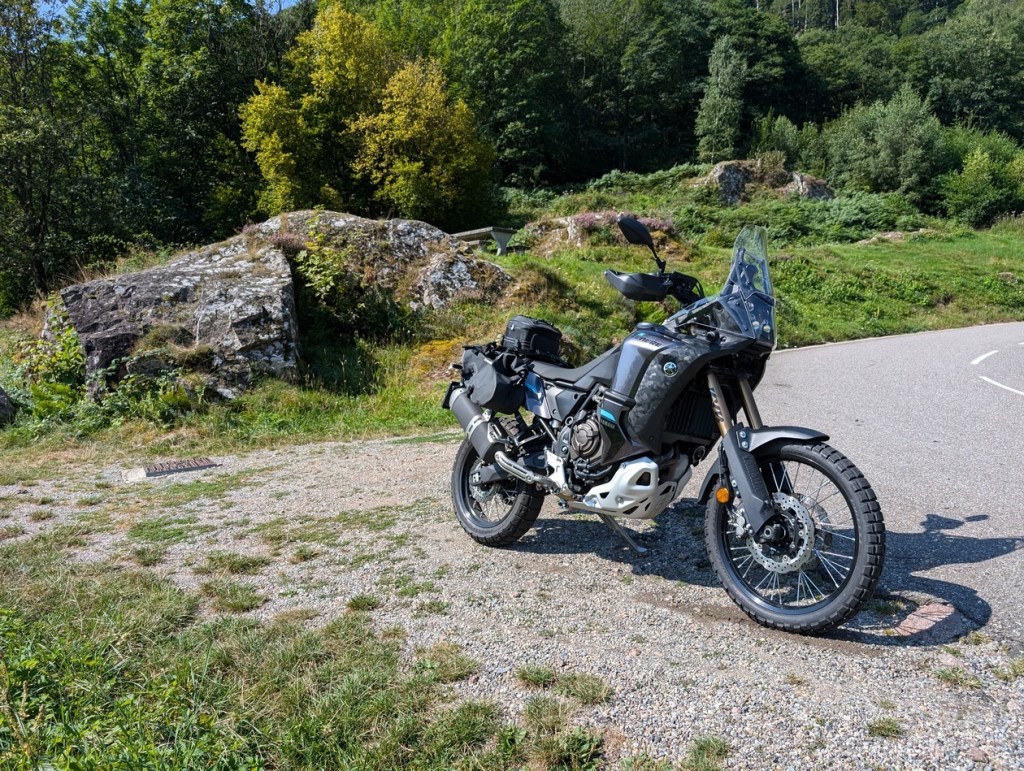
The dual tank is undoubtedly the eyecatcher of the World Raid. I was often asked about it, and I think it looks fantastic. The same goes for the whole World Raid: adventure bikes don’t get better-looking than this. The gray Mistral Grey of the test bike gives it a sleeker look, while this Ténéré looks even more imposing in Icon Blue.
The built quality is top-notch, as we’ve come to expect from the brand with the three tuning forks. The components feel rock-solid, and nothing is loose or rattling. Yamaha’s quality control might even go a little too far: the entire bike is covered in so many marker lines that it’s almost distracting.

Offroad
Although offroading wasn’t the purpose of the test and our offroad trip to the Italian Alps was several years ago, I couldn’t resist taking on some gravel roads. From the first few meters, it was immediately noticeable how natural it feels to stand upright on the World Raid. Everything is where you expect it to be, from the handlebars to the high-mounted rear brake.
Here too, the suspension controls every bump smoothly, and only the jerky throttle response in second gear occasionally spoils the fun. No worries, in third gear it effortlessly pulls through the corners as well.

Conclusion
Atop a deserted mountain pass in the Vosges, I sit next to the Yamaha Ténéré 700 World Raid. Surrounded by the sounds of nature, I drift off into dreams of riding towards the setting sun, embarking on endless adventures… Yes, this T7 evokes a lot of emotions.
However, it’s not all moonlight and roses. The turbulence at higher speeds is deafening. The operation of the scroll wheel is already vague, and with gloves on, it becomes nearly impossible. Forget about cruise control on a Ténéré. But I’m more than willing to overlook these shortcomings because the combination of the engine, chassis and suspension in the World Raid is simply fan-tas-tic.
For five years now, Yamaha has been riding the wave of T7 success. This success has certainly not gone unnoticed by the competition. Old rivals like the Transalp have been dusted off, while newcomers are openly challenging the Ténéré. Take the Kove 800X for instance, with a sharper price, less weight, more power and electronic support. I’m curious to see how Yamaha will respond to this.
Pros
+ That suspension!
+ Those looks!
+ That engine!
Cons
– Turbulence at higher speeds
– No cruise control
– Menu navigation is tricky
Tech specs
Engine
Engine type: 4-valves, 4-stroke, Liquid-cooled, DOHC
Displacement: 689cc
Bore x stroke: 80.0mm x 68.6mm
Compression ratio: 11.5:1
Maximum power: 54 kW @ 9,000 rpm
Maximum torque: 68 Nm @ 6,500 rpm
Lubrication system: Wet sump
Clutch type: Wet, Multiple Disc
Ignition system: TCI
Starter system: Electric
Transmission system: Constant Mesh, 6-speed
Final transmission: Chain
Fuel consumption: 4.3 l/100 km
CO2 emission: 100 g / km
Fuel system: Electronic Fuel Injection
Chassis
Frame: Double cradle, Steel tube backbone
Caster angle: 27º
Trail: 105 mm
Front suspension system: Up side down telescopic fork
Rear suspension system: link suspension, Swingarm
Front travel: 230 mm
Rear travel: 220 mm
Front brake: Hydraulic dual disc, Ø 282 mm
Rear brake: Hydraulic single disc, Ø 245mm
Front tyre: 90/90 – 21 M/C 54V
Rear tyre: 150/70 R 18 M/C 70V
DimensionsOverall length: 2,370 mm
Overall width: 905 mm
Overall height: 1,490 mm
Seat height: 890 mm
Wheel base: 1,595 mm
Minimum ground clearance: 255 mm
Wet weight (including full oil and fuel tank): 220 kg
Fuel tank capacity: 23.0 litres
Oil tank capacity: 3.0 litres
 Team Throttle