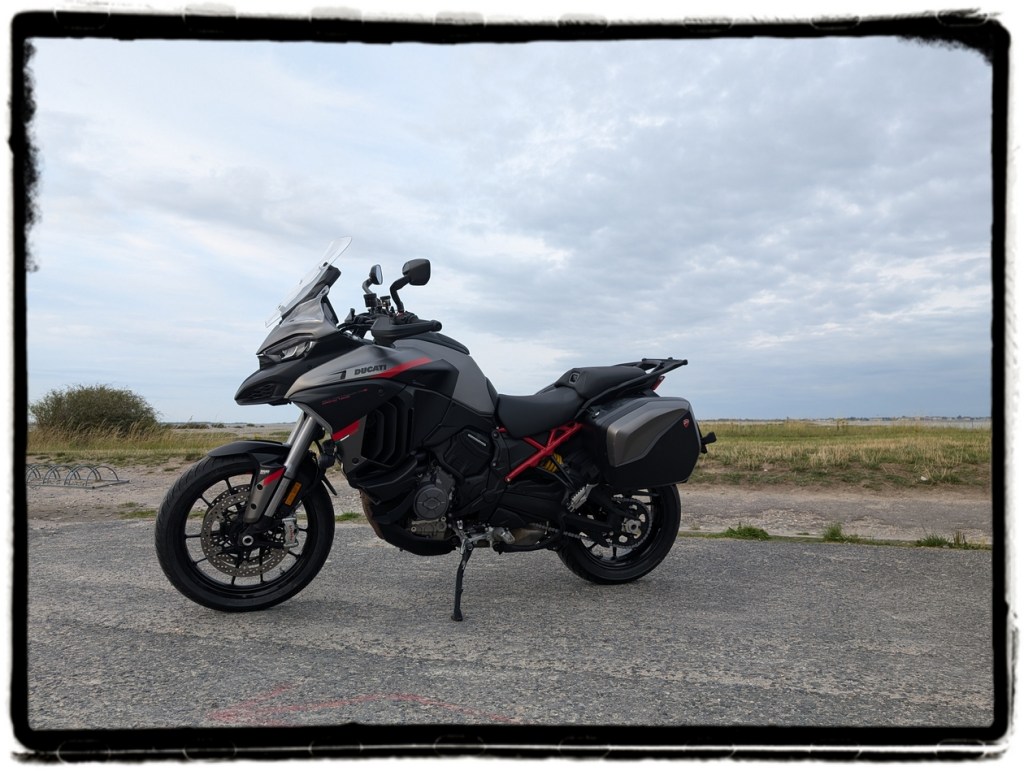
Those folks at Ducati are something else. If you were considering a Multistrada not too long ago, you would have had to choose between six models (V2, V2 S, V4, V4 S, V4 S Rally, and V4 S Pikes Peak). But hey, the more, the merrier, right? So, Ducati added two extra models in 2023: the V4 S Grand Tour and the V4 S RS.
Let me help you identify the different family members. The V2 is the twin-cylinder, with the V2 S as its more luxuriously equipped counterpart. On the other hand, the V4 is the standard four-cylinder. Wheelie control, cornering ABS and traction control come standard on the “regular” V4, while the V4 S offers more options, including electronic suspension, a larger display with smartphone connectivity, a quickshifter and cruise control. The V4 S Rally is geared towards off-road enthusiasts, the Grand Tour for the travel-hungry, the Pikes Peak for the sporty riders, and the RS for the even sportier ones.
I had the chance to test whether the Ducati Multistrada V4 S Grand Tour truly lives up to its promise as a touring bike and took it for a weekend ride all the way to Normandy.
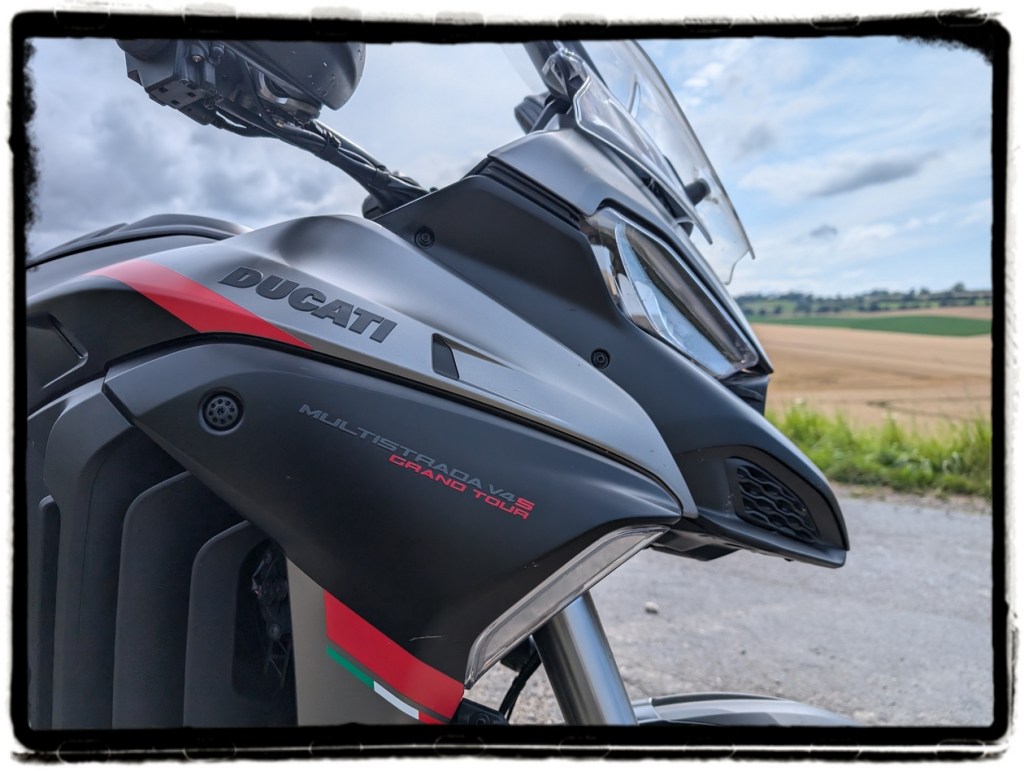
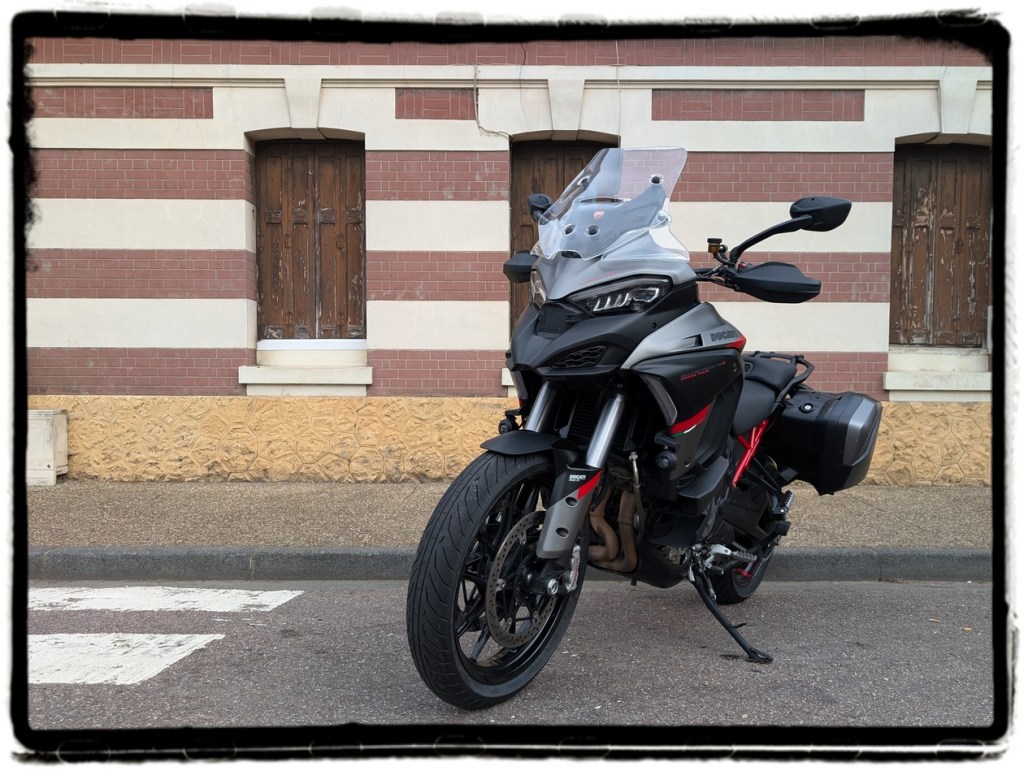
The Grand Tour comes with a bundle of options on top of the V4 S equipment: side panniers, heated seats for both rider and pillion, heated grips, fog lights, adaptive cruise control (instead of non-adaptive), blind-spot warning, tire pressure monitoring and a center stand. These options can also be ordered on other Multistradas too, but on the Grand Tour, they come in a more advantageous package deal. The matte gray color scheme however is completely unique to the Grand Tour and is the only color you can get it in. Price tag: $28,395. Are you shocked now? Start configuring a new GS …
Those remembering the Multistrada 1260 will notice that the latest Multistrada generation said goodbye to the trellis frame (do I hear some cursing?) and the single-sided swingarm (ok, I need to cover my ears now). Fortunately, this Italian adventure bike has gained a more compact and accessible look (decibels dropping again).

Regardless, the design of the V4 is certainly impressive. It’s undoubtedly one of the most striking adventure bikes on the market, although I find the matte gray color choice a bit … gray. Lately, we’ve seen examples of radars and sensors messing up the design. In the case of the Multistrada, the front radar for cruise control integrated into the nose is relatively unobtrusive, and the blind-spot sensor above the taillight is exactly how it should be for every brand: conspicuously inconspicuous.

When I set off on the Multistrada for the first time, the exceptionally comfortable riding position immediately stood out. It felt familiar right away. What particularly struck me was how the handlebars feel in hand. It’s rare that I consciously think, “Hey, this feels great!” A day of racking up miles towards France was far from a chore. A small note about the windscreen: it’s easily adjustable manually, but with my 5’11”, I found that even in its highest position, it didn’t fully eliminate turbulence. Not a big deal on back roads, but on the highway, an extra few inches would significantly increase comfort.
On the highway, I engaged the cruise control, and on the Grand Tour, it’s adaptive. This feature automatically keeps you at a safe distance from the vehicle ahead. No other test bike’s adaptive cruise control has ever convinced me (for example, check out my review of the BMW R 1300 GS), but Ducati takes it a step further: you can’t disable the adaptive element to switch to “normal” cruise control. Other brands allow this. Very annoying, Ducati!
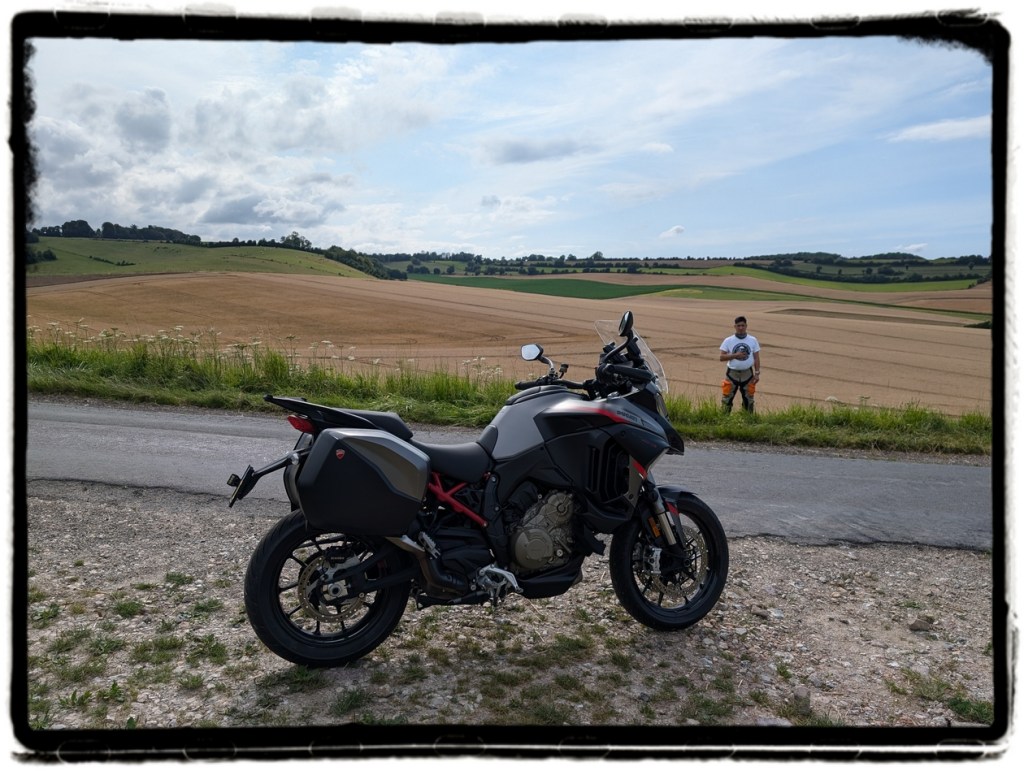
But who buys a motorcycle with the thought, “Man, I can’t wait to use my cruise control”? Cruise control off, time to hit the smaller roads, and finally give that V4 engine some real action. Because what a beast of an engine it is! 170 hp and 121 Nm are already impressive on paper, but it’s the experience of all that power that makes it so much more remarkable.
A great example of the V4’s fieriness: I hadn’t been on the Multi for long before the front wheel briefly lifted off the ground. That shouldn’t be really surprising when you have the riding mode set to Sport and enthusiastically twist the throttle.

During those rapid accelerations, you feel how smoothly and fiercely the Multistrada climbs through the revs. The power delivery is so linear that the large tachometer on the TFT display comes in handy to check if you’re nearing the redline. For this beast, the red zone is synonymous with the “beware-of-your-license zone.”
Aside from the large tachometer, the display is generously filled with information, yet it remains easy to read. Ducati has equipped the bike with plenty of buttons to control the display and other settings. Initially, it took some time to figure out which button does what and where to find certain settings in the menu. The system lacks a bit of intuitiveness, but after a few days, I could navigate it effortlessly.
The only thing I really struggled with was the smartphone connectivity, specifically the GPS. To use it, you need to install two (two!) apps: the Ducati Link app for connecting your smartphone to the dashboard, and the Sygic app for navigation. It took me quite a bit of patience and trial and error to figure out the ritual for getting the navigation up and running. The fact that Ducati only provides a tutorial in Italian on their website is just baffling.

When it comes to navigation, user-friendliness is hard to find, and it makes you wonder why it doesn’t work with a more common navigation app (just to name a few: Google Maps! Waze!), or even better, proper smartphone mirroring like Android Auto or Apple CarPlay. According to Ducati, this is because only Sygic is compatible with the display (which is made by Bosch). I can’t help but wonder how they manage this at Audi.
Ducati did however include one clever feature: navigating with your smartphone drains the battery in no time, so this Multistrada has a storage compartment on top of the tank. Not only does it have a USB charging port, but it also includes a small fan. This smart little addition prevents an overheated smartphone (and an “over and out navigation”). It proved necessary, too, because after a few hours of navigating and charging simultaneously, my phone felt warm and not hot or overheated, thanks to that little fan.

But enough talk about the navigation, let’s get back to riding. If you want to avoid unexpected wheelies, it’s best to steer clear of Sport mode and opt for Touring instead. In this mode, the wheelie control intervenes earlier and the throttle response is smoother. Don’t roll your eyes just yet, the Multistrada V4 still takes off very swiftly.
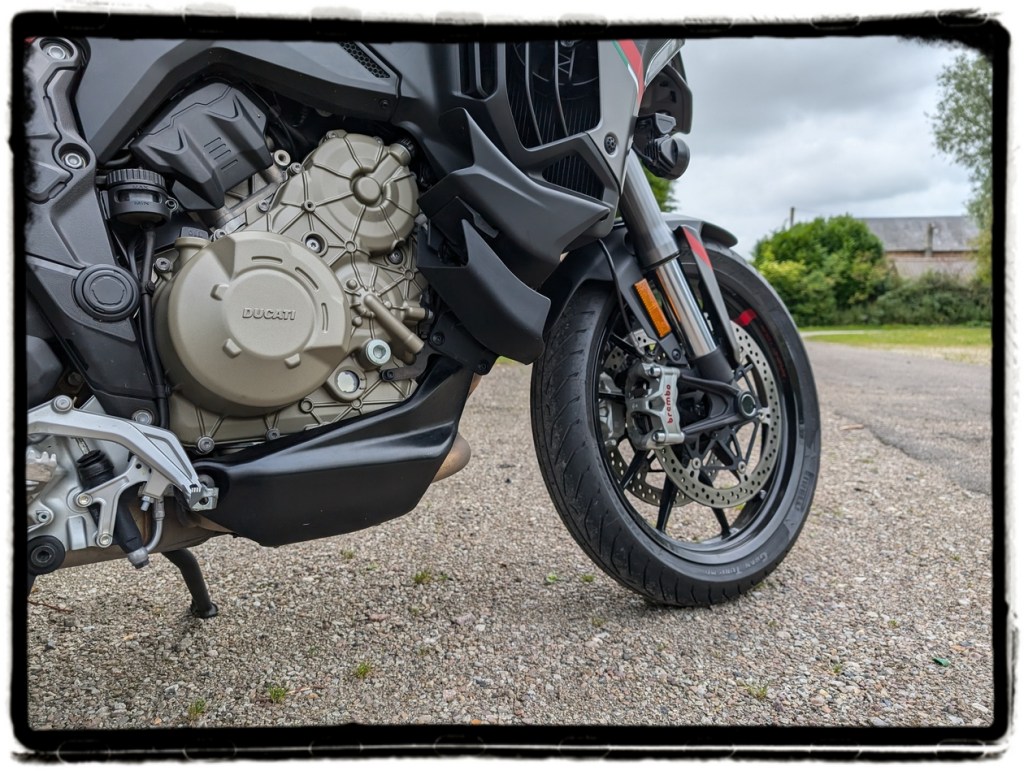
On the backroads, you can fully appreciate the engine’s elasticity. Combined with the superb Brembo brakes (with the highly praised Stylema calipers up front) and the adjustable Sachs Skyhook semi-active electronic suspension, you’re in for a treat. Oh, and I almost forgot to mention the outstanding gearbox and the up-and-down quickshifter. It’s rare to experience them this flawless.
At the same time, you’re still riding a heavy adventure bike, not a super naked. The Multistrada has no trouble going fast, braking hard or following the line precisely, but it’s not particularly nimble or playful. But you can’t really expect that from this type of bike.
Ducati chose to remove the rubber steering damper to provide more feedback and sharper steering. The Grand Tour is the only V4 model where this trick is applied. One might wonder why then they replaced the 17” front wheel of the previous generation with a 19” one. Does stability suffer that much with a 17-inch wheel? By the way, the RS and Pikes Peak models still come with a 17-incher.
And there are more choices I don’t understand. For example, the luggage cases. Anyone who has traveled for more than a weekend knows that this type of luggage isn’t the first choice, both in terms of usability and storage space. They can hold 8.1 gallons (left) and 6.9 gallons (right). Meanwhile, Ducati offers a set of aluminum cases in the catalog, providing 10.8 and 9.2 gallons of space, and with a handy top lid. That would be a much more logical choice for a Grand Tour.
I would also point out the need for a slightly higher windshield, and while we’re at it, why not fit the 7.9 gallons tank from the V4 S Rally instead of the standard 5.9 gallons version? It’s not that 5.9 gallons won’t get you anywhere, but the V4 is quite thirsty. I didn’t even ride particularly aggressively to record a consumption of 36 MPG.
Conclusion
My initial conclusion about the Ducati Multistrada V4 S Grand Tour was: what a fantastic bike. The engine, the riding experience, the level of comfort: how can you not be pleased with this? However, when I zoom in on the “Grand Tour” aspect, I must be a bit more critical and conclude that Ducati has missed some opportunities to give this Grand Tour maximum touring capabilities. I admit that I am being very strict. But at the same time, I would also give every devoted GS rider this tip: before you order that new 1300 GS, also take a look at a Multistrada. I recently tested the GS and was very enthusiastic about it, but put the GS and the Multistrada side by side … It would be unfair to describe the GS as boring, but the Multistrada V4 undeniably brings more excitement to the table. After all, it’s Italian.
Pros
+ Tremendous amount of riding pleasure
+ Very comfortable and very sporty too
+ Excellent gearbox and quickshifter
Cons
– Equipment could be more touring-oriented
– Adaptive cruise control technology cannot be turned off

Tech specs
Engine
Type: Ducati V4 Granturismo, 90-degree V4, 4 valves per cylinder, counter-rotating crankshaft, twin pulse firing order ,semi dry sump, liquid cooled
Displacement: 1158 cc
Bore x Stroke: 83 x 53.5 mm
Compression Ratio: 14:1
Power: 170 hp (125 kW) at 10,500 rpm
Torque: 125 Nm at 8,750 rpm
Fuel injection: Electronic fuel injection, 46mm equivalent elliptical throttle bodies with Ride-by-Wire system
Exhaust: Stainless steel muffler, double catalytic converter and 4 lambda probes
Transmission
Gearbox: 6 speed with up/down quick shift
Final drive: Multiplate clutch with hydraulic control, self-servo action on drive, slipper action on over-run
Chassis
Frame: Aluminum monocoque frame
Front Suspension: Fully adjustable USD fork, 50 mm, electronic compression and rebound damping adjustment with Ducati Skyhook suspension
Front wheel: Light alloy cast, 3” x 19”
Rear Suspension: Fully adjustable monoshock, electronic adjustment with Ducati Skyhook suspension, aluminum double-sided swingarm
Rear wheel: Light alloy cast, 4.5” x 17”
Travel: Front 6.7 in (170 mm), Rear 7.1 in (180 mm)
Front brake: 2x 330 mm semi-floating discs, radially mounted Brembo M50 Stylema monoblox 4-piston 2-pad calipers, radial master cylinder, cornering abs
Rear brake: 265 mm disc with Brembo caliper, cornering abs
Dimensions and weights
Seat height: Adjustable 33.1 – 33.9 in
Wheelbase: 61.7 in
Rake 24.2°
Trail 4.0 in
Fuel tank: 5.8 gal
 Team Throttle