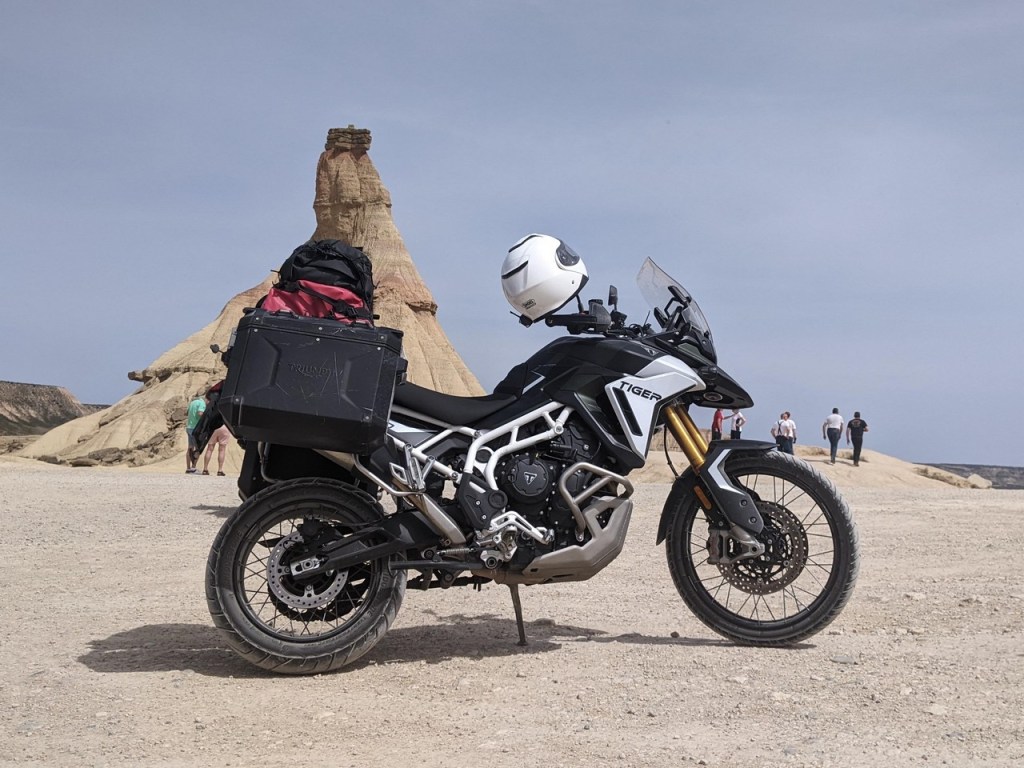
The Triumph Tiger has always held a special place in my motorcycling heart. When I tested the Tiger 800 XCA in 2015, I immediately ordered one. And even though I traded in that Tiger five years later for a big twin, my love for the three-cylinders from Hinckley is still strong. My Street Triple RS doesn’t rack up nearly as many miles as it deserves, yet it never fails to put a broad smile on my face every time I ride it. I’m curious to see if the same holds true for the new Tigers. That’s why I was eagerly anticipating taking the Triumph Tiger 900 Rally Pro on a week-long trip to the Picos de Europa.

New generation
In 2020, Jean tested the Tiger 900 Rally Pro in the Moselle region. For the 2024 model year, Triumph has refreshed its 900 lineup. The changes compared to the previous model may seem subtle, but they are far from it.
To start with, the number of Tigers (and specifically the 900 series) has been reduced from an overwhelming seven models to just three. Because it turned out that the vast majority of buyers opted for the lavishly equipped top versions. From this year on, there are two street models (the GT and GT Pro) and one model that’s more off-road oriented: the Rally Pro.

The T-plane three-cylinder engine has undergone a serious overhaul. New pistons, a higher compression ratio, new cylinder heads with larger intake valves, new camshafts and other modifications have resulted in a 15% increase in power (from 95 to 108 hp at 9500 rpm) and an additional 3 Nm of torque (now 90 Nm) delivered at 400 rpm lower than before. The Tiger 900 has become more powerful, and that power is now more broadly usable, which enhances both its on-road and off-road performance.
The previous Rally Pro was already extremely well-equipped, and the new Rally Pro’s equipment list has been expanded even further. Standard features now include a center stand, skid plate and crash bars, tubeless spoke wheels, six riding modes, cruise control, cornering ABS and traction control, TPMS, heated grips and seats, a quickshifter … And the list goes on.

From an ergonomic point of view, Triumph gave the Rally Pro a flatter seat, brought the handlebars 15 mm closer to the rider, and added rubber dampers to reduce vibrations. The most noticeable updates are the new side body panels and the new 7-inch dashboard, the latter being borrowed from the Tiger 1200.
Triumph opted for a minimalist layout for the basic screen. Although it’s well-designed, the interface is not the best on the market. The symbols and their positions on the screen lack consistency which can be confusing at times. I would have liked to see more information displayed, as there is plenty of space available.

Standing next to the Tiger 900 Rally Pro, its height is immediately noticeable. The new fairing may make it look quite slim, but don’t be fooled: this is not a small motorcycle. With the seat in its lowest position (860 mm), I can just about get both feet flat on the ground, which is necessary to keep the 222 kg bike upright. Although the Tiger still carries its weight relatively high, that weight becomes surprisingly manageable once you start riding.
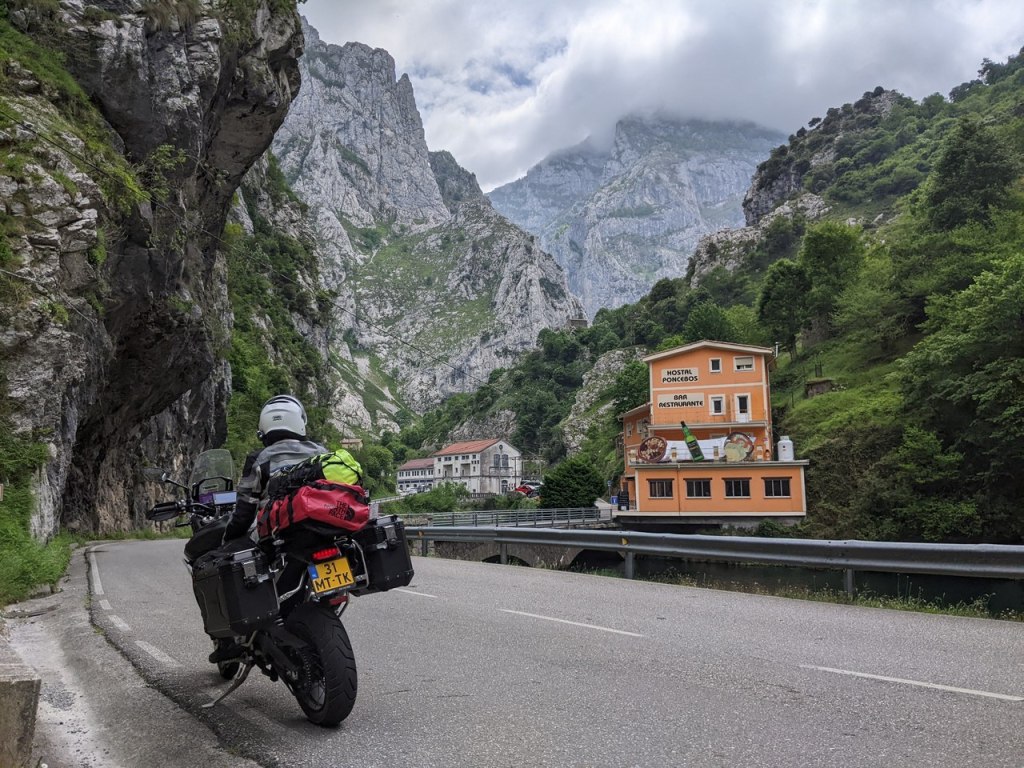
With full aluminum panniers (Triumph branded, made by Givi) and a tower of dry bags strapped to the back, I set off together with Jean on a BMW R 1300 GS and our regular riding buddy Shih on his KTM 890 Adventure, heading towards the Picos. Vamonos!
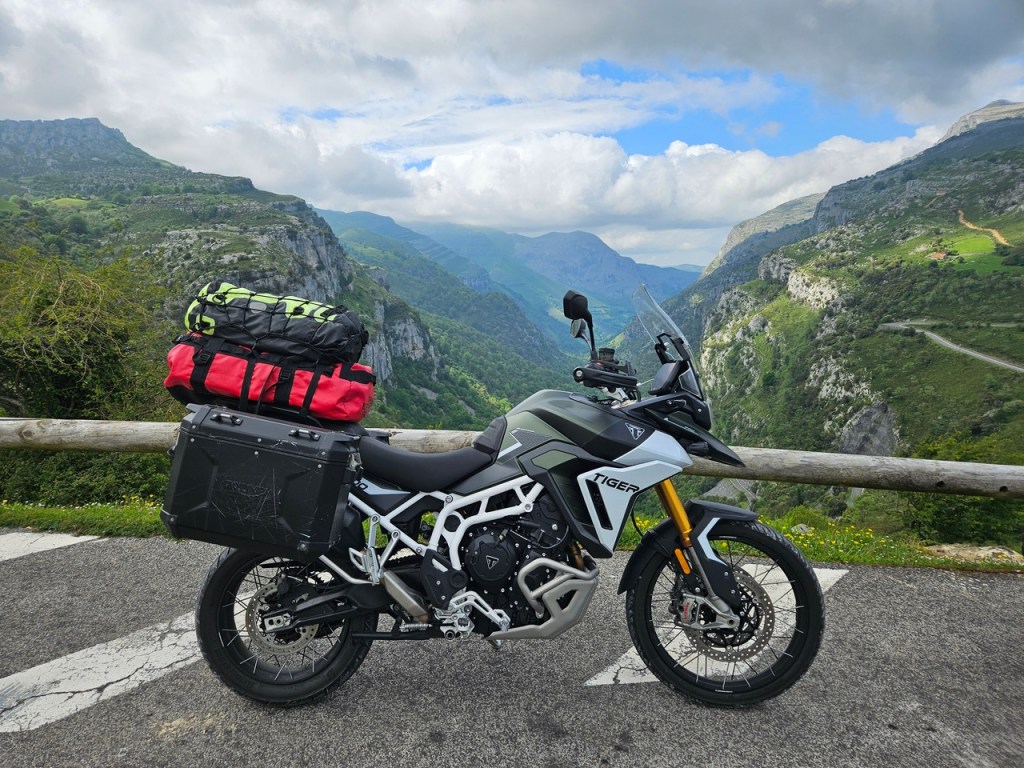
Right away, the loaded Tiger wobbled through the first corners. Oops, I forgot to adjust the preload. Fortunately, this can be done at the rear without tools, using the (stiff) adjustment knob. The Rally Pro doesn’t have electronic suspension? Nope, for that, you need to choose the GT Pro, where it works really well and “on the go”. It’s a real shame that Triumph doesn’t include this feature on its flagship model within the 900 family. Thankfully, the manual adjustment does make a significant difference, and after tweaking the front damping by two clicks, the Tiger holds its line nicely.
Midway through the trip, we stayed at the same campsite for a few days, and the luggage came off. Suddenly, the Tiger was oversprung and the Showa suspension needed to be re-adjusted.
Finding the ideal setting took a bit of effort, but once dialed in, the suspension absorbed bumps effortlessly, and when pushing the throttle, this Tiger handled more tightly than I remembered. And yet, even though Triumph gave the Rally Pro a slightly steeper head angle than its competitors, it never quite matches the sharpness of the KTM 890 Adventure I tested last year.
T-plane … or V-twin?
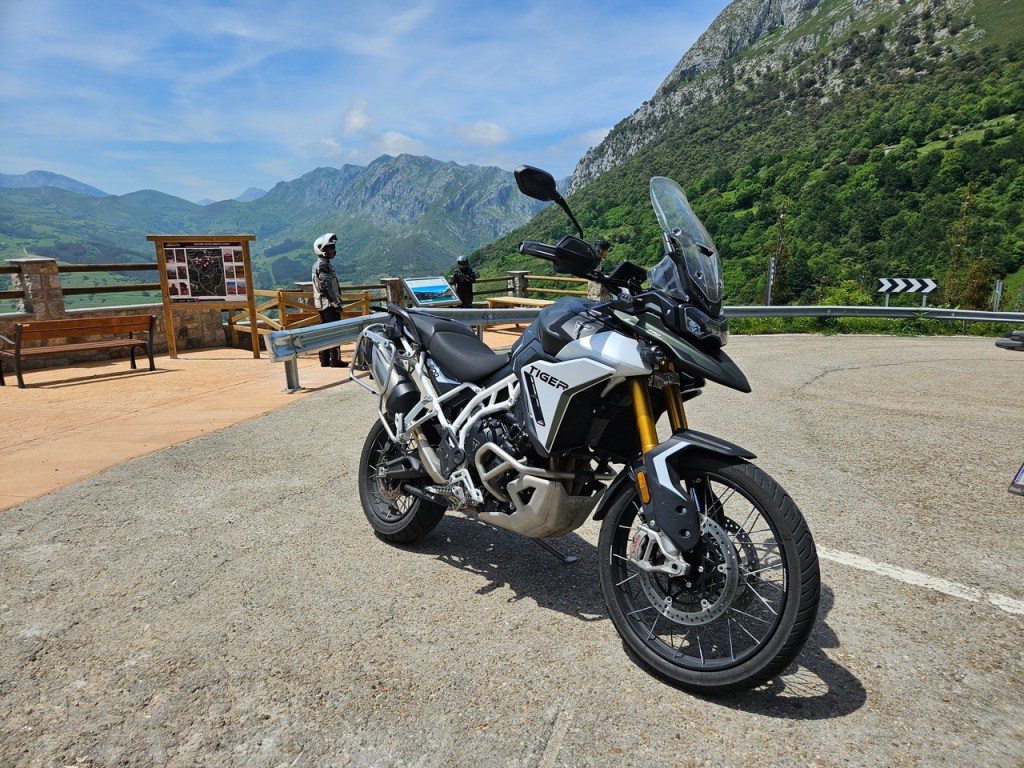
In June, the Picos de Europa offer fantastic twisty roads with little traffic: a perfect combination for opening up the throttle now and then. The triple engine picks up nicely at low revs, and you would let it scream all the way to the redline. Yes, you would, because with the new firing order that Triumph introduced with the launch of the 900, this new triple behaves almost like … a twin-cylinder.
The reason behind Triumph’s decision isn’t hard to find: marketing departments want buyers of adventure motorcycles to dream of world journeys on uncharted paths. In that fantasy world, twin cylinders like the Ténéré, Africa Twin, GS and KTM’s reign supreme. Triumph counters this with the T-plane: their triple engine received new camshafts and a 1-3-2 firing order, which creates a short power interruption, improving traction.
The result is an engine that feels more torquey at lower revs, but still delivers the typical high-end punch of a three-cylinder, albeit with more vibrations. A lot more vibrations. The vibrations in the handlebars, footpegs and seat (in that order) are so strong that I find myself shifting early, well before the redline comes into view. The silky-smooth power delivery of the past is no more.
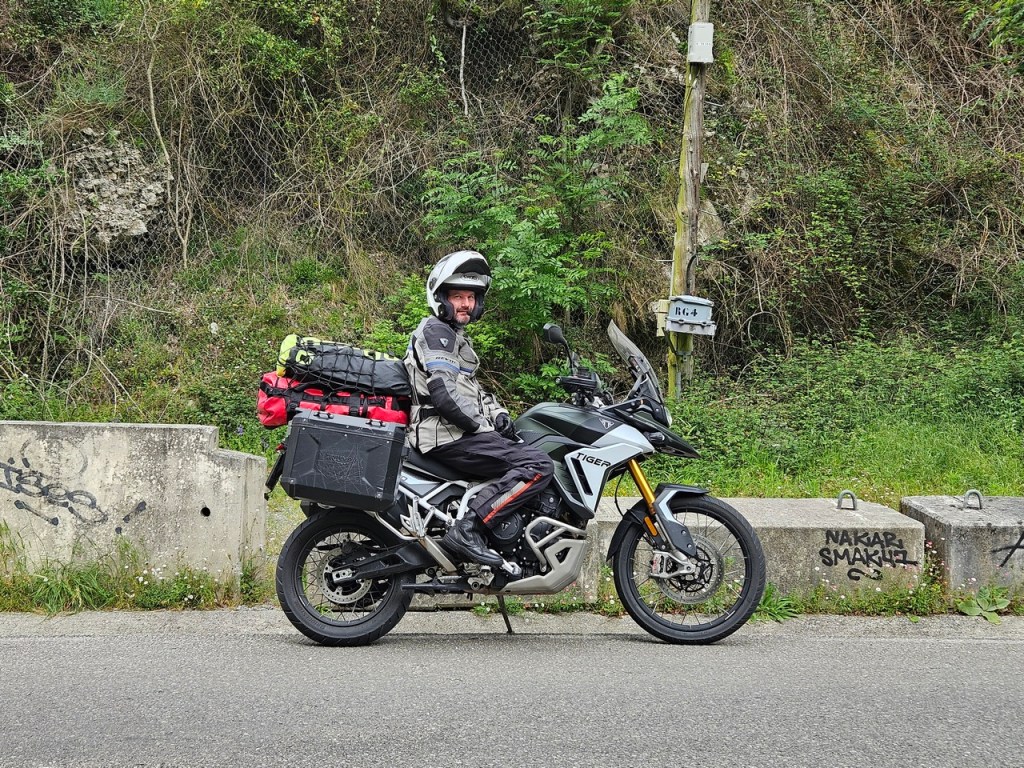
It’s been clear for a long time that Triumph knows how to build a gearbox, and this bike is no exception. Shifting is incredibly easy with the standard quickshifter: it clicks softly but decisively into each gear, both up and down. I’d also like to praise the neutral. The Rally Pro has the easiest-to-find neutral ever! Well done, Triumph.
When you see the Brembo Stylema calipers on the front wheel (yes, you read that right: Stylemas on an adventure bike!), you know right away that braking won’t be an issue. The tall suspension compresses slightly under braking without bottoming out and remains very stable, allowing you to effortlessly brake into corners. Trail braking has never felt as easy and natural as it does on this Tiger.
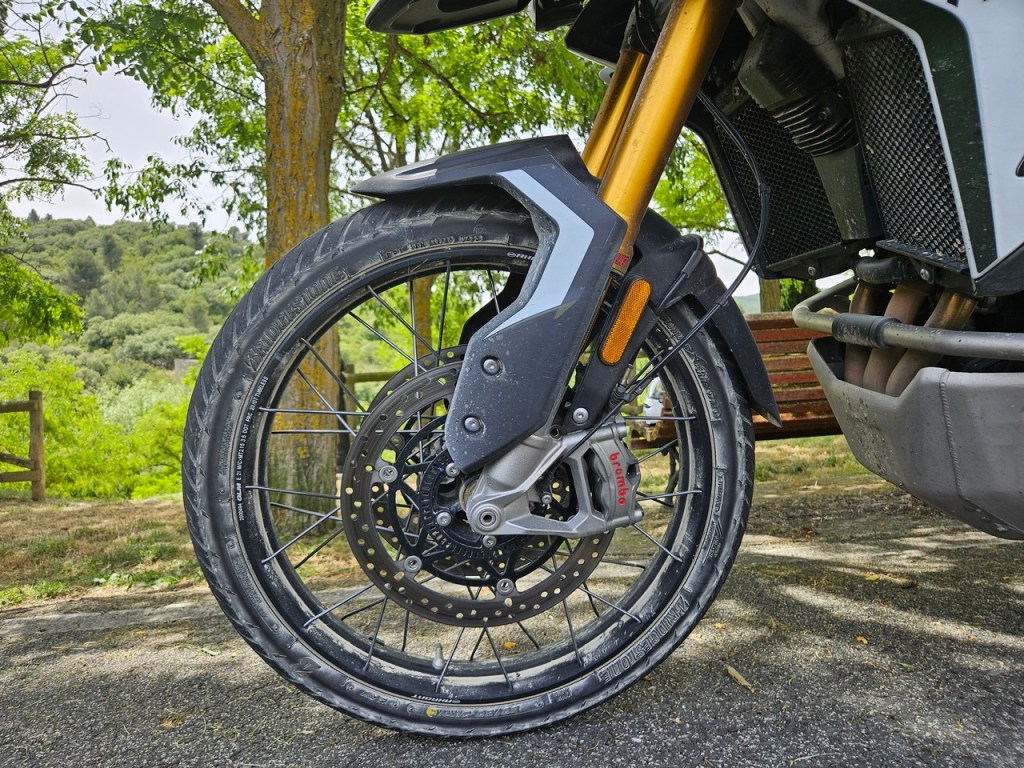
Offroad
When we reached the Bardenas Reales at the end of our trip, the new firing order suddenly made a lot of sense. Combined with the excellent Offroad mode, the Tiger becomes incredibly easy to handle in this offroad paradise. While on the Tiger 800 you constantly had to play with the clutch, that’s barely necessary on the 900. The throttle response is predictable, and the electronics help keep everything in check. At least, that is, if you remembered to select Offroad mode before transitioning from asphalt to offroad, which must be done while stationary. You can’t switch modes on the go. And after selecting Offroad mode, you have to confirm it again. Seriously, Triumph?
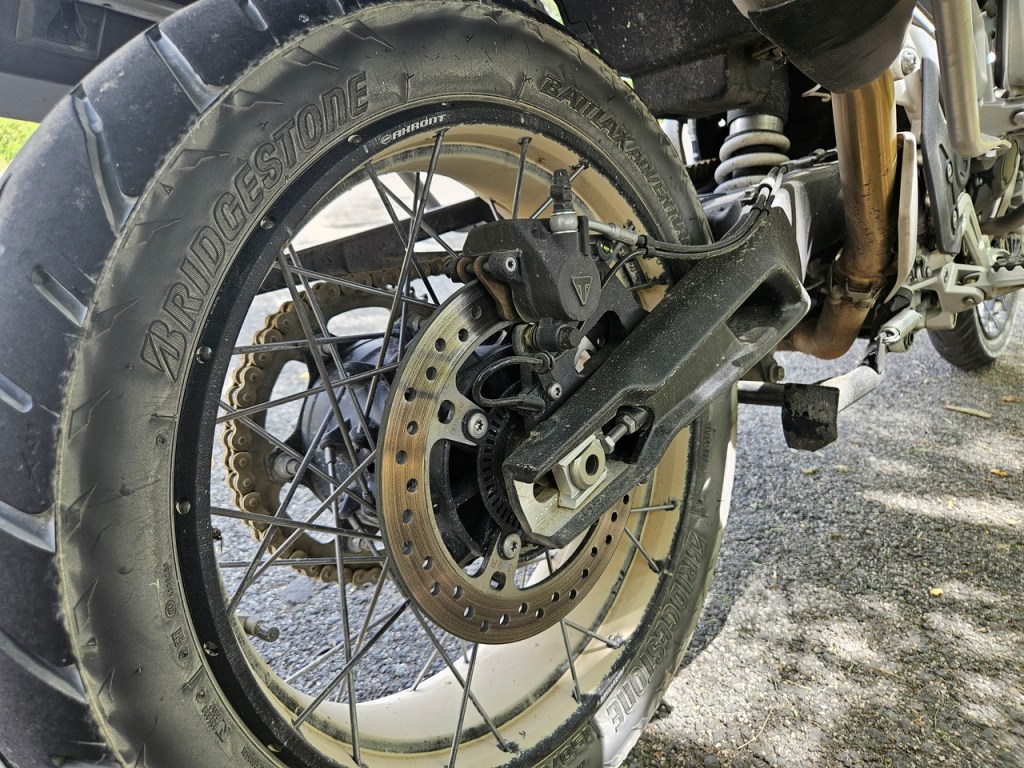
The standing position feels natural, but the lack of grip on the slippery tank and the street-oriented Bridgestone Battlax Adventure A41 tires limit the fun. While in the Spanish desert, I couldn’t help but think it’s a shame they still equip the Rally with a 17-inch rear wheel, whereas other offroad-focused adventure bikes now come with 18-inch tires. A missed opportunity?
Conclusion
The Triumph Tiger 900 Rally Pro is a prime example of a well-evolved motorcycle. The current bloodline began with the Tiger 800 in 2010, and each generation has clearly improved upon the last. It’s also evident that Triumph listens to customer feedback and criticism during development, which is always nice to see. The newest member of Triumph’s mid-range adventure family is packed with electronics, making it all the more disappointing that the suspension remains analog. Given its equipment and base price of £14,495, the Rally Pro should no longer be considered a mid-range bike, if not for the fact that Triumph still has the Tiger 1200 in its lineup.
I certainly understand Triumph’s strategy of using T-plane technology to make their 888 cc triple more offroad-focused and torquey at low revs, and they’ve succeeded remarkably well in this. However, I do miss that signature intake sound and the high-revving scream that Triumph’s older three-cylinders were so famous for. Everything was better in the past. Or at least, some things were.
Photography: Landers, Flanders & Shanders
Pros
+ Very well-equipped
+ Improved over the previous generation
+ Noticeably better offroad performance
Cons
– No electronic suspension, even though its street-focused sibling has it
– Vibrations, despite improvements over the 2020 model
– A triple disguised as a twin-cylinder?
Tech specs
Engine & transmission
Type: Liquid-cooled, 12 valve, DOHC, inline 3-cylinder
Capacity: 888 cc
Bore: 78.0 mm
Stroke: 61.9 mm
Compression: 13.0:1
Max Power:108 PS / 106.5 bhp (79.5 kW) @ 9,500 rpm
Max Torque: 90 Nm @ 6,850 rpm
System: Multipoint sequential electronic fuel injection with electronic throttle control
Exhaust: Stainless steel 3 into 1 header system, side mounted stainless steel silencer
Final Drive: O-ring Chain
Clutch: Wet, multi-plate, slip and assist
Gearbox: 6 speed
Chassis
Frame: Tubular steel trellis main frame. Fabricated, bolt-on aluminium rear subframe.
Swingarm: Twin-sided, cast aluminium alloy
Front Wheel: Spoked tubeless, 21 x 2.15 in
Rear Wheel: Spoked tubeless, 17 x 4.25 in
Front Tyre: Bridgestone Battlax Adventure 90/90-21
Rear Tyre: Bridgestone Battlax Adventure 150/70-R17
Front Suspension: Showa 45mm upside down forks, manual preload, rebound and compression damping adjustment, 240mm travel
Rear Suspension: Showa rear suspension unit,manually adjustable preload and rebound damping, 230mm wheel travel
Front Brakes: Twin 320mm floating discs, Brembo Stylema 4 piston Monobloc calipers. Radial front master cylinder, Optimised Cornering ABS
Rear Brakes: Single 255mm disc. Single piston sliding caliper. Optimised cornering ABS
Instrument Display and Functions: Full-colour 7” TFT instrument pack with My Triumph Connectivity System
Dimsensions & weights
Width Handlebars: 935 mm
Height Without Mirror: 1452 mm low screen position, 1502 mm high screen position
Seat Height: Adjustable 860/880 mm
Wheelbase: 1551 mm
Rake: 24.4 º
Trail: 116.8 mm
Tank Capacity: 20 L
Wet Weight: 228 kg
 Team Throttle